
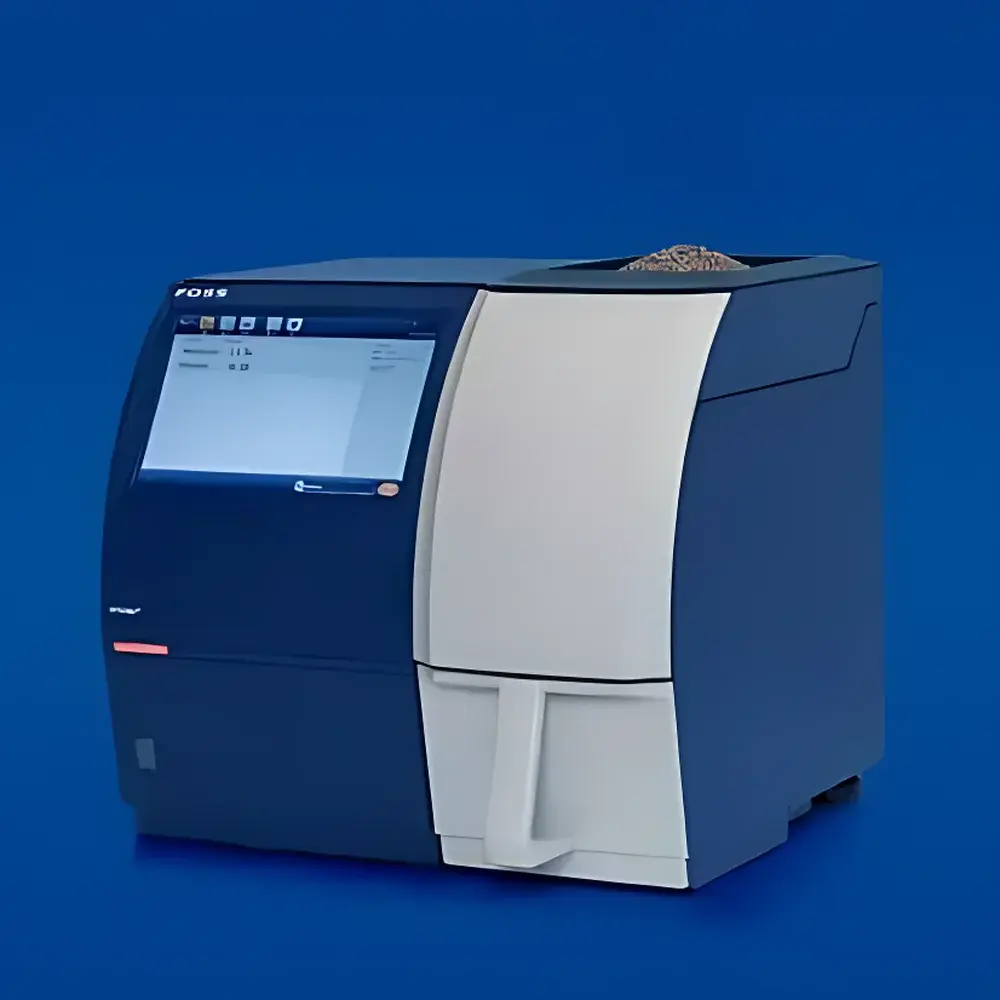
FOSS Infratec Grain Analyzer
| Brand | FOSS |
|---|---|
| Origin | Denmark |
| Model | Infratec Grain & Flour |
| Instrument Type | Laboratory Near-Infrared Spectrometer |
| Principle | Grating-based Scanning Transmission NIR |
| Wavelength Range | 570–1100 nm |
| Scan Speed | 60 scans/sec |
| Data Sampling Interval | 0.5 nm |
| Measurement Mode | Transmission |
| Chemometrics Software | ANN (Artificial Neural Networks), PLS (Partial Least Squares) |
| Path Length Control | Motorized, 6–33 mm auto-adjustable |
| Subsample Capacity | 1–30 (standard: 10) |
| Analysis Time | 60 s (10 subsamples, including bulk density) |
| Compliance | EN 15948, IP54 dust- and splash-resistant enclosure |
| Patents | US 4,944,589 |
Overview
The FOSS Infratec Grain Analyzer is a laboratory-grade, transmission-mode near-infrared spectrometer engineered for rapid, non-destructive compositional analysis of whole grains, milled flours, oilseeds, and legumes. Operating on grating-scanning optical architecture, it captures high-resolution spectral data across the 570–1100 nm range with a fixed 0.5 nm sampling interval—enabling robust discrimination of subtle molecular absorption features associated with moisture, protein, oil, starch, fiber, ash, gluten, and amino acid profiles. Unlike filter-based or diode-array systems, the holographic digital grating ensures long-term wavelength stability and inter-instrument spectral reproducibility—a critical requirement for calibration transfer across multi-site grain trading networks and centralized quality control laboratories. The fiber-optic light delivery system minimizes alignment drift and thermal sensitivity, contributing to measurement repeatability < ±0.1% RSD for key parameters under routine operation.
Key Features
- Transmission-mode optical path with motorized, precision-controlled sample cell (6–33 mm path length), optimized for heterogeneous particulate matrices including intact kernels, cracked grains, and fine flour.
- High-speed scanning engine (60 scans/sec) combined with dynamic subsampling algorithm reduces full-sample analysis time to 40 seconds for 10 representative subsamples—including simultaneous bulk density determination.
- Dual chemometric modeling framework: ANN (Artificial Neural Networks) for complex, non-linear relationships in heterogeneous grain populations; PLS (Partial Least Squares) for standardized, traceable quantification aligned with reference method validation protocols.
- Industrial-grade enclosure compliant with EN 15948 (CEN standard for NIR instruments in cereals) and rated IP54 for dust resistance and protection against water splashes—suitable for agri-processing environments adjacent to milling or receiving bays.
- Patented optical design protected under US 4,944,589 and EP 0 320 770 B1, ensuring proprietary signal-to-noise optimization and minimal stray-light interference in high-absorbance regions.
Sample Compatibility & Compliance
The Infratec supports direct analysis of unprocessed and processed cereal and oilseed materials without grinding, sieving, or chemical reagents—including wheat, barley, rye, oats, maize, sorghum, rice, millet, soybeans, rapeseed, sunflower, and flax. Its transmission geometry accommodates both whole-kernel and flour formats via interchangeable sample holders. All calibrations are developed and validated against AOAC, ICC, and ISO reference methods (e.g., ISO 20483 for protein, ISO 712 for moisture), and comply with GLP documentation requirements for audit readiness. The system meets EU regulatory expectations for instrument qualification under Regulation (EU) No 1169/2011 for nutritional labeling support and supports FDA 21 CFR Part 11-compliant data integrity when integrated with validated LIMS environments.
Software & Data Management
The embedded FOSS WinISI III software provides full calibration lifecycle management—from raw spectrum acquisition and outlier detection to model validation, performance monitoring, and drift correction. Each analysis generates a timestamped, digitally signed report containing spectral metadata, subsample statistics, confidence intervals, and residual plots. Results export natively to CSV, XML, or OPC UA for seamless integration with enterprise LIMS, ERP, or SCADA platforms. Audit trails record all user actions, parameter changes, and calibration updates—fully traceable per ISO/IEC 17025 and GMP Annex 11 requirements. Remote diagnostics and firmware updates are supported via secure TLS-encrypted connection.
Applications
The Infratec serves as a primary analytical platform across the grain value chain: at elevators and ports for real-time grading and contract settlement; in flour mills for process control and blend optimization; in oilseed crushing facilities for oil yield prediction; in plant breeding programs for high-throughput phenotyping; in malting and brewing labs for starch degradation profiling; and in biofuel production for cellulose/lignin ratio estimation. It is routinely deployed for compliance testing against national standards (e.g., USDA FGIS, Canadian Grain Commission, DGCCRF) and supports HACCP-critical control points in baked goods and breakfast cereal manufacturing.
FAQ
Does the Infratec require daily recalibration?
No—its grating-scanning architecture and thermally stabilized optics enable stable baseline performance for ≥72 hours between verification checks using certified reference standards.
Can existing PLS calibrations from other FOSS instruments be transferred to the Infratec?
Yes, provided spectral resolution and preprocessing settings are harmonized; FOSS provides cross-platform calibration migration services with documented equivalence assessment.
Is the ANN modeling module validated for regulatory submissions?
ANN models are fully documented per ICH Q5E guidelines and may be submitted as part of analytical procedure validation packages for regulatory review, subject to site-specific IQ/OQ/PQ execution.
What sample preparation is required for whole-kernel analysis?
None—kernels are loaded directly into the motorized cell; the system automatically adjusts path length and acquires ≥10 randomized subsamples per measurement cycle.
How is instrument performance verified over time?
FOSS supplies NIST-traceable ceramic and polymer reference standards for routine wavelength accuracy, photometric linearity, and noise-level verification—aligned with ASTM E1655 and ISO 12099 protocols.




