
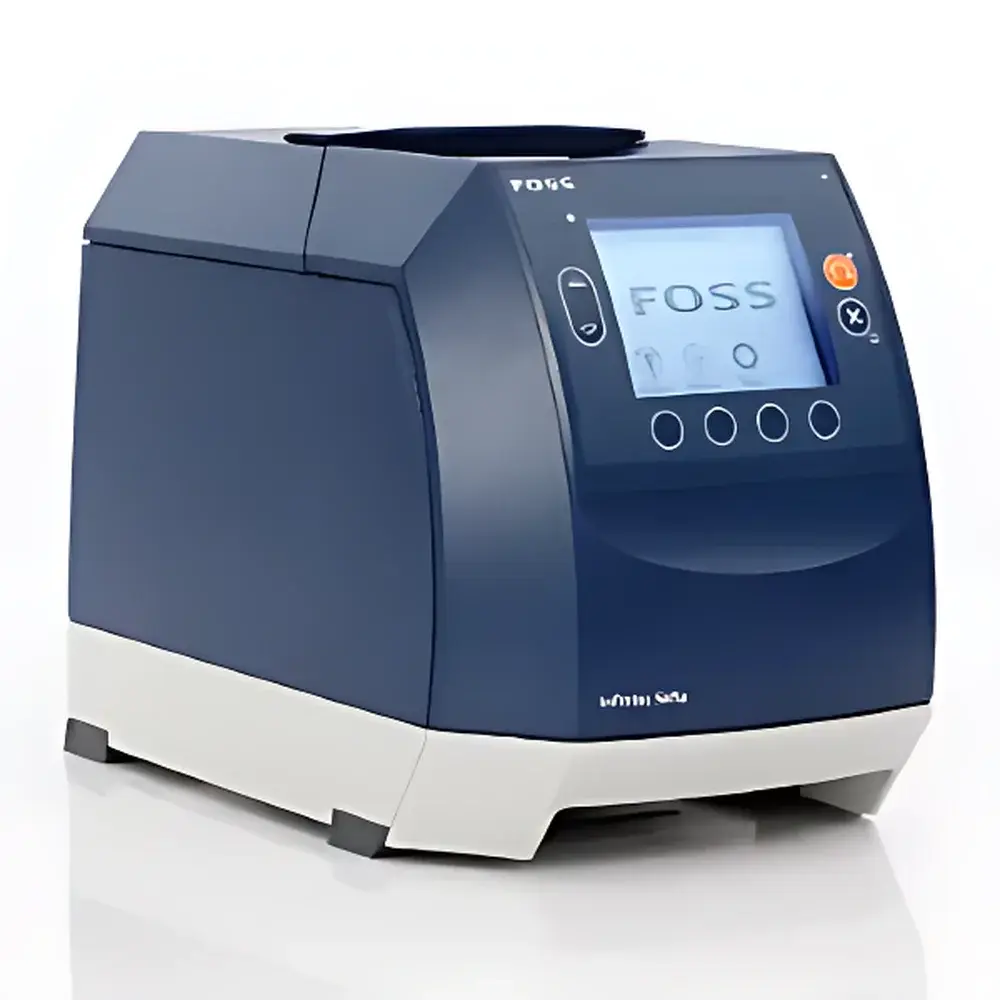
FOSS Infratec™ Sofia Portable Grain Analyzer
| Brand | FOSS |
|---|---|
| Origin | Denmark |
| Model | Infratec™ Sofia |
| Instrument Type | Portable Near-Infrared Spectrometer |
| Wavelength Range | 850–1050 nm |
| Measurement Mode | Transmission NIR |
| Analysis Time | ~3 minutes for 10 subsamples |
| Dimensions (W × D × H) | 255 × 390 × 295 mm |
| Weight | 9 kg |
| Operating Temperature | 0–45 °C |
| Storage Temperature | −20–70 °C |
| Relative Humidity | <93% RH (non-condensing), up to 100% cyclic |
| Power Supply | 100–240 V AC, 50–60 Hz, Class I with earth grounding |
| EMC Environment | Light industrial, agricultural & mobile machinery |
| Sample Preparation | None required (whole-grain analysis) |
Overview
The FOSS Infratec™ Sofia Portable Grain Analyzer is a rugged, field-deployable near-infrared (NIR) spectrometer engineered for rapid, non-destructive quantitative analysis of intact cereal grains. Based on diode array transmission spectroscopy, the instrument operates within the 850–1050 nm spectral window—optimized for robust detection of moisture, protein, starch, oil, and ash content in wheat, barley, oats, rye, corn, and sorghum. Unlike traditional lab-based NIR systems requiring grinding and homogenization, the Infratec™ Sofia performs direct whole-grain measurement without sample preparation, preserving natural heterogeneity while delivering reproducible results aligned with official reference methods. Its optical architecture mirrors that of the FOSS Infratec™ 1241—the globally recognized benchmark for grain trading and official pricing under international commodity standards (e.g., ISO 24333, ICC 168, and USDA FGIS protocols). Designed for operation in variable ambient conditions—including onboard harvesters, grain elevators, or mobile labs—the system meets IEC 60529 IP54-equivalent mechanical resilience and electromagnetic compatibility (EMC) requirements for agricultural machinery.
Key Features
- Diode array-based transmission NIR optics enabling high signal-to-noise ratio and long-term photometric stability
- True portable form factor (9 kg, compact footprint) with dual-power capability: 100–240 V AC mains or 12 V DC vehicle supply
- Whole-grain analysis—no milling, sieving, or drying required—minimizing operator error and throughput delay
- Calibration traceability to FOSS global reference network; compatible with official Infratec™ 1241 calibrations for regulatory consistency
- Ruggedized chassis rated for vibration, dust, and thermal cycling per EN 60068-2 environmental test standards
- Integrated thermal stabilization and automatic dark-current compensation for reliable performance across 0–45 °C operating range
Sample Compatibility & Compliance
The Infratec™ Sofia supports unprocessed, bulk grain samples ranging from 100 g to 500 g per measurement cycle. It is validated for major cereals including soft/hard wheat, durum, barley, triticale, oats, maize, and sorghum. Method equivalence has been demonstrated against AOAC 991.20 (moisture), AOAC 984.13 (crude protein), and ISO 16634-1 (total nitrogen → protein conversion). The instrument complies with IEC 61000-6-2 (immunity) and IEC 61000-6-4 (emissions) for industrial environments, and its electrical safety conforms to IEC 61010-1:2010 (Class I, overvoltage Category II). While not intrinsically safe for Zone 1 hazardous areas, it is routinely deployed in grain handling facilities compliant with NFPA 61 and ATEX 2014/34/EU when installed per manufacturer-specified mounting and grounding procedures.
Software & Data Management
Control, calibration management, and data aggregation are handled via Mosaic™—FOSS’ enterprise-grade NIR software platform. Installed on standard Windows PCs, Mosaic enables remote configuration, firmware updates, and calibration synchronization across fleets of Infratec™ Sofia units. All spectra and result logs are timestamped, user-tagged, and stored locally with optional cloud backup. Audit trails comply with GLP and GMP principles: every calibration change, user login, and result export is recorded with immutable metadata (operator ID, instrument serial, GPS-derived location if enabled, and environmental sensor readings). Mosaic supports 21 CFR Part 11-compliant electronic signatures and role-based access control—essential for QA/QC workflows in certified laboratories and commercial grain inspection services.
Applications
- On-farm harvest readiness assessment (e.g., optimal moisture thresholds for combine settings)
- Real-time quality sorting at intake points—enabling dynamic pricing based on protein or test weight prediction
- Pre-storage moisture verification to mitigate spoilage risk and ensure compliance with FAO storage guidelines
- Research applications in plant breeding programs requiring high-throughput phenotyping of grain composition traits
- Extension service support for agronomists conducting field trials on fertilizer response or varietal performance
- Regulatory sampling verification prior to shipment under national grain grading regulations (e.g., U.S. FGIS, Canadian Grain Commission, DGCCRF)
FAQ
Is the Infratec™ Sofia suitable for regulatory grain trading?
Yes—it shares identical optical design, calibration algorithms, and validation protocols with the Infratec™ 1241, which is approved for official pricing in multiple jurisdictions including the EU, USA, Canada, and Australia.
Does it require daily recalibration?
No. Factory-installed calibrations remain stable for ≥12 months under typical field use. FOSS recommends annual verification using certified reference materials and optional on-site recalibration by authorized service engineers.
Can it analyze mixed grain lots or damaged kernels?
It is optimized for homogeneous lots. For heterogeneous samples (e.g., admixtures or severely shriveled kernels), statistical confidence intervals widen; users should follow ISO 712 guidance on representative sampling and report uncertainty alongside results.
What data export formats does Mosaic support?
CSV, XML, and PDF reports; integration with LIMS via ODBC and RESTful API endpoints for automated data ingestion into enterprise systems.
Is training provided for operators and data managers?
FOSS offers certified instructor-led courses covering method validation, troubleshooting, GLP documentation, and Mosaic administration—available on-site or via virtual classroom delivery.



