
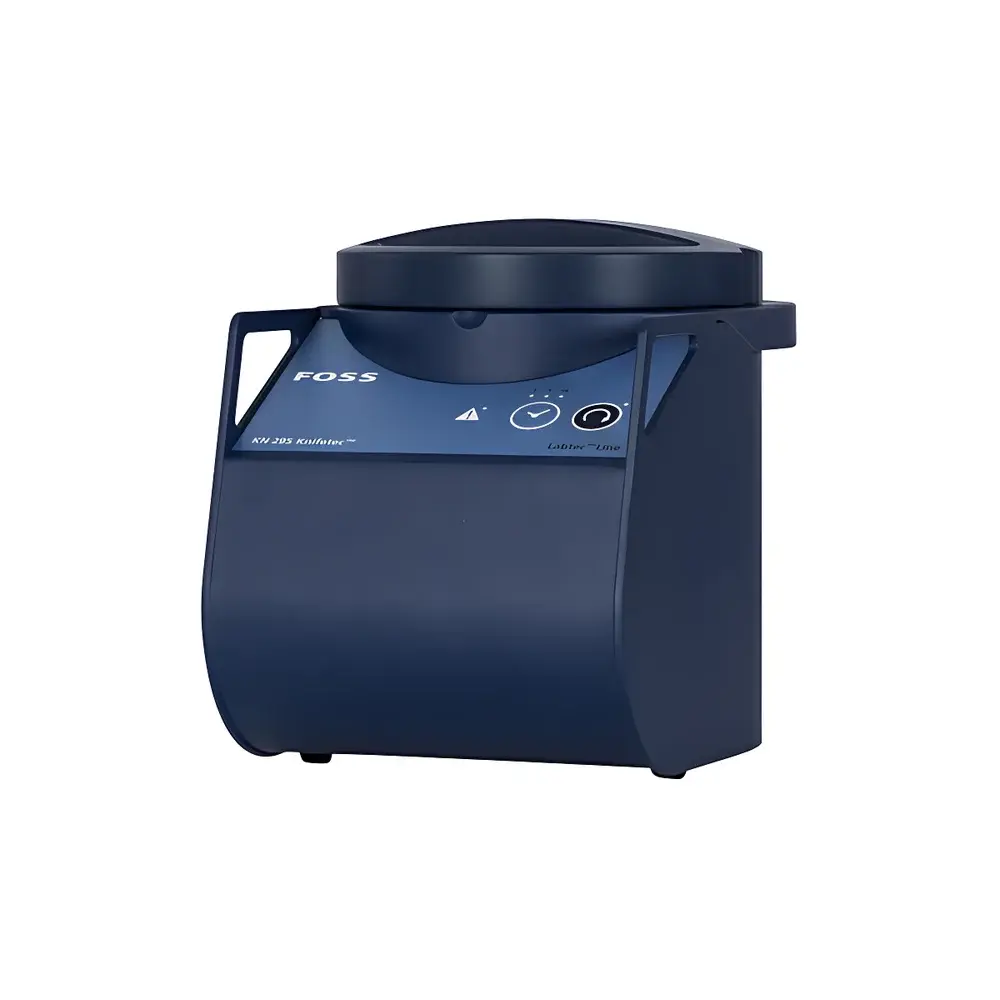
FOSS KN295 Knife Mill
| Brand | FOSS |
|---|---|
| Origin | Denmark |
| Model | KN295 |
| Instrument Type | Knife Mill |
| Sample Applicability | Hard, High-Fat, High-Moisture & High-Fiber Materials |
| Feed Size | <15 mm |
| Output Particle Size | 3–4 mm (pre-grinding) |
| Batch Capacity | 100 mL (50–150 g) |
| Rotational Speed | 20,000 rpm |
| Cooling | Integrated Tap-Water or Lab-Cooled Water Circulation System |
| Safety | Interlocked Lid Switch (halts rotation within 1 s) |
Overview
The FOSS KN295 Knife Mill is an engineered laboratory grinding system designed for the rapid, reproducible, and thermally controlled size reduction of challenging biological and agricultural samples. Operating on high-speed rotary knife shearing mechanics, it delivers consistent particle size distribution across heterogeneous matrices—including oilseeds, meat products, fruits, vegetables, cereals, feedstuffs, and fibrous plant tissues. Its core architecture integrates a robust 20,000 rpm motor-driven stainless-steel cutting assembly housed in a fully removable, autoclavable grinding chamber. Unlike conventional disc or rotor mills, the KN295 employs a precision-machined, dual-edge knife geometry optimized for simultaneous impact, shear, and compression forces—enabling efficient disintegration without excessive heat buildup or sample adhesion. The mill’s design complies with fundamental requirements for sample homogenization prior to moisture, fat, protein, fiber, or elemental analysis per ISO 6497, AOAC 984.27, and ASTM D5198 protocols.
Key Features
- 20,000 rpm high-torque brushless motor ensures rapid (<10 s), repeatable grinding cycles with minimal operator variability
- Integrated water-cooling interface accepts standard lab tap water or recirculating chillers (recommended flow: 1–2 L/min), maintaining sample temperature below 30 °C during extended operation—critical for moisture-sensitive or lipid-rich materials
- Interlocked safety lid switch halts blade rotation within 1 second upon lid displacement, meeting IEC 61000-6-2 and EN 60335-1 electrical safety requirements
- Fully demountable upper housing, stainless-steel grinding chamber (AISI 304), and tool-free knife removal enable complete cleaning between batches—reducing cross-contamination risk and supporting GLP-compliant workflows
- Adjustable tilt mechanism (up to 45°) facilitates unobstructed access to internal components and simplifies residue evacuation post-grinding
- No consumable grinding elements (e.g., discs or rings); only the hardened steel knife requires periodic inspection and replacement per usage intensity
Sample Compatibility & Compliance
The KN295 accommodates diverse solid and semi-solid matrices with initial particle dimensions up to 15 mm. It is validated for use with high-fat samples (e.g., soybeans, peanuts, rendered animal tissue), high-moisture specimens (fresh fruits, leafy greens), and high-fiber materials (straw, alfalfa, cereal bran). Final output size ranges from coarse pre-grind (3–4 mm) suitable for NIR calibration or further milling, to sub-10 µm fines achievable via sequential passes with optimized dwell time and cooling. The system supports compliance with ISO/IEC 17025 method validation criteria when paired with documented SOPs, and its mechanical design aligns with FDA 21 CFR Part 11 data integrity principles where integrated timers and cooling logs are recorded externally.
Software & Data Management
The KN295 operates as a standalone electromechanical instrument with no embedded firmware or digital interface. Timing is managed via a front-panel analog timer (0–60 s, ±0.5 s accuracy), ensuring deterministic, non-software-dependent operation. For traceability, users are advised to record grinding duration, coolant inlet temperature, ambient conditions, and batch identifiers in laboratory notebooks or LIMS-compatible spreadsheets. When deployed in regulated environments (e.g., contract testing labs under ISO 17025 or GMP), the absence of proprietary software eliminates validation overhead associated with electronic records—while still permitting full audit trails through manual log entries and procedural documentation.
Applications
- Preparation of homogeneous subsamples for Karl Fischer titration (moisture), Soxhlet extraction (crude fat), and AOAC Method 962.09 (crude fiber)
- Routine homogenization of feed and grain samples prior to near-infrared (NIR) spectral calibration and chemometric modeling
- Processing of meat and fish tissues for proximate analysis, heavy metal digestion (EPA Method 3050B), or DNA/RNA extraction workflows
- Standardized size reduction of botanicals and herbal matrices for pharmacopoeial assays (USP & Ph. Eur. general chapters on particle size and uniformity)
- Supporting ISO 5725-2 repeatability studies where inter-batch consistency must be demonstrated across operator shifts and instrument units
FAQ
What types of samples require water cooling during grinding?
Samples with >15% moisture content (e.g., fresh tomatoes, raw poultry) or >25% fat content (e.g., sunflower seeds, lard) benefit most from active cooling to prevent thermal softening, wall adhesion, and analyte degradation.
Can the KN295 achieve particle sizes below 100 µm?
Yes—by performing two sequential 5-second grinds with intermediate chamber cooling and knife repositioning, median particle diameters of ≤10 µm are attainable for brittle matrices like dried legumes or roasted coffee beans.
Is the knife assembly compatible with other FOSS mills?
No—the KN295 knife is mechanically and dimensionally specific to this model and not interchangeable with KN290, KN293, or other FOSS knife mill variants.
How often should the knife be replaced?
Under typical usage (≤20 batches/day), replace the knife every 6–12 months or after 500 operational hours—whichever occurs first—to maintain consistent cut quality and minimize heat generation.
Does the KN295 meet CE marking requirements?
Yes—it carries CE marking per Directive 2014/30/EU (EMC) and 2014/35/EU (LVD), with test reports available upon request from authorized FOSS distributors.



