
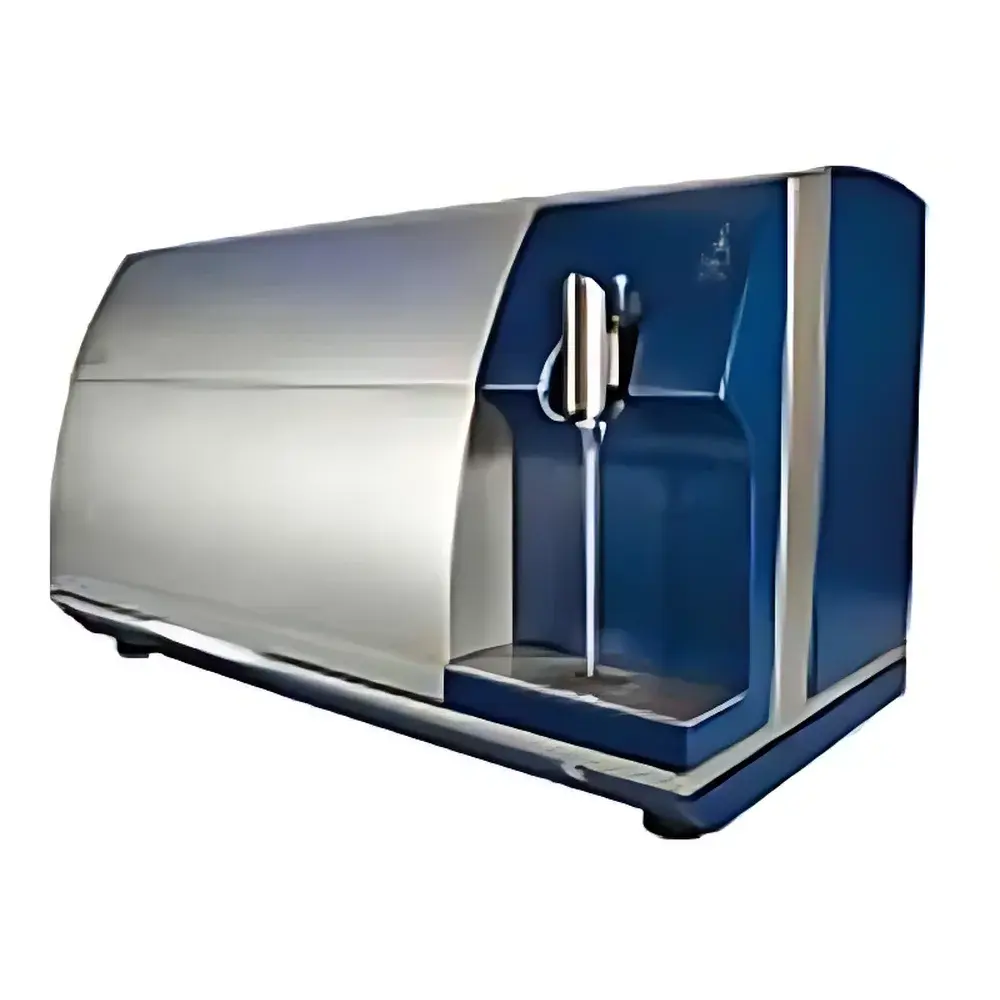
FOSS MilkoScan™ FT2 Fourier Transform Infrared Dairy Analyzer
| Brand | FOSS |
|---|---|
| Origin | Denmark |
| Model | MilkoScan™ FT2 |
| Automation | Fully Automatic |
| Analysis Time | 30 s |
| Sample Volume Range | 4–25 mL |
| Repeatability | <0.2% CV (for fat, protein, lactose, total solids, SNF in raw milk) |
| Accuracy | <0.8% CV (for fat, protein, lactose, total solids, SNF in raw milk) |
| Operating Temperature Range | 5–55 °C |
| Carry-over | <1% |
| Optical System | Sealed, temperature-controlled FTIR interferometer |
| Calibration Methods | Intercept/slope adjustment |
| Supported Chemometric Models | PLS, modified PLS, PCA |
| Compliance | CE-marked |
Overview
The FOSS MilkoScan™ FT2 is a high-performance, fully automated Fourier Transform Infrared (FTIR) dairy analyzer engineered for precise, rapid, and reproducible quantification of compositional parameters in liquid and semi-liquid dairy products. Based on robust Michelson interferometry and calibrated multivariate regression models, the instrument measures absorbance spectra across the mid-infrared region (typically 5,000–900 cm⁻¹) to simultaneously determine fat, protein, lactose, total solids, non-fat solids, freezing point depression (FPD), density, titratable acidity, free fatty acids, urea, and casein—without chemical reagents or sample dilution. Its sealed, thermally stabilized optical path minimizes thermal drift and ensures long-term spectral fidelity, while its integrated conductivity sensor enables direct, real-time FPD measurement—a critical parameter for detecting adulteration via water addition. Designed for deployment in both QC laboratories and near-line production environments, the MilkoScan™ FT2 meets stringent industrial requirements for traceability, regulatory compliance, and operational continuity.
Key Features
- Fully automated fluidic system optimized for viscous, undiluted samples—including cream, condensed milk, yogurt, and ice cream mixes—eliminating manual dilution steps and reducing operator dependency.
- Integrated conductivity sensor for direct, high-precision freezing point depression (FPD) analysis, enhancing detection sensitivity for water adulteration and improving raw milk quality assessment.
- Thermally controlled, hermetically sealed FTIR optical module with diode laser reference, delivering improved spectral stability and extended component lifetime versus lamp-based predecessors.
- Modular hardware architecture enabling field-replaceable subassemblies (e.g., peristaltic pump modules, flow cells, preheaters), minimizing downtime and simplifying preventive maintenance.
- Enhanced accuracy of <0.8% CV for fat, protein, lactose, total solids, and SNF in raw milk—representing a 20% improvement over the MilkoScan™ FT120—supporting tighter process control and reduced raw material overages.
- Automated cleaning protocol with hot solution back-flush of the measurement cell, significantly extending optical cell service life and maintaining baseline consistency across thousands of analyses.
- Upgradable chemometric platform supporting PLS, modified PLS, and PCA algorithms; compatible with WinISI™ III software for user-developed calibrations and model transfer from legacy FT120 instruments.
Sample Compatibility & Compliance
The MilkoScan™ FT2 supports a broad spectrum of dairy matrices without dilution or derivatization: raw milk, pasteurized milk, skim milk, cream (up to 60% fat), sweetened condensed milk, evaporated milk, whey, whey protein concentrate, fermented milks (e.g., kefir, cultured buttermilk), flavored milks, ice cream mix, quark, and yogurt. Standard calibration packages cover milk, cream, condensed milk, and infant formula; optional models extend coverage to whey products, fermented dairy, desserts, and ice cream. The instrument complies with CE marking directives including EN 61010-1 (safety), EN 61000-6-2/6-3 (EMC), CLP Regulation (EC) No. 1272/2008, WEEE 2012/19/EU, and packaging waste directives. When configured with FOSS Integrator v5.0+ and enabled audit trails, it satisfies FDA 21 CFR Part 11 requirements for electronic records and signatures in regulated environments.
Software & Data Management
FOSS Integrator serves as the central software platform for method management, result visualization, user access control, and electronic recordkeeping. It supports role-based permissions (administrator, analyst, reviewer), configurable workflows, and full audit trail logging—including user ID, timestamp, parameter changes, and calibration events. All spectral data, raw absorbance files, and prediction outputs are stored in a secure SQL database with automatic backup scheduling. Integration with LIMS via ASTM E1384 or HL7 protocols enables seamless data exchange. WinISI™ III is available as an optional add-on for advanced chemometric development, allowing users to build, validate, and deploy custom calibrations using local reference data—ensuring alignment with internal specifications and regional compositional standards (e.g., ISO 9622, IDF 141, AOAC 983.17).
Applications
The MilkoScan™ FT2 is deployed across the dairy value chain: at farm gates for supplier payment based on fat/protein content; in receiving bays for incoming raw milk verification; in R&D labs for formulation optimization; in production lines for real-time blend control and standardization; and in finished-product QA for release testing. Its ability to quantify FPD directly supports compliance with Codex Alimentarius standards for milk authenticity. In infant formula manufacturing, it verifies nutritional label claims under ISO 8968 and USP . For whey processing facilities, it monitors protein concentration and lactose removal efficiency during ultrafiltration and spray drying. Its ruggedized enclosure (IP54-rated) and vibration-resistant suspended IR measurement cell permit installation within 2 meters of filling lines—enabling true near-line process analytics without sacrificing metrological integrity.
FAQ
Can I transfer existing MilkoScan™ FT120 calibrations to the FT2?
Yes—FOSS provides official calibration migration tools that retain slope/intercept adjustments and spectral preprocessing settings, eliminating redundant wet chemistry validation for legacy models.
Does the instrument require daily recalibration?
No—routine verification using certified reference standards (e.g., NIST-traceable milk controls) is recommended per shift or every 24 hours; full recalibration is typically required only after major hardware service or model updates.
Is the FT2 suitable for analyzing high-viscosity samples like quark or Greek yogurt?
Yes—the redesigned peristaltic pump and wide-bore flow path accommodate samples up to 100,000 cP without clogging or carry-over, and automated cleaning prevents residue accumulation between runs.
How does the built-in conductivity sensor improve FPD measurement accuracy?
It eliminates reliance on empirical correlations between electrical conductivity and freezing point, instead measuring conductance directly in the same sample stream used for FTIR analysis—reducing inter-method variability and improving detection limits for water adulteration.
What validation documentation is provided for regulatory audits?
FOSS supplies IQ/OQ documentation templates, factory acceptance test (FAT) reports, and instrument-specific uncertainty budgets aligned with ISO/IEC 17025; additional GMP/GLP implementation support is available through FOSS Validation Services.
Related Products





