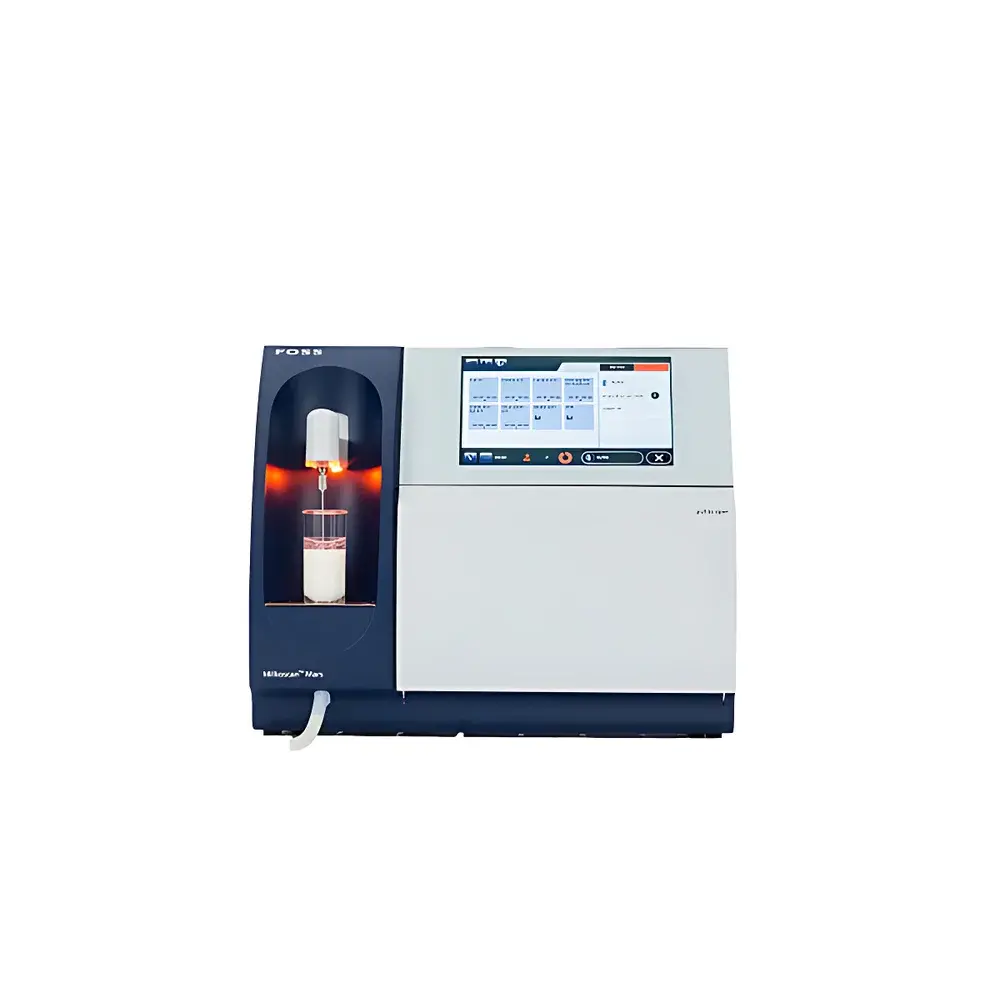
FOSS Milkoscan Mars Dairy Analyzer
| Brand | FOSS |
|---|---|
| Origin | Denmark |
| Model | Milkoscan Mars |
| Automation | Fully Automatic |
| Analysis Time | 1 min per sample |
| Measurement Parameters | Fat, Protein, Lactose, Total Solids, Non-Fat Solids |
| Repeatability | ≤0.5% CV (for raw milk major components) |
| Accuracy | ≤1.2% CV (for raw milk major components) |
| Technology | Fourier Transform Infrared (FTIR) Spectroscopy |
| Compliance | Designed for ISO 9001–certified dairy QA/QC environments |
| Screening Capability | Pre-installed ASM (Adulterant Screening Module) models for urea, sucrose, formaldehyde, sodium bicarbonate, potassium nitrate, and other common adulterants |
Overview
The FOSS Milkoscan Mars Dairy Analyzer is a benchtop FTIR-based instrument engineered for rapid, non-destructive compositional analysis of liquid dairy products—primarily raw milk, standardized milk, and cream. Operating on the principle of mid-infrared absorption spectroscopy, the system quantifies molecular vibrational modes unique to fat esters, amide bonds (proteins), hydroxyl groups (lactose), and water-soluble solids. This enables simultaneous determination of fat, protein, lactose, total solids, and non-fat solids in under 60 seconds per sample—without reagents, consumables, or sample preparation beyond homogenization. The Milkoscan Mars is deployed at critical control points across the dairy supply chain: farm gate intake, receiving bays, processing lines, and finished-product release. Its design emphasizes robustness for high-throughput laboratory and production-floor environments, with thermal stabilization and optical path calibration routines ensuring measurement stability across ambient temperature fluctuations typical in dairy plants.
Key Features
- Fully automated operation with integrated peristaltic sampling, automatic rinsing, and self-diagnostic routines—requiring minimal operator intervention.
- Pre-calibrated FTIR optical engine with solid-state laser reference and thermoelectrically cooled detector for long-term spectral stability.
- On-board Adulterant Screening Module (ASM): factory-loaded, validated chemometric models for rapid detection of economically motivated adulterants—including urea, sucrose, formaldehyde, sodium bicarbonate, and potassium nitrate—based on spectral deviation analysis.
- Compliance-ready architecture: audit trail logging, user access levels (admin/operator), electronic signature support, and data export formats compatible with LIMS integration (CSV, XML, ASTM E1384).
- Calibration management system with traceable reference standards aligned to ISO 5725 and IDF 141 guidelines for dairy compositional analysis.
Sample Compatibility & Compliance
The Milkoscan Mars accepts homogenized liquid samples ranging from raw whole milk (3–5% fat) to skim milk, standardized milk, cream (up to 40% fat), and reconstituted milk powders. Sample temperature is actively controlled between 35–40 °C during analysis to minimize viscosity-related scattering effects and ensure reproducible flow dynamics through the quartz flow cell. The instrument complies with international dairy testing standards including ISO 9622 (milk fat/protein/lactose by FTIR), IDF 141 (precision requirements for routine milk analysis), and AOAC Official Method 972.16. All performance specifications—including repeatability (≤0.5% CV) and accuracy (≤1.2% CV) for primary components—are verified using certified reference materials traceable to NIST SRM 1846 (Whole Milk Powder). Data handling conforms to FDA 21 CFR Part 11 requirements when configured with appropriate software settings and network authentication protocols.
Software & Data Management
The instrument operates via FOSS WinISI III software—a validated, Windows-based platform supporting method development, calibration transfer, and multivariate model management. All analytical results are timestamped and linked to sample ID, operator ID, instrument serial number, and calibration status. Raw interferograms and processed spectra are archived alongside quantitative outputs, enabling retrospective spectral review for root-cause analysis of outliers. Export options include structured CSV files for ERP integration, PDF reports compliant with internal QA templates, and encrypted database backups. Audit trails record all user actions—including calibration updates, method edits, and result deletions—with immutable timestamps and IP-address logging where networked.
Applications
- Raw milk acceptance testing at collection centers and processing plants—enabling real-time payment based on component value.
- Process control during standardization: dynamic adjustment of fat/protein ratios in blending tanks using continuous feedback from inline-capable Milkoscan variants (Mars supports offline verification).
- Finished product release testing for pasteurized milk, UHT milk, and cream—verifying compliance with labeling claims and regulatory thresholds (e.g., EU Regulation (EC) No 1234/2007).
- Adulteration surveillance: detection of low-cost nitrogenous fillers (urea), sweeteners (sucrose), preservatives (formaldehyde), or neutralizing agents (NaHCO₃) that distort natural compositional signatures.
- Supplier qualification and contract compliance monitoring—supporting traceability from farm to plant via batch-level digital records.
FAQ
What regulatory standards does the Milkoscan Mars meet for routine milk analysis?
It is validated per ISO 9622:2013 and IDF 141:2019 for fat, protein, lactose, and total solids quantification in raw and processed milk.
Can the ASM module be customized for additional adulterants not included by default?
Yes—FOSS offers custom model development services using client-supplied spiked reference samples and cross-validation against independent reference methods.
Is routine maintenance required beyond daily cleaning?
Yes: quarterly optical alignment verification, annual detector performance validation, and biannual calibration update using FOSS-certified reference standards are recommended per ISO/IEC 17025 quality management requirements.
Does the system support integration with enterprise LIMS or SAP QM modules?
Yes—via standard ODBC drivers and configurable API endpoints; FOSS provides documented interface specifications and validation support packages.
How is data integrity ensured during power interruption or software crash?
All measurements trigger atomic write operations: raw data, metadata, and checksums are committed to non-volatile storage before result display; unsaved changes are rolled back automatically on restart.