
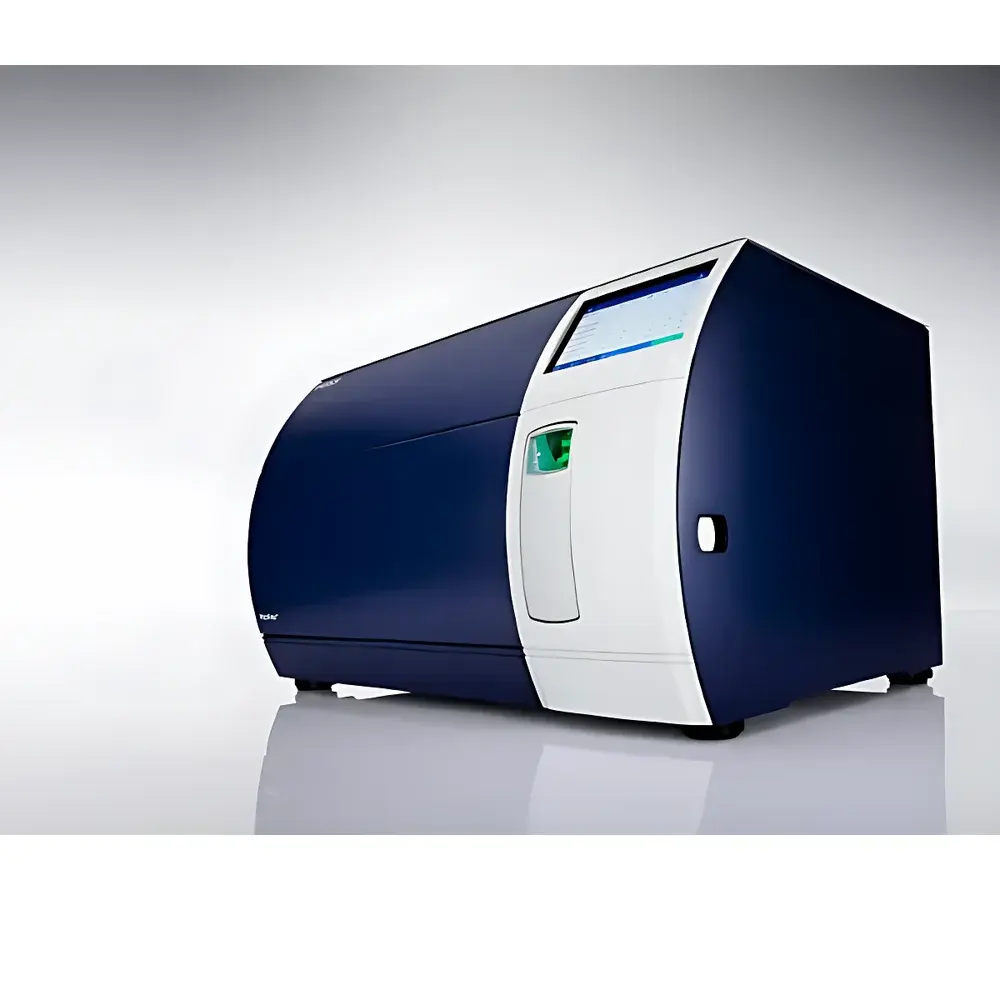
FOSS MycoFoss Rapid Mycotoxin Analyzer
| Brand | FOSS |
|---|---|
| Origin | Denmark |
| Model | MycoFoss |
| Detection Principle | Bead-based Flow Cytometric Immunoassay |
| Sample Throughput | Up to 12 samples per run |
| Assay Time | ≤8 minutes per sample |
| Target Analytes | Aflatoxins (AFB1, AFB2, AFG1, AFG2), Deoxynivalenol (DON), Zearalenone (ZEA), Ochratoxin A (OTA), T-2 Toxin, Fumonisins (FB1, FB2, FB3) |
| Sample Types | Ground corn, wheat, and barley |
| Automation Level | Fully automated sample preparation, assay execution, and data reporting |
| Compliance Support | Audit-trail enabled, 21 CFR Part 11–ready software architecture, GLP/GMP-aligned workflow design |
| Data Management | Integrated instrument control, result traceability, PDF report generation, and CSV export |
Overview
The FOSS MycoFoss Rapid Mycotoxin Analyzer is a fully automated, benchtop immunoassay platform engineered for high-throughput, regulatory-grade mycotoxin screening in cereal-based raw materials. It employs bead-based flow cytometric immunoassay (FCIA) technology — a quantitative, multiplex-capable method that combines magnetic microbead capture with laser-induced fluorescence detection. Unlike conventional ELISA or lateral flow devices, FCIA delivers superior precision through real-time measurement of bound antibody–antigen complexes on individually resolved microspheres, enabling simultaneous quantification of up to six mycotoxin classes in a single 8-minute assay cycle. Designed specifically for grain receiving, feed mill quality assurance, and food ingredient verification workflows, the MycoFoss system operates without manual pipetting, washing steps, or subjective interpretation, thereby eliminating inter-operator variability and ensuring analytical reproducibility across shifts and laboratories.
Key Features
- Fully integrated automation: From solvent-assisted extraction and filtration to immunoassay incubation, magnetic bead separation, and fluorescent signal acquisition — all steps are executed within a closed, self-contained cartridge system.
- Multi-analyte flexibility: Pre-configured assay kits support targeted testing protocols — including corn/wheat panels (AFLA, DON, ZEA, OTA, T-2, FUM) and barley-specific panels (DON, ZEA, OTA, T-2) — with validated cross-reactivity profiles aligned to EU Commission Regulation (EC) No 401/2006 and FDA Guidance for Industry #235.
- Regulatory-grade data integrity: Software enforces user authentication, electronic signatures, audit trails, and version-controlled method files — meeting foundational requirements for 21 CFR Part 11 compliance and supporting GLP/GMP documentation audits.
- Minimal operator dependency: Requires no specialized immunology training; routine operation involves only sample weighing, cartridge loading, and initiation via touchscreen interface.
- Robust environmental tolerance: Operates reliably in ambient grain-handling environments (15–30 °C, 30–70% RH), with vibration-damped optical modules and sealed fluidic pathways to ensure long-term stability.
Sample Compatibility & Compliance
The MycoFoss system is validated for homogenized, milled samples of corn (maize), wheat, and barley — with defined particle size distribution (≤500 µm) and moisture content (10–15% w/w). Extraction protocols comply with AOAC Official Method 2013.04 (for aflatoxins and fumonisins) and EN 15841:2010 (for DON and ZEA). All assay kits carry CE-IVD marking and are manufactured under ISO 13485-certified processes. Method validation reports include documented limits of quantification (LOQs) aligned with EU maximum levels (e.g., 2 µg/kg for AFB1 in unprocessed cereals, 1250 µg/kg for DON in wheat intended for breadmaking), with intra-laboratory precision (RSDr) ≤12% and inter-laboratory reproducibility (RSDR) ≤20% across three independent trials.
Software & Data Management
The MycoFoss Control Software (v3.2+) provides role-based access control, customizable test templates, and automated pass/fail flagging against configurable action limits. Each analysis generates a timestamped, digitally signed PDF report containing raw fluorescence intensities, calibration curve parameters, concentration results, uncertainty estimates, and QC metrics (e.g., %CV of calibrator replicates, bead count consistency). Data exports support CSV, XML, and LIMS-compatible ASTM E1384 formats. Instrument diagnostics log temperature stability, fluidic pressure profiles, and optical alignment status — all retained for ≥12 months to satisfy internal quality review cycles and external accreditation assessments (e.g., ISO/IEC 17025).
Applications
- Raw material acceptance at grain elevators and feed mills — rapid triage of incoming truckloads prior to unloading.
- In-process monitoring during blending and premix formulation to verify toxin mitigation efficacy of clay-based binders or enzymatic detoxifiers.
- Finished product release testing for pet food, infant cereals, and organic bakery ingredients where multi-mycotoxin co-contamination poses cumulative risk.
- Contract laboratory services offering accredited mycotoxin screening under ISO/IEC 17025 scope — leveraging built-in method traceability and report templating.
- Research applications investigating mycotoxin migration kinetics during thermal processing or storage under controlled humidity conditions.
FAQ
What sample preparation is required prior to analysis?
Ground grain samples must be sieved to ≤500 µm and equilibrated to ambient lab humidity. No derivatization, centrifugation, or SPE cleanup is needed — the system performs on-cartridge extraction using acetonitrile–water–acetic acid (79:20:1 v/v/v).
Can the MycoFoss validate compliance with EU Regulation (EC) No 1881/2006?
Yes — assay LOQs and recovery data are benchmarked against this regulation’s maximum levels; full validation packages (including spike-recovery, matrix interference, and ruggedness studies) are supplied with each kit lot.
Is remote instrument monitoring supported?
The system supports SNMP-based network health polling and optional integration with enterprise SCADA platforms via OPC UA — enabling centralized fleet management for multi-site operations.
How frequently does the optical module require recalibration?
Laser alignment and photomultiplier gain are verified automatically during every startup sequence; full optical calibration is recommended annually by FOSS Field Service Engineers using NIST-traceable reference beads.
Are consumables supplied with instrument warranty coverage?
Cartridges and reagent kits are consumables and excluded from the standard 24-month hardware warranty; however, FOSS offers extended service agreements covering preventive maintenance, calibration, and priority technical support.






