
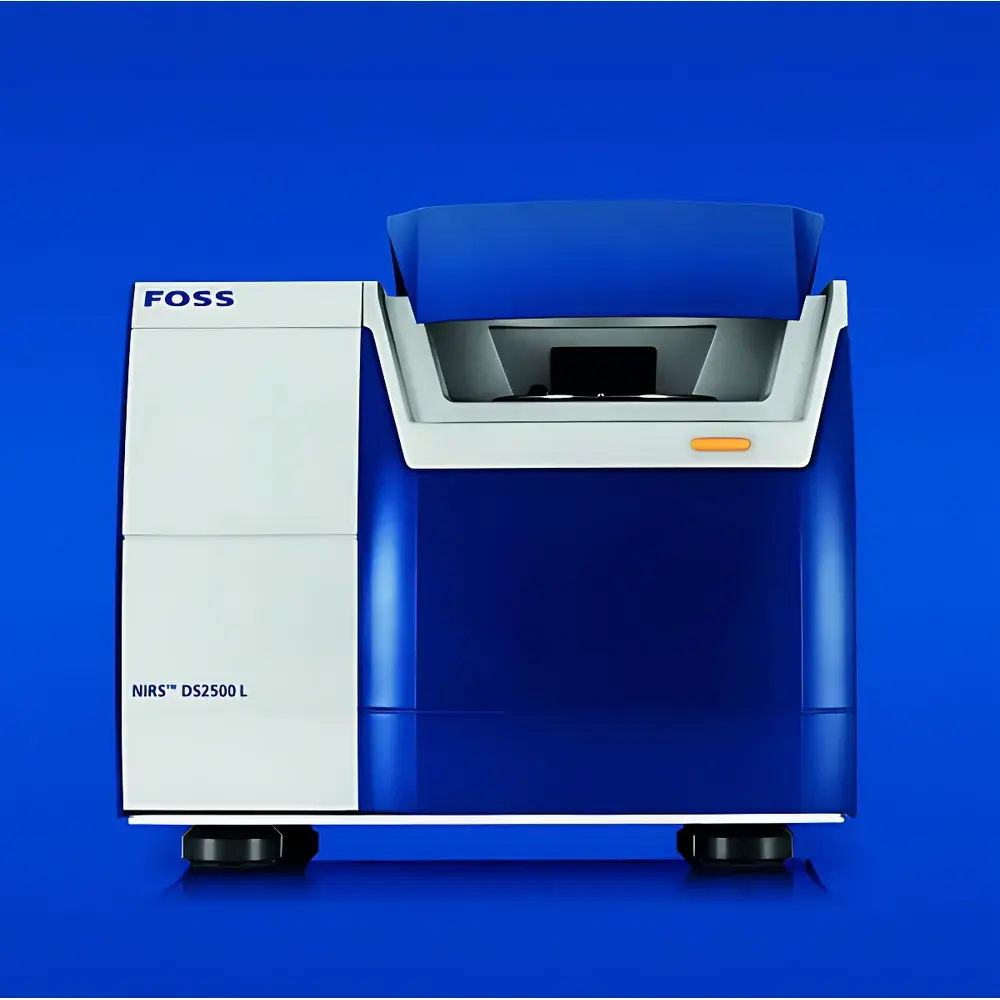
FOSS NIRS™ DS2500 L Near Infrared Spectrometer for Oil & Fat Quality Analysis
| Brand | FOSS |
|---|---|
| Origin | Denmark |
| Model | NIRS™ DS2500 L |
| Instrument Type | Laboratory |
| Principle | Grating Scanning |
| Wavelength Range | 400–2500 nm |
| Scan Time | <40 s per sample |
| Data Sampling Interval | 10 s |
| Measurement Mode | Transmission (for liquids) |
| Chemometrics Software | WinISI |
| IP Rating | IP54 |
| Temperature Control | Automatic, Closed-Loop Sample Thermal Regulation |
Overview
The FOSS NIRS™ DS2500 L is a high-performance, laboratory-grade near-infrared spectrometer engineered for rapid, non-destructive quantitative analysis of edible oils, biodiesel feedstocks, and liquid fat-based matrices. Operating on the principle of grating-based scanning spectroscopy, it captures full-spectrum absorbance data across the visible and short-wave near-infrared region (400–2500 nm), where overtone and combination vibrations of C–H, O–H, and C=O bonds produce chemically specific spectral signatures. Unlike filter-based or diode-array instruments, the DS2500 L’s monochromator architecture delivers superior photometric stability and wavelength reproducibility—critical for long-term calibration transfer between instruments and laboratories. Its optical design incorporates a convergent light path optimized for both round vials and standard square cuvettes, eliminating geometry-induced spectral variance and ensuring measurement equivalence regardless of sample container format. The system is purpose-built for routine quality control in oilseed processing, refining, and biofuel production facilities, where regulatory compliance, method harmonization, and cross-site analytical consistency are operational imperatives.
Key Features
- Grating-scanning monochromator with fixed slit and thermally stabilized optics for <±0.2 nm wavelength accuracy and <0.01% photometric repeatability over 8-hour operation
- IP54-rated enclosure—dust-protected and splash-resistant—enabling reliable deployment in industrial lab environments subject to ambient particulate and humidity fluctuations
- Integrated Peltier-controlled thermal regulation: automatically equilibrates liquid samples to user-defined target temperatures (20–40 °C range) without external chillers or baths; achieves setpoint within ±0.3 °C in ≤90 seconds
- Automated reference validation cycle: performs post-measurement reference standard analysis using built-in quartz reference cells, logging spectral deviation metrics for trending and preventive maintenance alerts
- Remote diagnostics and calibration health monitoring via FOSS Connect cloud service—supports secure, audit-ready access for service engineers and QA personnel
- One-touch workflow: intuitive touchscreen interface guides operators through sample type selection, vial insertion, and start—no spectral preprocessing or manual baseline correction required
Sample Compatibility & Compliance
The DS2500 L is validated for transmission-mode analysis of homogeneous liquid oils—including soybean, palm, rapeseed, sunflower, and waste cooking oil—with viscosity up to 120 cSt at 40 °C. It accommodates standard 10 mm pathlength square cuvettes (quartz or optical glass) and 12-mm-diameter round vials (with optional adapter). All hardware and firmware comply with IEC 61000-6-3 (EMC emission standards) and IEC 61010-1 (safety requirements for electrical equipment). Data integrity workflows align with GLP and GMP principles: WinISI software supports 21 CFR Part 11-compliant electronic signatures, audit trails, and role-based user permissions. Calibration models developed per AOAC Official Method 2012.01 (NIR for FFA in vegetable oils) and ISO 12228-2 (iodine value by NIR) are pre-validated and transferable across DS2500 L installations globally.
Software & Data Management
WinISI III (v4.5+) serves as the embedded chemometrics platform, supporting partial least squares (PLS), principal component regression (PCR), and support vector regression (SVR) modeling. It includes automated outlier detection, spectral preprocessing (SNV, derivatives, multiplicative scatter correction), and model validation via cross-validation and external test sets. All raw spectra, prediction results, instrument logs, and calibration metadata are stored in a relational SQLite database with timestamped, immutable records. Export options include CSV, ASTM E1382-compliant .jdx files, and PDF reports containing spectral overlays, residual plots, and uncertainty estimates per analyte. Data backups synchronize securely to on-premise NAS or FOSS-hosted servers with TLS 1.3 encryption.
Applications
- Quantification of free fatty acids (FFA) in crude and refined vegetable oils (0.05–5.0% w/w)
- Determination of iodine value (IV) for oxidative stability assessment (70–140 g I₂/100 g)
- Color evaluation (ASTM D156, Gardner scale) without solvent dilution
- Moisture content (0.01–0.5% w/w) and trace solvent residues (hexane, ethanol) in biodiesel blends
- Authentication of oil blends and detection of adulteration (e.g., palm oil in olive oil)
- Process endpoint determination during caustic refining and bleaching steps
FAQ
What reference standards are required for initial calibration setup?
Primary calibrations require wet-chemistry reference values generated per AOAC or ISO methods for each target analyte; FOSS provides certified reference materials (CRMs) for FFA, IV, and color traceability.
Can calibration models be transferred between DS2500 L units without revalidation?
Yes—provided instruments are within factory-specified optical alignment tolerances and operated under identical temperature/humidity conditions; FOSS recommends annual inter-instrument verification using a shared transfer standard set.
Is WinISI compatible with LIMS integration?
Yes—via configurable ODBC drivers and RESTful API endpoints supporting HL7 and ASTM E1382 message schemas for bidirectional data exchange.
How frequently must the internal reference standard be replaced?
The fused silica reference cell is rated for >10,000 scans; replacement is triggered automatically when spectral drift exceeds 0.5% absorbance unit deviation from baseline—typically every 18–24 months under continuous use.
Does the DS2500 L support method development for new oil matrices not covered in standard libraries?
Yes—WinISI includes guided model development workflows compliant with ISO 18116, including sample selection strategy, spectral outlier removal, and robustness testing against instrumental parameter variation.




