
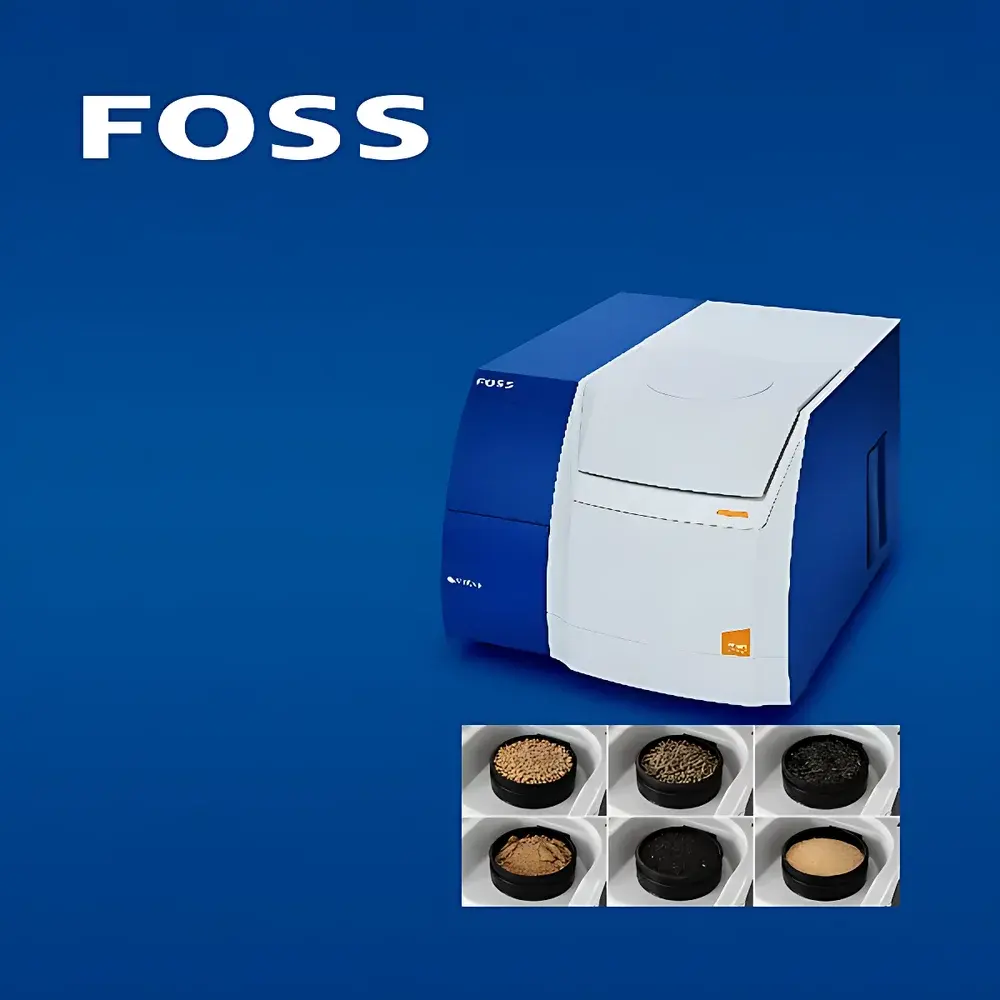
FOSS NIRS DS3 F Near Infrared Spectrometer
| Brand | FOSS |
|---|---|
| Origin | Denmark |
| Model | NIRS DS3 F |
| Instrument Type | Laboratory NIR Spectrometer |
| Optical Principle | Grating Scanning |
| Wavelength Range | 850–2500 nm |
| Scan Speed | <1 minute per sample |
| Data Sampling Interval | 0.5 nm |
| Measurement Mode | Diffuse Reflectance / Transflectance |
| Chemometrics Software | WinISI with Artificial Neural Network (ANN) algorithms |
| Enclosure Rating | IP65 |
| Cooling System | Closed-Loop Liquid Cooling |
| Sample Interface | RFID-Enabled Sample Cups |
| Factory Calibration Strategy | Pre-Standardized, Inter-Instrument Transferable Calibration |
| Language Options | English or Chinese UI & Network Management Software |
| Compliance Support | ASTM E1655, ISO 12099, USP <857>, GLP/GMP-ready audit trail capabilities in WinISI |
Overview
The FOSS NIRS DS3 F is a laboratory-grade near infrared (NIR) spectrometer engineered for high-reproducibility quantitative and qualitative analysis across agricultural, food, feed, pharmaceutical, and industrial raw material testing environments. Based on grating scanning optical architecture, it delivers high signal-to-noise ratio spectra across the full 850–2500 nm spectral range—covering key overtones and combination bands of C–H, N–H, and O–H bonds essential for moisture, protein, fat, starch, fiber, and ash quantification. Its fixed optical path and factory-predefined calibration strategy eliminate the need for user-performed instrument standardization, enabling direct deployment and seamless transfer of calibrations between instruments within the same FOSS network—a critical advantage for multi-site laboratories requiring method harmonization and regulatory consistency.
Key Features
- ISIscan Nova Operating Software: Introduces scheduled power-on and automated self-diagnostic routines; instruments complete warm-up and internal validation before operator arrival, minimizing downtime and maximizing daily throughput.
- Intelligent Light Source Monitoring: Real-time tracking of halogen lamp usage with predictive lifetime alerts issued 500 hours prior to end-of-life; software-guided reset protocol ensures traceability after manual lamp replacement—no tools required due to tool-free bayonet-style coupling.
- RFID-Enabled Sample Cup Recognition: Each cup carries a passive RFID tag storing cup geometry, material, and application-specific metadata; the system validates cup–method compatibility and issues immediate warnings upon mismatch, enforcing SOP compliance and reducing operator error.
- IP65-Rated Industrial Enclosure: Dust-tight and protected against low-pressure water jets, ensuring operational stability in production-floor or field-deployed lab settings where environmental control is limited.
- Closed-Loop Liquid Cooling System: Maintains thermal equilibrium of optical components independent of ambient fluctuations, preserving spectral baseline stability and long-term photometric repeatability.
- Modular Sample Handling: Supports interchangeable cups and accessories for solids (e.g., grains, pellets), liquids (flow cells, cuvettes), and semi-solids (slurries, pastes), all compatible with the same core optical engine and chemometric workflow.
Sample Compatibility & Compliance
The NIRS DS3 F accommodates diverse physical forms via standardized FOSS-certified sample holders—including rotating cup modules for heterogeneous solids, temperature-controlled liquid cells, and custom-designed flow cells for inline process integration. All hardware and software components comply with internationally recognized analytical standards: ASTM E1655 (standard practices for NIR quantitative analysis), ISO 12099 (animal feeding stuffs—guidelines for NIR calibration), and USP (Near-Infrared Spectroscopy). WinISI software supports 21 CFR Part 11-compliant electronic signatures, audit trails, and role-based access control—fully aligned with GLP and GMP documentation requirements for regulated industries.
Software & Data Management
WinISI serves as the primary chemometrics platform, integrating multivariate regression (PLS), principal component analysis (PCA), and artificial neural network (ANN) modeling for robust calibration development and prediction. It enables full lifecycle management—from raw spectrum acquisition and outlier detection to model validation (using cross-validation and external test sets), version control, and secure export of results in CSV, Excel, or LIMS-compatible XML formats. The optional network management module allows centralized administration of multiple DS3 F units, remote diagnostics, firmware updates, and synchronized calibration library distribution—ensuring consistent performance across global laboratory networks.
Applications
The NIRS DS3 F is routinely deployed for rapid, non-destructive analysis in grain quality assessment (moisture, protein, oil content in wheat, corn, soybean), dairy ingredient verification (casein, lactose, fat in milk powder), pet food formulation (crude protein, ash, fiber), and pharmaceutical excipient identity testing (e.g., lactose polymorph screening). Its ability to operate without consumables or sample preparation significantly reduces cost-per-analysis and accelerates batch release decisions. Method transfer studies confirm ≤2% RMSEP deviation across instruments when using FOSS’s inter-instrument calibration migration protocol—validating its suitability for distributed QC networks.
FAQ
Does the NIRS DS3 F require daily standardization or wavelength calibration?
No. The instrument ships with factory-applied wavelength and photometric calibration, and employs a stable grating-based optical design that maintains alignment under normal operating conditions. Routine verification uses built-in ceramic reference tiles; full recalibration is only required after major service events.
Can existing WinISI calibration models be migrated to the DS3 F?
Yes—FOSS provides backward-compatible model transfer utilities. Legacy PLS and ANN models developed on earlier FOSS platforms (e.g., XDS, NIRSystems) can be imported and validated with minimal retraining, provided spectral resolution and preprocessing match.
Is the RFID cup system mandatory for operation?
RFID reading is enabled by default but configurable; users may disable cup validation in administrator mode for legacy or custom cup use—though this disables traceability logging and voids certain GLP/GMP compliance features.
What cooling medium is used in the closed-loop system?
A proprietary non-toxic, non-corrosive glycol–water mixture circulates through sealed aluminum heat exchangers; no user maintenance or refilling is required during the instrument’s rated service life.
How does the DS3 F handle spectral drift caused by ambient temperature changes?
Thermal stabilization is achieved via dual-stage control: the closed-loop liquid system regulates detector and grating temperature to ±0.1 °C, while real-time dark-current correction compensates for minor detector response shifts—resulting in <0.05% absorbance drift over 8-hour continuous operation at ±5 °C ambient fluctuation.




