
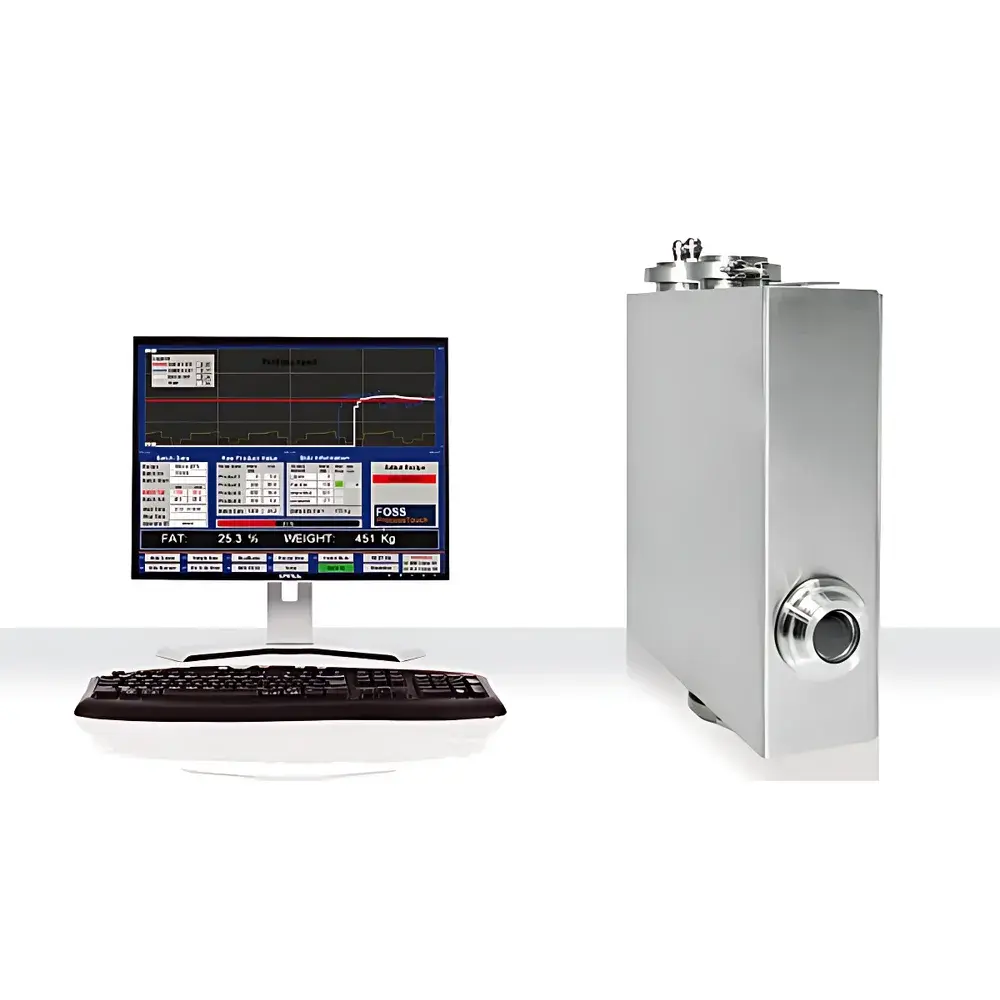
FOSS ProFoss™ 2 Online Soybean Meal Analyzer
| Brand | FOSS |
|---|---|
| Origin | Denmark |
| Model | ProFoss™ 2 Online Soybean Meal Analyzer |
| Instrument Type | Online Near-Infrared Spectrometer |
| Principle | Grating-based diode array (non-scanning) NIR spectroscopy |
| Wavelength Range | 1100–1650 nm |
| Analysis Time per Result | 2–3 seconds (real-time) |
| Sampling Mode | Diffuse reflectance and/or transmission |
| Chemometrics Software | ISIscan NOVA™ Instrument Control |
| Data Acquisition Interval | 2–3 seconds (real-time) |
| Compliance Ready | Designed for integration with industrial process control systems (OPC UA/DA), supports audit-ready data logging per GLP/GMP-aligned workflows |
Overview
The FOSS ProFoss™ 2 Online Soybean Meal Analyzer is an industrial-grade, non-scanning near-infrared (NIR) spectrometer engineered for continuous, real-time compositional analysis of soybean meal and related protein-rich feed materials directly on the production line. Utilizing a fixed grating and high-stability diode array detector architecture, the system captures the full spectral range from 1100 to 1650 nm in a single acquisition—eliminating mechanical scanning delays and ensuring robust signal reproducibility across varying conveyor speeds and bulk material flow conditions. Unlike dispersive or FT-NIR systems, the ProFoss™ 2’s solid-state optical design delivers inherent wavelength stability and minimal drift over extended operation, enabling long-term calibration retention without routine recalibration. Its dual high-intensity tungsten-halogen light source configuration provides redundancy: if one lamp degrades or fails, the second lamp automatically engages without interrupting measurement continuity or compromising photometric accuracy—critical for unattended 24/7 operation in feed milling environments.
Key Features
- Real-time analysis cycle of 2–3 seconds per measurement, synchronized with dynamic material flow on belt conveyors or pneumatic transfer lines.
- Simultaneous diffuse reflectance and transmission optical path options, configurable per application requirements (e.g., particle size-dependent scattering compensation or homogeneous matrix penetration).
- High-resolution diode array detector with optimized signal-to-noise ratio (>10,000:1) across the 1100–1650 nm range, supporting quantification of moisture, crude protein, oil, fiber, and ash content in soybean meal with proven repeatability (RSD < 0.2% for protein under controlled feed stream conditions).
- Factory-established calibrations transferable between instruments via standardized spectral file formats—enabling scalable deployment across multiple processing lines or facilities without revalidation overhead.
- Integrated thermal stabilization and vibration-dampened optical housing ensure operational integrity in ambient temperatures from 5 °C to 40 °C and industrial dust/humidity levels typical of feed manufacturing plants.
Sample Compatibility & Compliance
The ProFoss™ 2 is validated for heterogeneous, flowing soybean meal streams with particle sizes ranging from 100 µm to 2 mm and bulk densities of 450–650 kg/m³. It accommodates variable moisture content (8–14% w/w) and temperature fluctuations (20–50 °C) without requiring physical sample conditioning. The instrument complies with IEC 61000-6-2 (EMC immunity) and IEC 60529 IP65 enclosure rating for dust- and water-resistant operation. Its data architecture supports traceable, time-stamped spectral records aligned with FDA 21 CFR Part 11 requirements when deployed with FOSS ISIscan NOVA™ software configured for electronic signatures, audit trails, and role-based access control—facilitating GLP and GMP-aligned quality assurance in regulated feed production.
Software & Data Management
ISIscan NOVA™ serves as the embedded chemometrics platform, providing model development, validation, and deployment tools compliant with ASTM E1655 and ISO 12099 standards for NIR method validation. Users can import reference laboratory data (e.g., Kjeldahl protein, Soxhlet fat) to build PLS regression models with full cross-validation reporting. The software supports automated outlier detection, spectral preprocessing (SNV, derivatives, multiplicative scatter correction), and real-time prediction uncertainty estimation. OPC UA and legacy OPC DA interfaces enable bidirectional communication with DCS, SCADA, or MES platforms—allowing process setpoint adjustments (e.g., dryer temperature, mixer dwell time) triggered by NIR-predicted composition deviations exceeding user-defined thresholds.
Applications
- Continuous monitoring of soybean meal protein content during post-extraction drying and cooling stages to optimize energy use and prevent over-drying.
- Blend uniformity verification in compound feed premixing operations where soybean meal constitutes >20% of formulation.
- Raw material acceptance testing at receiving docks using rapid NIR screening against contractual specification limits (e.g., minimum 47% CP, maximum 12% moisture).
- Early detection of adulteration or substitution events (e.g., urea addition, cereal filler blending) through spectral residual analysis and principal component trajectory monitoring.
- Supporting HACCP critical control point documentation by generating time-synchronized analytical records linked to batch identifiers and operator logins.
FAQ
How often does the ProFoss™ 2 require calibration verification?
Calibration verification is recommended every 30 days using a stable reference standard (e.g., certified soybean meal SRM) or via periodic lab correlation—though field deployments commonly demonstrate calibration stability beyond 90 days under consistent operating conditions.
Can the system be integrated with existing plant automation infrastructure?
Yes—the ProFoss™ 2 includes native OPC UA and OPC DA server functionality, enabling seamless integration with Siemens PCS7, Rockwell FactoryTalk, ABB 800xA, and other industrial control systems without third-party gateways.
Is method transfer between instruments supported out-of-the-box?
Yes—calibration models generated in ISIscan NOVA™ are portable across ProFoss™ 2 units using standardized .cal and .spc file formats, eliminating the need for local re-modeling when expanding measurement points.
What maintenance is required for the dual-light-source system?
Lamp replacement is typically required every 12–18 months depending on duty cycle; the system logs cumulative lamp hours and triggers alerts prior to end-of-life, with hot-swap capability ensuring zero downtime during replacement.
Does the analyzer support regulatory audit readiness?
When deployed with ISIscan NOVA™ in validated mode (user-configurable audit trail, electronic signatures, and secure database logging), the system meets baseline requirements for FDA 21 CFR Part 11 and EU Annex 11 compliance in feed quality management systems.






