
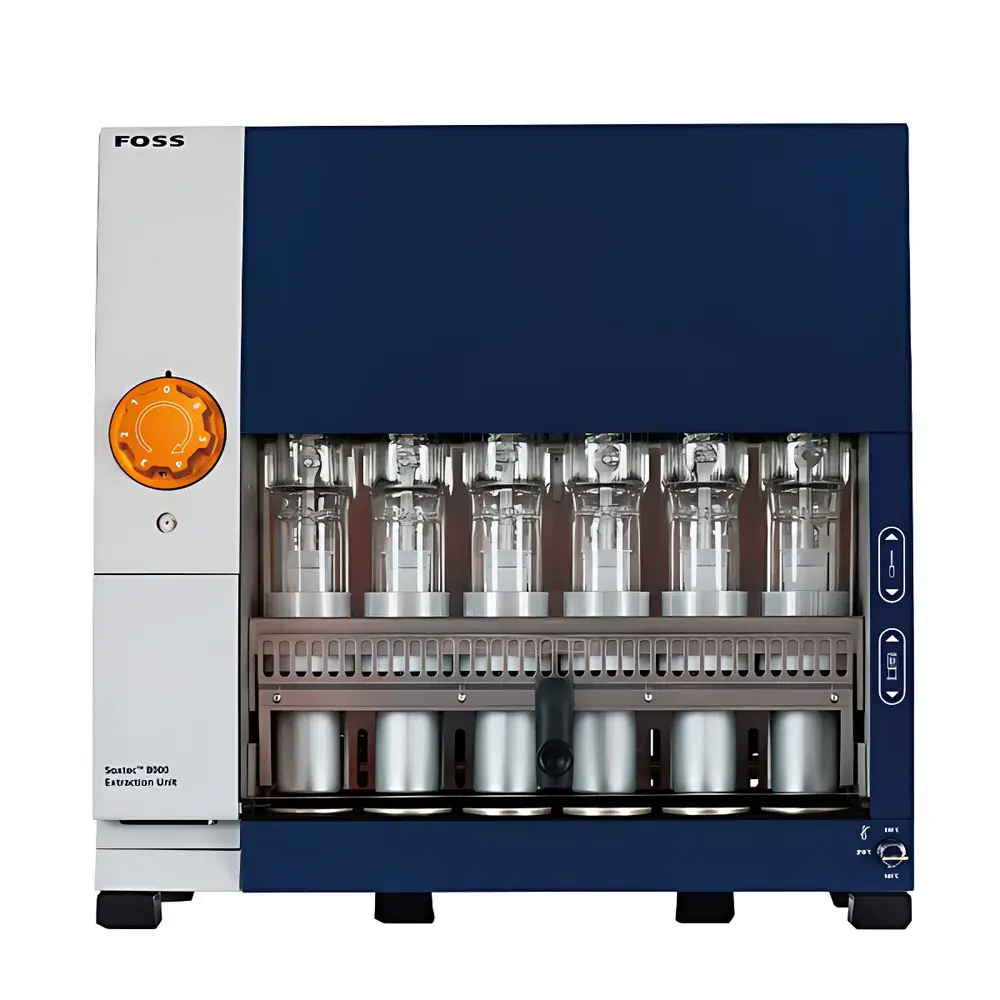
FOSS Soxtec 8000 Automated Soxhlet Extraction System
| Brand | FOSS |
|---|---|
| Origin | Denmark |
| Model | Soxtec 8000 |
| Extraction Chamber Volume | 65 mL |
| Receiver Flask Capacity | 40–110 mL |
| Temperature Range | 0–285 °C |
| Temperature Control Accuracy | ±1% |
| Throughput | 6 or 12 samples per batch |
| Solvent Recovery Efficiency | up to 80% |
| Safety Features | Automatic solvent leak detection, auto-empty alert for recovery tank, self-diagnostic startup sequence |
Overview
The FOSS Soxtec 8000 Automated Soxhlet Extraction System is an engineered solution for quantitative determination of crude fat, free fat, and solvent-extractable matter in solid and semi-solid matrices. Based on the classical Soxhlet principle—cyclical solvent reflux, dynamic percolation, and controlled evaporation—the Soxtec 8000 implements a standardized four-stage thermal extraction protocol: boiling, rinsing, solvent recovery, and pre-drying. Unlike manual or semi-automated systems, it eliminates operator intervention after sample loading, delivering reproducible, GLP-compliant results across diverse regulatory environments. Its design adheres to internationally recognized methodologies including AOAC Official Method 920.39, ISO 6496, ISO 1444, and USP <467> for residual solvents, making it suitable for food safety labs, feed quality control, environmental testing, and industrial R&D.
Key Features
- Modular dual-throughput configuration: selectable 6-position or 12-position heating blocks, each with independent power control and real-time temperature monitoring.
- Rotary solvent dosing system: ensures precise, repeatable delivery of extraction solvent (e.g., petroleum ether, diethyl ether, or hexane) without manual pipetting—reducing exposure risk and inter-sample variability.
- Integrated solvent recovery loop: captures and condenses vaporized solvent during boiling and rinsing phases; achieves up to 80% recovery efficiency, minimizing consumable costs and VOC emissions.
- Comprehensive safety architecture: includes real-time solvent leak detection via integrated vapor sensors, automatic shutdown on anomaly detection, and audible/visual alerts for recovery tank saturation.
- Self-diagnostic boot sequence: verifies heater integrity, temperature sensor calibration, solvent path continuity, and condenser cooling status prior to run initiation—ensuring analytical readiness and traceability.
- Uniform heating envelope: patented circumferential heating elements provide consistent thermal distribution across all extraction chambers, eliminating hot-spot bias and improving extraction kinetics.
Sample Compatibility & Compliance
The Soxtec 8000 accommodates heterogeneous solid and particulate samples within standard cellulose extraction thimbles (e.g., Whatman 913 or FOSS-certified equivalents). Validated applications span foodstuffs (cereals, dairy powders, meat products), animal feed, soil and sludge matrices, wastewater solids, petrochemical residues, pulp and paper extracts, synthetic polymers, and textile fibers. All operational parameters comply with ISO/IEC 17025 requirements for method validation, and the system supports audit-ready documentation under FDA 21 CFR Part 11 when paired with FOSS’s optional LabX™ software. It meets CE marking requirements for electrical safety (EN 61000-6-3, EN 61000-6-4) and chemical handling (ATEX Zone 2 compliance for solvent vapor containment).
Software & Data Management
When integrated with FOSS LabX™ Laboratory Software (optional), the Soxtec 8000 enables full digital workflow management—including method storage, user access control, electronic signatures, and automated report generation. Raw temperature logs, solvent volume tracking, cycle timing stamps, and alarm history are time-stamped and stored with cryptographic integrity. Audit trails meet GLP/GMP data integrity standards (ALCOA+ principles), supporting inspection readiness for regulatory agencies such as EFSA, USDA-FSIS, and EU Reference Laboratories. Local standalone operation is also supported via intuitive touchscreen interface with multilingual support (English, German, French, Spanish, Chinese).
Applications
- Determination of crude fat content in cereals and oilseeds per AOAC 991.36 and ISO 6496.
- Analysis of ether extract in animal feed formulations under ISO 1444 and EN ISO 6497.
- Quantification of extractable organic matter in contaminated soils and sediments (EPA Method 3541).
- Residual solvent assessment in polymer pellets and packaging materials per USP <467> and ICH Q3C(R8).
- Quality control of fiber-based materials in pulp and textile manufacturing (TAPPI T 204 cm-17).
- Monitoring lipid oxidation stability in processed foods using accelerated solvent extraction prior to GC-FID analysis.
FAQ
What solvents are compatible with the Soxtec 8000?
The system supports low-boiling, non-polar solvents commonly used in fat extraction—including petroleum ether (bp 40–60 °C), diethyl ether (bp 34.6 °C), and n-hexane (bp 69 °C)—provided they meet flash point and vapor pressure specifications outlined in the FOSS Safety Manual.
Can the Soxtec 8000 be validated for ISO/IEC 17025 accreditation?
Yes. The instrument’s temperature uniformity, solvent delivery accuracy, and cycle repeatability can be verified using FOSS-provided IQ/OQ protocols and NIST-traceable reference standards.
Is remote monitoring supported?
With LabX™ software and network connectivity, users may monitor run status, receive email/SMS alerts on completion or fault conditions, and access historical data via secure web portal.
How often does the solvent recovery tank require manual emptying?
Frequency depends on daily throughput and solvent type; typical usage requires transfer every 2–5 extraction batches. The system triggers visual and audible alerts when fill level exceeds 90%.
Does the Soxtec 8000 support method customization beyond AOAC/ISO standards?
Yes. Users may define custom temperature ramps, dwell times, rinse cycles, and drying profiles via LabX™ or the onboard interface—subject to hardware limits and safety interlocks.



