
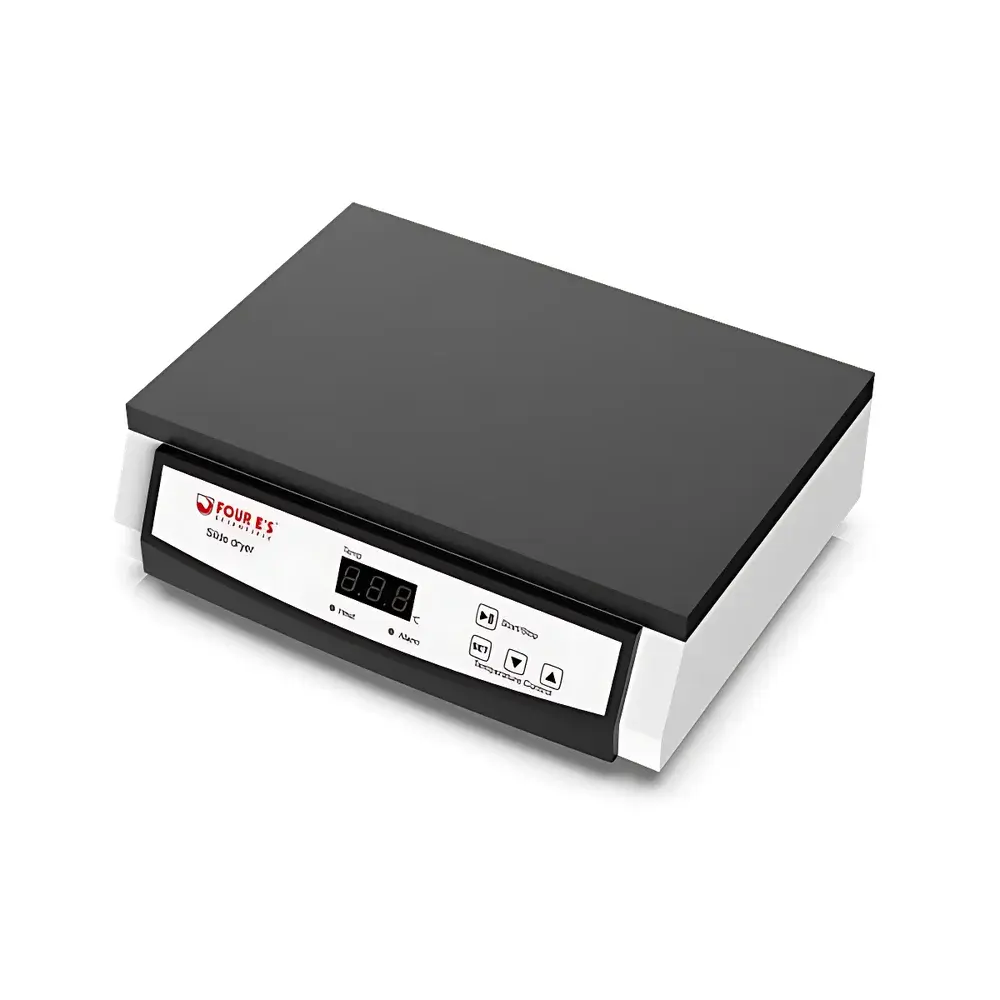
FOUR E’S SCIENTIFIC SDR200101 Tissue Flattening and Baking Station
| Brand | FOUR E'S SCIENTIFIC |
|---|---|
| Origin | Guangdong, China |
| Manufacturer Type | Direct Manufacturer |
| Country of Origin | China |
| Model | SDR200101 |
| Pricing | Upon Request |
Overview
The FOUR E’S SCIENTIFIC SDR200101 Tissue Flattening and Baking Station is a dedicated benchtop instrument engineered for standardized post-sectioning thermal processing in histopathology laboratories. It operates on the principle of controlled conductive heating to facilitate tissue adhesion, paraffin consolidation, and water evaporation from glass-mounted tissue sections—critical preparatory steps prior to hematoxylin and eosin (H&E) staining or immunohistochemical (IHC) analysis. Unlike general-purpose ovens, this device integrates precision thermal management with ergonomic workflow design specifically for pathology slide processing. Its architecture supports reproducible baking conditions across batches, directly contributing to reduced section detachment, minimized edge curling, and improved antigen preservation—key quality determinants in diagnostic histology.
Key Features
- 23-Slide Capacity Heating Platform: Features a large-format, uniformly heated aluminum plate (280 × 180 mm) with optimized thermal mass distribution to ensure ±0.5 °C temperature uniformity across all positions—validated per ASTM E220-22 calibration practices.
- Digital PID Temperature Control: Employs a closed-loop proportional-integral-derivative algorithm with real-time thermistor feedback, enabling setpoint accuracy within ±0.3 °C and stability of ≤±0.2 °C over 60-minute dwell cycles.
- Intuitive Touch-Enabled Interface: Equipped with a backlit LCD display and tactile membrane buttons; supports dual-mode operation (time-based bake or continuous hold), with adjustable parameters ranging from 30 °C to 80 °C and 1–120 minutes.
- Power-Fail Recovery Logic: Built-in non-volatile memory retains user-defined temperature/time settings and active operational state, automatically resuming the pre-interruption program upon power restoration—compliant with GLP data integrity expectations.
- Over-Temperature Safety Cut-Off: Dual independent thermal protection: primary control loop + redundant mechanical thermostat (trip point at 85 °C), certified to IEC 61010-1:2010 for laboratory equipment safety.
- Hygienic, Seamless Work Surface: Anodized aluminum platform with zero seams or crevices; resistant to common histological solvents (xylene, ethanol, citrate buffer) and compatible with routine disinfection protocols (70% isopropanol, sodium hypochlorite).
Sample Compatibility & Compliance
The SDR200101 accommodates standard 1″ × 3″ (25 × 75 mm) microscope slides—including charged, APES-coated, poly-L-lysine, and silanized variants—without requiring adapters. It is validated for use with both conventional paraffin-embedded tissues and low-melting-point wax formulations (e.g., 56–58 °C melting range). The unit meets CE marking requirements under the EU Medical Device Regulation (MDR 2017/745) Annex II classification for ancillary pathology equipment. While not classified as an IVD device, its performance aligns with ISO 15189:2022 clause 5.3.2 (equipment verification) and supports traceable calibration via external NIST-traceable thermometers (e.g., Fluke 1523).
Software & Data Management
This model operates as a standalone hardware system without embedded software or network connectivity. All operational parameters are entered manually and retained locally in EEPROM. For laboratories implementing electronic lab notebooks (ELN) or LIS integration, timestamped baking logs can be manually recorded or captured via external digital thermographic validation (e.g., FLIR E8-XT thermal imaging during qualification). Audit trail compliance for FDA 21 CFR Part 11 is achieved through documented SOPs governing parameter entry, calibration frequency (recommended quarterly), and preventive maintenance logs—not via onboard digital signatures.
Applications
- Routine H&E slide preparation in clinical pathology labs (CAP-accredited or ISO 15189-certified environments)
- Pre-baking of sections prior to antigen retrieval in IHC workflows (e.g., Dako PT Link or Leica Bond systems)
- Stabilization of frozen-section mounts before cryostat storage
- Quality assurance testing of new slide coatings or adhesive substrates
- Research histology where batch-to-batch thermal consistency impacts morphometric analysis repeatability
FAQ
Is the SDR200101 suitable for baking immunofluorescence (IF) slides?
Yes—when operated at ≤60 °C for ≤30 minutes, it preserves fluorophore integrity better than convection ovens due to absence of air currents and lower thermal overshoot.
Can the unit be calibrated in-house?
Yes—using a NIST-traceable reference thermometer placed directly on the platform surface; calibration certificates should document deviation at three points (45 °C, 60 °C, 75 °C) per ISO/IEC 17025 guidelines.
Does it support programmable multi-step protocols?
No—this is a single-setpoint, single-duration instrument; complex ramp-and-hold sequences require external timer coordination.
What maintenance is required?
Monthly visual inspection of heating surface integrity and annual verification of thermal cut-off response using calibrated heat source; no lubrication or consumables needed.
Related Products



