
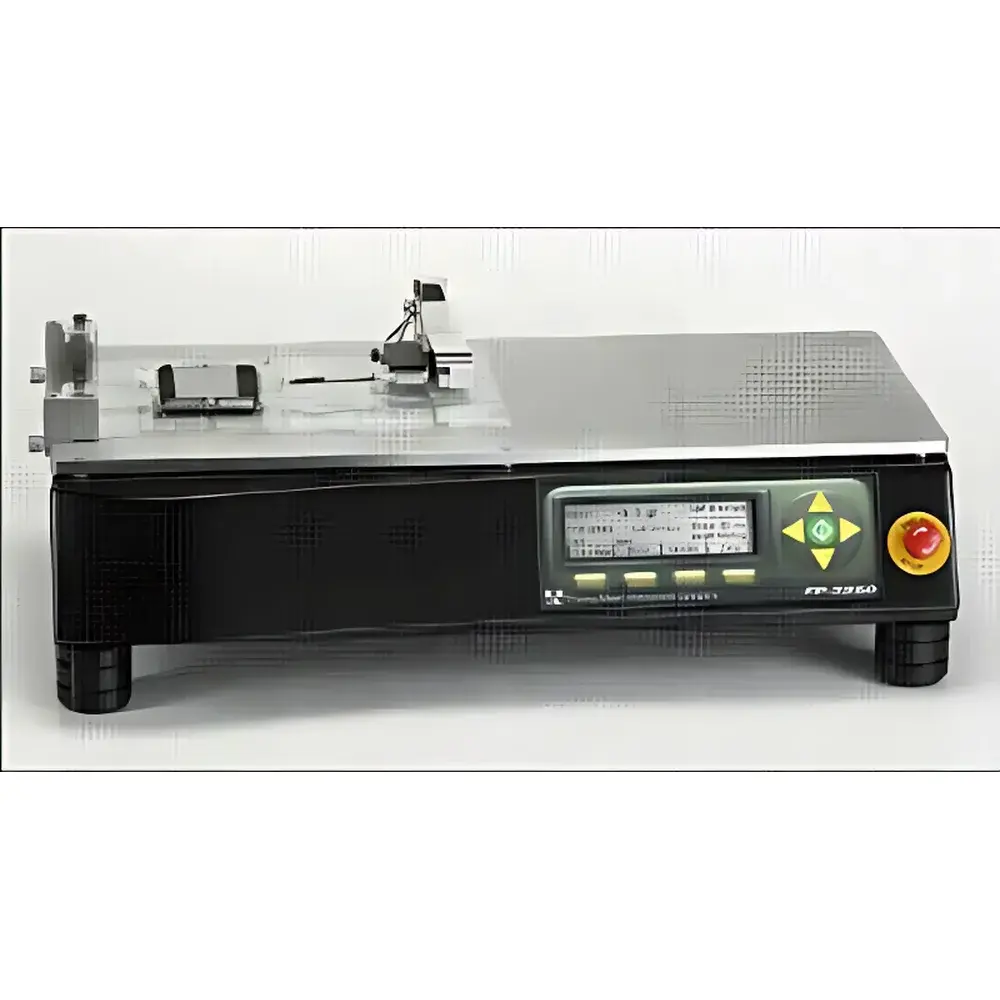
T/A FP-2260 Friction and Peel Tester
| Brand | T/A |
|---|---|
| Origin | USA |
| Manufacturer Type | Authorized Distributor |
| Product Origin | Imported |
| Model | FP-2260 |
| Price Range | USD 14,000 – 70,000 |
| Standards Compliance | ASTM D1894, D4521, D3330, F88 |
| Load Cell Options | 0.5 kg, 1 kg, 2 kg, 10 kg |
| Resolution | 0.1 g |
| Accuracy | ±0.25% of full scale |
| Force Units | g, kg, oz, lb, N |
| Test Speed | Standard: 1–20 in/min |
| High-Speed | 10–110 in/min |
| Standard Sled Masses | 200 g, 500 g, 1000 g, 3 lb |
| Test Duration | 0.1–99 s |
| Travel Distance | 0.1–14.0 in |
| Display | 240 × 64 pixel LCD |
| Data Storage | 127 test records |
| Test Area | 225 mm × 350 mm |
| Power Supply | 220 V, 50 Hz |
| Dimensions (L×W×H) | 27 in × 12 in × 7 in |
| Weight | 20 kg |
Overview
The T/A FP-2260 Friction and Peel Tester is an electromechanical force measurement system engineered for precision evaluation of interfacial resistance between packaging materials under controlled sliding and peeling conditions. It operates on the fundamental principles of Coulomb friction mechanics and linear peel mechanics—quantifying static and kinetic coefficients of friction (COF) via sled-on-surface translation, and seal strength or adhesive bond integrity via 90° or 180° peel configurations per ASTM F88 and ISO 8295. Designed specifically for packaging R&D, quality control, and production validation laboratories, the FP-2260 delivers traceable, repeatable mechanical property data critical to optimizing material handling, pouch stacking stability, high-speed filling line performance, and end-user opening behavior. Its dual-mode architecture supports both horizontal COF testing (ASTM D1894/D4521) and vertical peel/seal strength assessment (ASTM D3330/F88), eliminating the need for separate dedicated instruments.
Key Features
- Modular sensor mounting system enabling rapid reconfiguration between horizontal friction sled tests and vertical peel fixtures—no tools required.
- Motor-driven crosshead with programmable speed profiles: standard range (1–20 in/min) for low-velocity COF characterization; high-speed mode (10–110 in/min) for dynamic seal integrity simulation.
- Adjustable test head orientation (0° to 90°) to accommodate variable peel angles and surface contact geometries across diverse substrates.
- High-resolution load cell array (0.1 g resolution, ±0.25% FS accuracy) with selectable capacity options (0.5 kg to 10 kg) to match application-specific force ranges—from thin film slip testing to heavy-duty laminated pouch evaluation.
- Integrated 240 × 64 pixel monochrome LCD interface with intuitive menu navigation, real-time force curve display, and on-device data review.
- Onboard memory stores up to 127 complete test records—including peak pull force, average peel load, COF static/dynamic values, standard deviation, and timestamped metadata.
- Automated return-to-start and emergency stop functionality ensures operator safety and workflow consistency during high-throughput testing.
Sample Compatibility & Compliance
The FP-2260 accommodates a broad spectrum of flexible and semi-rigid packaging substrates, including but not limited to: virgin and recycled paper, corrugated board, BOPP, PET, PE, CPP, aluminum foil laminates, metallized films, heat-seal coatings, and medical-grade Tyvek®. Its 225 mm × 350 mm test bed accommodates oversized samples without trimming, supporting full-width seal evaluation per ASTM F88 Annex A3. All operational modes are fully aligned with internationally recognized test standards: static and kinetic COF per ASTM D1894 and ISO 8295; peel adhesion per ASTM D3330 (Method A); seal strength per ASTM F88; and high-speed friction assessment per ASTM D4521. The instrument’s mechanical design and calibration protocol support GLP-compliant documentation when integrated with external LIMS or audit-ready reporting software.
Software & Data Management
While the FP-2260 operates as a stand-alone unit with embedded firmware, its RS-232 serial interface enables seamless integration with third-party data acquisition platforms—including custom Python-based QC dashboards or validated enterprise systems compliant with FDA 21 CFR Part 11 requirements. Exported datasets include raw force-time traces, calculated COF ratios (μs, μk), peel metrics (mean, max, min, SD), and configurable pass/fail thresholds. Calibration certificates are traceable to NIST standards, and firmware updates maintain alignment with evolving ISO/ASTM revision cycles. Audit trails—when enabled via external software—record user login, test parameter changes, result modifications, and export events to satisfy GMP documentation requirements.
Applications
- Optimizing anti-block additive concentration in polyolefin films by correlating COF reduction with processing efficiency and stack stability.
- Validating heat-seal integrity of medical device pouches under accelerated aging conditions per ISO 11607-2.
- Comparing peel initiation forces across different adhesive chemistries (acrylic vs. rubber-based) used in label backing materials.
- Assessing coefficient of friction variation across humidity-controlled environments (20% RH to 80% RH) to predict seasonal packaging performance.
- Supporting root-cause analysis of pouch delamination failures in retort-stabilized food packaging.
- Generating comparative datasets for supplier qualification against internal specifications or industry benchmarks such as ISTA 3A or ECMA-370.
FAQ
Does the FP-2260 comply with FDA 21 CFR Part 11 requirements for electronic records?
The FP-2260 itself does not provide Part 11-compliant electronic signatures or audit trail generation; however, its RS-232 output is compatible with validated third-party software platforms that implement full Part 11 controls.
Can the instrument perform both static and dynamic COF measurements in a single test run?
Yes—the FP-2260 automatically captures both static breakaway force (μs) and subsequent kinetic sliding force (μk) during one continuous sled translation cycle, per ASTM D1894 Section 7.3.
Is calibration verification possible without sending the unit to a service center?
Yes—users may perform routine verification using certified reference weights traceable to NIST, following the procedure outlined in the Operator’s Manual Appendix B.
What is the maximum sample thickness the test bed can accommodate?
The adjustable clamping mechanism accepts samples up to 12 mm thick, including multi-layer laminates and embossed structures.
Are replacement sleds and peel fixtures available for purchase separately?
Yes—T/A offers a full catalog of accessories, including stainless-steel sleds (200 g, 500 g, 1000 g, 3 lb), 90° and 180° peel fixtures, and custom-machined substrate holders for non-standard geometries.
Related Products






