
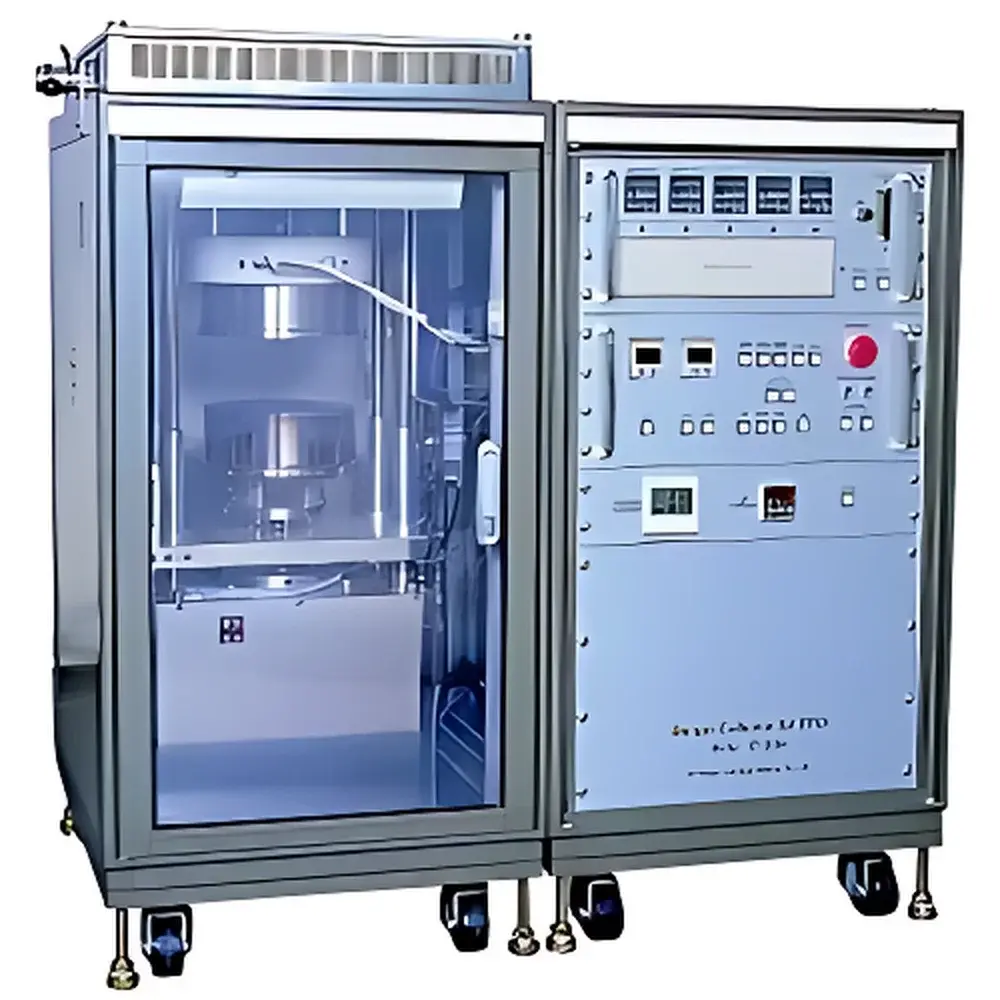
FP-9000 Flat-Panel Volatile Organic Compound (VOC) Trapping System
| Origin | Japan |
|---|---|
| Manufacturer Type | Authorized Distributor |
| Origin Category | Imported |
| Model | FP-9000 |
| Pricing | Available Upon Request |
Overview
The FP-9000 Flat-Panel Volatile Organic Compound (VOC) Trapping System is a precision-engineered thermal desorption sampling platform designed specifically for the quantitative capture and pre-concentration of trace-level volatile and semi-volatile organic compounds emitted from large-area flat-panel substrates—primarily LCD, OLED, and PDP display modules during manufacturing, aging, or failure analysis. Unlike conventional headspace samplers, the FP-9000 employs a vertically inverted quartz furnace architecture that positions the sample surface downward into a sealed, inert gas-purged trapping zone. This configuration ensures exclusive exposure of the device’s active emission surface while eliminating mechanical contact, substrate warping, or thermal stress-induced degradation. The system operates on the principle of controlled thermal desorption: the flat panel is heated uniformly under inert purge (typically high-purity nitrogen), volatilizing adsorbed or outgassed organics (e.g., plasticizers, residual solvents, monomers, and decomposition byproducts), which are then swept through a thermally stable, internally passivated transfer line and cryogenically focused onto a proprietary primary adsorption tube (PAT). Its design adheres to fundamental requirements for material emissions testing per ISO 16000-9 (indoor air—determination of VOC emissions from building products) and supports method development aligned with ASTM D6886 (standard practice for sampling and analysis of airborne organic compounds by sorbent tube/thermal desorption/GC–MS).
Key Features
- Inverted quartz furnace assembly with independent top- and bottom-plate heating control, enabling precise temperature ramping up to 500 °C (standard operating range: 350–450 °C) and uniform thermal distribution across Φ200 mm substrates.
- Hermetic sealing via dual O-rings made of polyimide (Kapton®-grade), rated for continuous use at 400 °C and certified for ultra-low leakage (<1 × 10⁻⁹ mbar·L/s helium leak rate).
- Integrated closed-loop cooling water circulation unit (rated for 15 L/min flow, ΔT ≤ 5 °C) for rapid post-run furnace quenching and thermal stability during extended sampling cycles.
- Motor-driven pressurization mechanism ensuring repeatable, non-manual clamping force (±2 kPa tolerance) and full mechanical interlock engagement before heating initiation.
- Comprehensive safety architecture including dual-channel overtemperature protection (current cutoff at 15 A, ground-fault detection at 30 mA), red mushroom-type emergency stop, hardware-based door interlock, and optional liquid leakage sensor for coolant integrity monitoring.
- Internally passivated stainless-steel transfer line with inertized inner coating (siliconized or Sulfinert® equivalent) to minimize analyte adsorption, catalytic degradation, or memory effects.
Sample Compatibility & Compliance
The FP-9000 accommodates rigid and semi-rigid flat-panel specimens up to 200 mm in diameter and 25 mm in thickness—including glass substrates, TFT backplanes, color filter arrays, and encapsulated OLED modules. It excludes flexible or curved displays requiring conformal sealing. All wetted surfaces contacting sample effluent (O-rings, quartz chamber, transfer line, PAT interface) are chemically inert and validated for compatibility with aldehydes, ketones, esters, aromatic hydrocarbons, and halogenated VOCs. The system meets mechanical and electrical safety requirements per IEC 61010-1 (Safety Requirements for Electrical Equipment for Measurement, Control, and Laboratory Use) and supports audit-ready documentation for GLP-compliant laboratories. While not FDA-cleared, its architecture aligns with extractables and leachables (E&L) study design principles outlined in USP and , particularly for electronics-grade materials qualification.
Software & Data Management
The FP-9000 operates via an embedded industrial PLC controller with local HMI touchscreen interface (no PC dependency). Temperature profiles, purge gas flow (0–500 mL/min N₂, mass-flow controlled), pressure setpoints, and safety status are logged with timestamped records stored internally (≥10,000 cycles) and exportable via USB 2.0. Audit trails include operator ID (optional RFID login), parameter changes, alarm events, and interlock activations—fully compliant with ALCOA+ data integrity principles. Raw logs meet minimum requirements for 21 CFR Part 11 readiness when paired with validated third-party LIMS integration (e.g., Thermo Fisher SampleManager, LabWare LIMS), though electronic signatures require external validation.
Applications
- Outgassing characterization of display modules during reliability stress testing (e.g., high-temperature storage, thermal cycling).
- Root-cause analysis of haze, discoloration, or electrode corrosion linked to volatile decomposition products.
- Qualification of new encapsulation resins, adhesives, or barrier films for low-VOC emission performance.
- Process validation of cleaning protocols (e.g., plasma ashing, solvent wipe) by quantifying residual contaminants.
- Comparative emissions profiling across supplier batches to enforce material specifications (e.g., IPC-CH-65B Annex B).
FAQ
Is the FP-9000 compatible with standard commercial thermal desorption tubes (e.g., Tenax TA, Carbopack™)?
No—the system uses proprietary Primary Adsorption Tubes (PATs) with optimized packing geometry and thermal mass for flat-panel effluent loading. An adapter is included to interface with industry-standard 1/4″ OD tubes, but direct use without calibration is not recommended.
What is the maximum allowable substrate weight?
The inverted furnace support stage is rated for static loads up to 5 kg; dynamic imbalance must be minimized to prevent resonance during heating cycles.
Can the system be integrated into an automated production-line environment?
Yes—RS-485 Modbus RTU and dry-contact I/O ports enable synchronization with MES systems for recipe-based run sequencing and pass/fail gate logic.
Does the cooling water unit require deionized water?
Yes—use of DI water (resistivity ≥1 MΩ·cm) is mandatory to prevent mineral deposition in the quartz furnace jacket and heat exchanger.
Are calibration certificates provided for temperature and flow sensors?
Factory calibration certificates (traceable to JCSS standards) are included; annual recalibration is recommended per ISO/IEC 17025 guidelines.



