
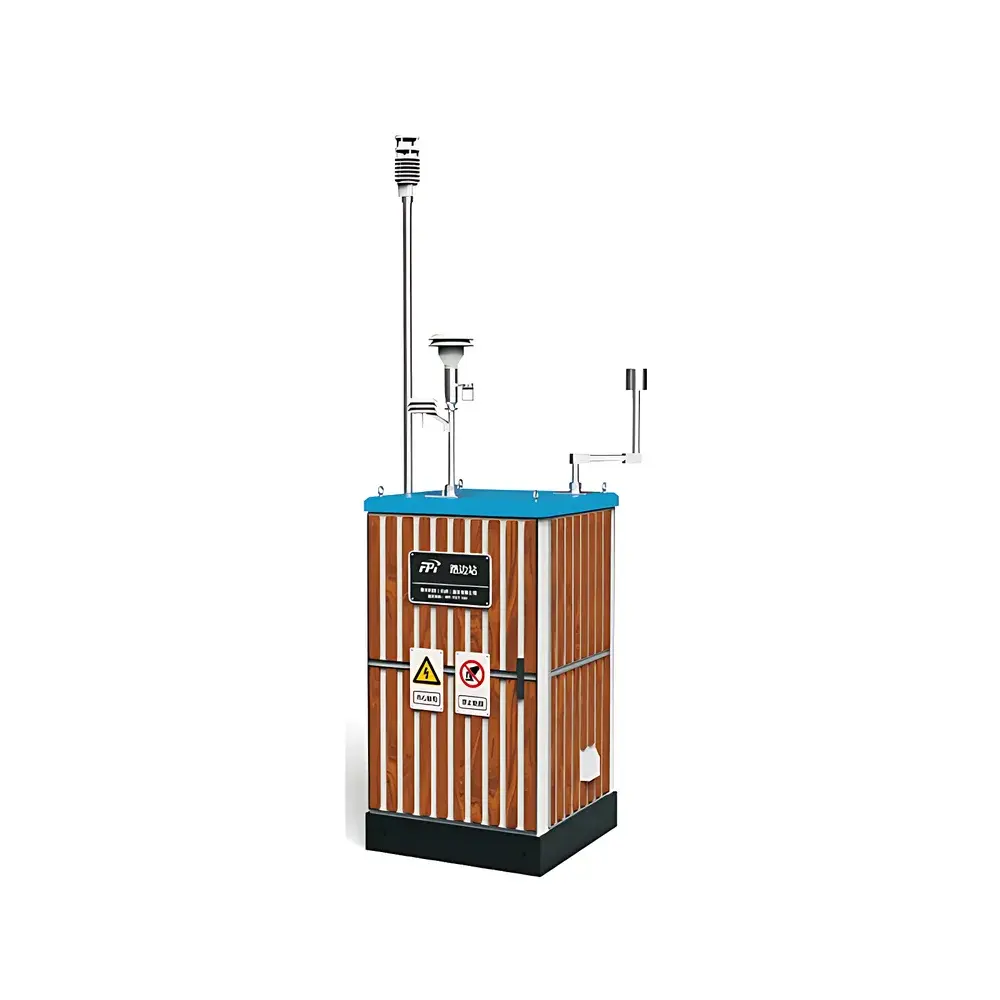
FPI AQMS-1000M Roadside Ambient Air Quality Continuous Monitoring System
| Brand | FPI |
|---|---|
| Origin | Zhejiang, China |
| Manufacturer Type | OEM/ODM Manufacturer |
| Country of Origin | China |
| Model | AQMS-1000M |
| Pricing | Upon Request |
| Pollutant Parameters | O₃ (UV Photometry), SO₂ (UV Fluorescence), NOₓ (Chemiluminescence), CO (NDIR Gas Correlation Filtering), PM₁₀ & PM₂.₅ (Beta Attenuation Method) |
| Meteorological Parameters | Wind Speed, Wind Direction, Temperature, Relative Humidity, Atmospheric Pressure |
| Enclosure Rating | IP55 |
| Operating Temperature Range | -30 °C to +50 °C |
| Communication Interfaces | RS232, Ethernet, USB |
| User Interface | Integrated Industrial Touchscreen PC (Color, High-Resolution) |
| Configuration | Modular Analytical Subsystem Architecture |
| Compliance | HJ 653–2013, HJ 654–2013, HJ 655–2013 (China), US EPA EQOA Designated Methods |
Overview
The FPI AQMS-1000M Roadside Ambient Air Quality Continuous Monitoring System is a field-deployable, modular analytical platform engineered for high-reliability, long-term unattended operation in demanding urban transportation environments. Designed specifically for roadside, highway, and tunnel applications, the system implements standardized physical measurement principles aligned with both Chinese national environmental monitoring standards (HJ 653–2013 for gaseous analyzers, HJ 654–2013 for PM instruments, and HJ 655–2013 for meteorological sensors) and U.S. Environmental Protection Agency (EPA) Equivalent Quality Assurance (EQOA) criteria. Core measurement methodologies include ultraviolet photometry for ozone (O₃), ultraviolet fluorescence for sulfur dioxide (SO₂), chemiluminescence detection for nitrogen oxides (NOₓ), non-dispersive infrared (NDIR) gas correlation filtering for carbon monoxide (CO), and beta-ray attenuation for mass concentration quantification of particulate matter (PM₂.₅ and PM₁₀). The system’s architecture supports dual configuration variants—Basic and Extended—enabling site-specific adaptation without hardware redesign.
Key Features
- Modular analytical subsystem design: Individual gas and particulate analyzers are mechanically and electrically decoupled, permitting independent calibration, maintenance, and replacement without system downtime.
- Integrated industrial-grade touchscreen PC: 10.1-inch color display with intuitive GUI for real-time parameter visualization, alarm management, diagnostic status review, and local instrument control—including zero/span adjustments and flow calibration routines.
- Ruggedized outdoor enclosure rated IP55: Provides protection against dust ingress and low-pressure water jets; internal thermal management ensures stable operation across -30 °C to +50 °C ambient conditions.
- Comprehensive I/O flexibility: Standard RS232 serial interface, 10/100BASE-T Ethernet port, and USB 2.0 host capability support integration with SCADA networks, third-party data loggers, or remote supervisory software platforms.
- Configurable pollutant coverage: Basic variant monitors NOₓ, CO, and PM₂.₅; Extended variant adds PM₁₀ and volatile organic compounds (VOCs) via optional photoionization detector (PID) or metal oxide semiconductor (MOS) sensor modules.
- Co-located five-parameter meteorological suite: Measures wind speed/direction, air temperature, relative humidity, and barometric pressure—essential for source attribution, dispersion modeling, and data normalization per ISO 19203:2017 and EPA Guidance on Meteorological Data Use in Air Quality Modeling.
Sample Compatibility & Compliance
The AQMS-1000M is validated for continuous sampling of ambient air in heterogeneous microenvironments characterized by rapid pollutant gradients, transient plume structures, and elevated particulate loading—typical of curb-side, underpass, and tunnel portals. All analytical modules comply with regulatory method equivalency requirements specified in China’s Ministry of Ecology and Environment (MEE) Technical Specifications for Ambient Air Quality Monitoring (HJ 653–2013 et seq.) and meet EPA EQOA performance criteria for reference and equivalent methods. The system supports audit-ready data logging with timestamped metadata (including instrument status flags, flow rates, and calibration event logs), facilitating compliance with GLP-aligned quality assurance protocols and enabling traceability for regulatory reporting under national air quality management frameworks.
Software & Data Management
Embedded firmware enables autonomous data acquisition at user-defined intervals (1–60 minute averaging), automatic outlier flagging, and internal storage of ≥12 months of 5-minute averaged records. Raw and processed datasets are exportable in CSV and NetCDF formats via USB or Ethernet. Optional FPI AirData Manager™ software provides centralized fleet monitoring, remote firmware updates, automated QA/QC report generation (including precision checks per ISO 5725-2), and audit trail functionality compliant with FDA 21 CFR Part 11 requirements for electronic records and signatures. All communication protocols adhere to Modbus TCP and HTTP RESTful API standards for interoperability with municipal environmental information systems (EIS) and national air quality data platforms.
Applications
The AQMS-1000M serves as a primary observational node in traffic-oriented air quality surveillance networks. Its compact footprint and robust mechanical design make it suitable for permanent installation on roadside poles, bridge abutments, tunnel walls, and urban canopy-level mounting structures. Primary deployment contexts include: (i) near-road exposure assessment for epidemiological studies (e.g., cohort health monitoring adjacent to major arterials); (ii) real-time emission inventory validation for mobile sources under evolving Euro 7/China VI regulations; (iii) dynamic ventilation control in road tunnels based on CO and NO₂ thresholds; (iv) localized air quality indexing in semi-enclosed public spaces such as shopping mall perimeters, stadium concourses, and transit hubs where conventional regional monitoring networks lack spatial resolution. The system’s modularity also supports research-grade deployments requiring co-location of VOC speciation or black carbon (BC) modules.
FAQ
What regulatory standards does the AQMS-1000M comply with?
The system conforms to HJ 653–2013 (gaseous pollutants), HJ 654–2013 (PM), and HJ 655–2013 (meteorology) issued by China’s MEE, and meets U.S. EPA EQOA equivalency requirements for reference and equivalent methods.
Can the system operate reliably in extreme temperatures?
Yes—the integrated thermal management subsystem maintains internal operating temperatures within instrument-specified ranges across ambient conditions from -30 °C to +50 °C.
Is remote diagnostics and calibration supported?
Remote firmware updates, real-time status interrogation, and zero/span initiation are fully supported via Ethernet or RS232 using FPI’s AirData Manager™ software suite.
How is data integrity ensured during transmission?
All data packets include CRC-32 checksums; time synchronization uses NTP over Ethernet; audit trails record all user-initiated actions with timestamps and operator IDs per 21 CFR Part 11 Annex 11 guidelines.
What meteorological parameters are measured, and how are they integrated?
Wind speed/direction, temperature, relative humidity, and barometric pressure are measured by a co-located, NIST-traceable sensor array and automatically synchronized with pollutant data streams for normalized reporting and dispersion modeling inputs.
Related Products







