
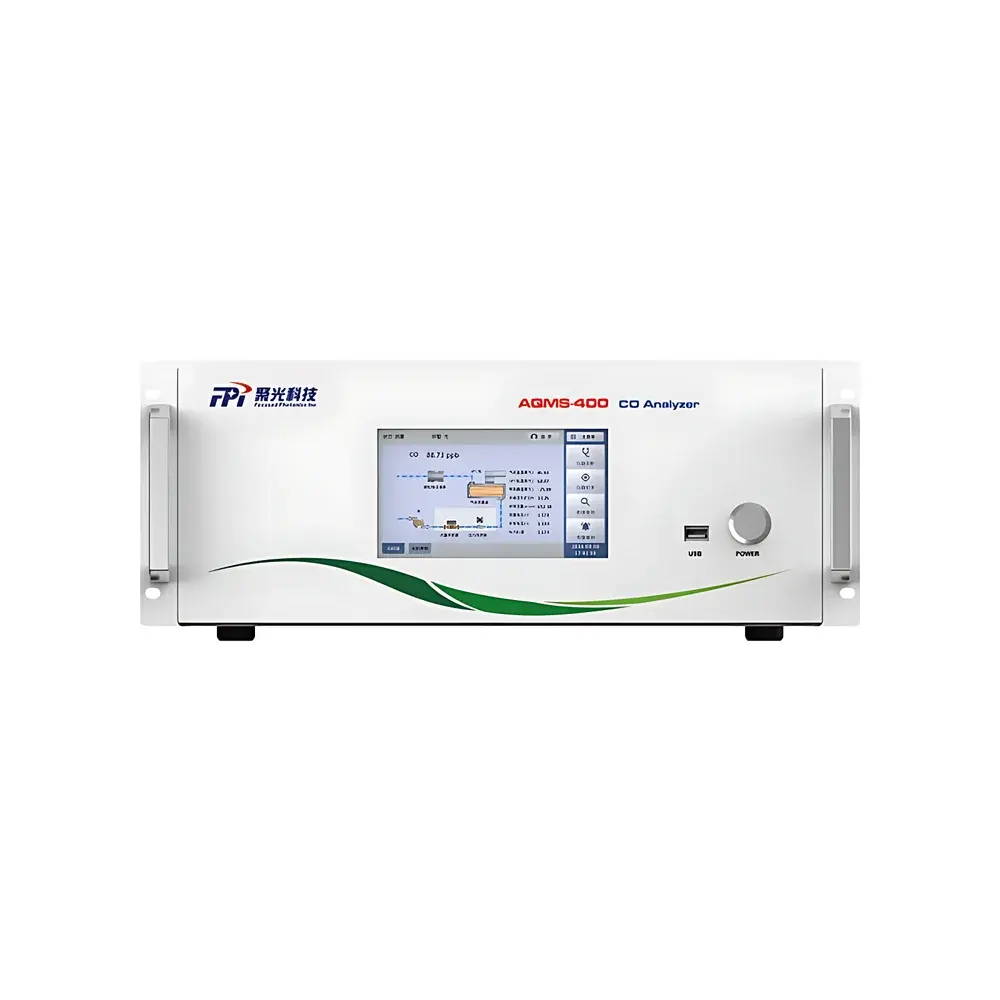
FPI AQMS-400 Carbon Monoxide Analyzer
| Brand | FPI |
|---|---|
| Origin | Zhejiang, China |
| Manufacturer Type | Original Equipment Manufacturer (OEM) |
| Instrument Type | Online Fixed-Station Analyzer |
| Detection Target | Single-Gas (CO) |
| Measurement Principle | Gas Filter Correlation Non-Dispersive Infrared (GFC-NDIR) |
| Compliance Context | Designed for ambient air quality monitoring networks compliant with Chinese HJ 659–2013 and compatible with international reference methods per ISO 12039 and EPA Method 10 |
Overview
The FPI AQMS-400 Carbon Monoxide Analyzer is a stationary, continuous-emission monitoring (CEM)-grade instrument engineered for precise, long-term quantification of carbon monoxide (CO) in ambient air at parts-per-trillion (ppt) to parts-per-million (ppm) concentration levels. It operates on the Gas Filter Correlation Non-Dispersive Infrared (GFC-NDIR) principle—a highly selective optical technique that eliminates spectral interference from co-existing gases such as CO₂, CH₄, and water vapor. Unlike conventional broadband NDIR systems, GFC-NDIR employs a dual-beam correlation architecture: one infrared beam passes through a high-concentration CO reference cell, while the other traverses a pure nitrogen (N₂) filter cell. The modulated signal difference between these paths—detected via a pyroelectric or thermopile sensor—is directly proportional to the CO concentration in the sample stream, following the Beer–Lambert law. This configuration delivers inherent immunity to optical contamination, source drift, and detector aging, making the AQMS-400 suitable for unattended operation in national ambient air quality monitoring stations (AAQMS), urban traffic sites, and industrial fence-line applications.
Key Features
- GFC-NDIR optical architecture with dual-path correlation detection for high specificity to CO without cross-sensitivity to humidity or hydrocarbons
- Integrated self-diagnostic functions including real-time source intensity monitoring, automatic alarm generation upon threshold violation, and predictive maintenance alerts for IR source replacement
- Embedded microprocessor-controlled pneumatic system ensuring stable sample flow (±1% regulation), pressure-compensated measurement, and temperature-stabilized optical path (±0.1 °C)
- Full remote operability via secure Ethernet interface supporting role-based access control (RBAC), encrypted firmware updates, and scheduled zero/span calibration routines
- High-resolution color TFT display with intuitive Chinese-language GUI, configurable soft keys for rapid access to diagnostics, calibration logs, and status history
- Comprehensive internal data logging: all calibration events, fault codes, environmental parameters (flow, pressure, temperature), and raw analog outputs are timestamped and stored with audit-trail integrity
Sample Compatibility & Compliance
The AQMS-400 is validated for use with ambient air samples containing particulate matter (PM₁₀), ozone (O₃), nitrogen oxides (NOₓ), sulfur dioxide (SO₂), and volatile organic compounds (VOCs) at typical urban and suburban concentrations. Sample inlet includes a heated particulate filter (10 µm cut-off) and optional Nafion™ dryer for dew-point suppression. The analyzer meets the performance specifications outlined in China’s HJ 659–2013 “Technical Specification for Ambient Air Quality Monitoring Instruments – Carbon Monoxide Analyzer” and aligns with the functional requirements of ISO 12039:2000 “Air Quality – Determination of Carbon Monoxide – Non-Dispersive Infrared Method”. While not certified to U.S. EPA Reference Method 10, its GFC-NDIR design satisfies the selectivity and stability criteria required for equivalency assessment under 40 CFR Part 53. Data output formats comply with MODBUS RTU/TCP and ASCII serial protocols for seamless integration into SCADA and national environmental information platforms.
Software & Data Management
Firmware v3.2+ supports GLP-compliant data handling with immutable event logging, electronic signature capability for calibration actions, and time-stamped metadata for every measurement cycle. All stored records—including zero/span coefficients, diagnostic flags, and environmental telemetry—are exportable via USB or FTP in CSV/JSON format. Remote software upgrades preserve user-configured parameters and historical datasets. Audit trails meet traceability requirements for regulatory reporting under China’s Ministry of Ecology and Environment (MEE) data governance guidelines and support retrospective validation for QA/QC audits. Optional cloud synchronization enables centralized fleet monitoring across provincial monitoring networks.
Applications
- Fixed-site ambient air quality monitoring networks (e.g., national AAQMS, provincial EEMS)
- Urban roadside and tunnel air quality surveillance
- Industrial boundary and fenceline emission verification
- Indoor air quality (IAQ) assessment in parking garages, underground facilities, and transit hubs
- Calibration reference for portable CO analyzers in field validation programs
- Research-grade CO profiling in atmospheric chemistry studies requiring long-term baseline stability
FAQ
What is the recommended calibration frequency for routine ambient monitoring?
For compliance with HJ 659–2013, zero and span calibration must be performed at least once every 7 days; automated daily checks are supported via internal reference gas injection.
Does the AQMS-400 require external gas cylinders for zero/span calibration?
Yes—zero gas (ultra-high-purity N₂ or synthetic air) and span gas (CO in N₂, traceable to NIM standards) are required; optional integrated permeation tube modules are available for unattended span generation.
Can the instrument operate under sub-zero ambient temperatures?
The standard unit is rated for 0–40 °C operating range; low-temperature variants with heated enclosure and thermal management are available upon request.
Is the data output compliant with FDA 21 CFR Part 11 or EU Annex 11?
While designed for environmental—not pharmaceutical—applications, the audit trail, electronic signature, and data immutability features align with core ALCOA+ principles; full Part 11 compliance requires site-specific validation protocol execution.
How is optical path contamination mitigated during extended deployment?
The GFC-NDIR design inherently rejects broad-band absorption artifacts; additionally, the optical chamber is sealed and purged with dry N₂ during idle cycles to minimize condensation and particulate deposition.
Related Products







