
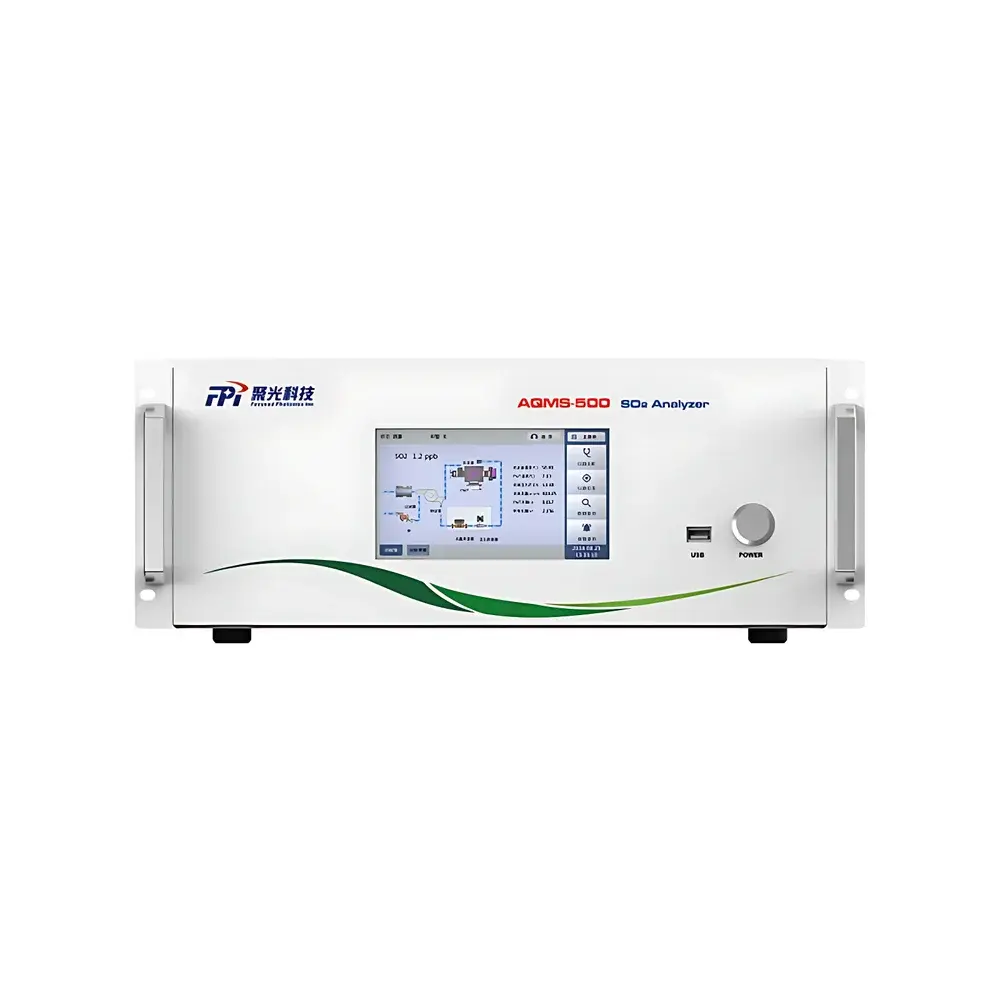
FPI AQMS-500 UV Fluorescence Sulfur Dioxide (SO₂) Analyzer
| Brand | FPI |
|---|---|
| Origin | Zhejiang, China |
| Manufacturer Type | Original Equipment Manufacturer (OEM) |
| Country of Origin | China |
| Model | AQMS-500 |
| Configuration | Continuous Emission Monitoring System (CEMS)-Grade Online Analyzer |
| Regulatory Classification | Ambient Air Quality Monitoring Instrument |
| Compliance Framework | Designed for integration into national and municipal air quality monitoring networks compliant with HJ 654–2013, EPA Method 40 CFR Part 53, and ISO 7935:1995 (Air Quality — Determination of Sulfur Dioxide — Ultraviolet Fluorescence Method) |
Overview
The FPI AQMS-500 UV Fluorescence Sulfur Dioxide (SO₂) Analyzer is a continuous, real-time ambient air quality monitoring instrument engineered for precise quantification of sulfur dioxide across trace-level concentration ranges—from sub-parts-per-trillion (ppt) background levels to parts-per-million (ppm) industrial emission thresholds. It operates on the well-established ultraviolet fluorescence (UVF) principle: SO₂ molecules absorb UV light at 214 nm, transition to an excited electronic state, and upon relaxation emit characteristic fluorescence photons centered near 320 nm. This photon signal is collected via a low-noise photomultiplier tube (PMT) under controlled temperature and pressure conditions, enabling high-sensitivity detection with inherent selectivity against common interferents such as NO₂, O₃, and hydrocarbons. The AQMS-500 is designed as a core module within fixed-site air quality monitoring stations (AQMS), supporting regulatory compliance reporting for national environmental protection agencies, municipal ecological monitoring centers, and industrial fence-line monitoring programs.
Key Features
- UV fluorescence detection architecture optimized for long-term stability and minimal drift—engineered for unattended operation over 30-day calibration intervals.
- Integrated optical self-diagnostic system continuously monitors UV lamp intensity; automatic alerting triggers maintenance workflows before photometric degradation impacts data validity.
- Multi-tiered access control with role-based authentication (administrator, operator, viewer) enables secure remote supervision via Ethernet or 4G LTE interface—supporting emergency shutdown, zero/span calibration initiation, and firmware updates without on-site intervention.
- Industrial-grade embedded controller with dual-core ARM processor ensures deterministic real-time data acquisition, timestamping, and internal event logging at 1-second resolution.
- Graphical color LCD display with localized Chinese UI supports intuitive navigation, context-sensitive status indicators, and one-touch access to calibration history, alarm logs, and sensor diagnostics.
- Onboard non-volatile memory retains ≥12 months of raw measurement data, calibration records, fault codes, and environmental metadata (sample flow rate, chamber temperature, barometric pressure) with configurable retention policies.
Sample Compatibility & Compliance
The AQMS-500 is validated for use with ambient air, stack gas (with optional heated sampling line and particulate filter), and indoor air samples meeting ISO 12039:2002 conditioning requirements. Sample inlet accepts standard 1/4″ OD PTFE or stainless-steel tubing; integrated mass flow controller maintains constant 0.8–1.2 L/min sampling rate across ±10% pressure fluctuations. The analyzer complies with China’s HJ 654–2013 technical specification for SO₂ analyzers used in ambient air monitoring networks and aligns with U.S. EPA Performance Specification 2 (PS-2) for equivalent method equivalency assessment. Data integrity safeguards include audit-trail-enabled software logging per GLP/GMP principles and optional 21 CFR Part 11-compliant electronic signature modules for regulated environments.
Software & Data Management
FPI’s AQMS-Link™ software suite provides centralized configuration, diagnostics, and data aggregation across distributed monitoring nodes. Raw fluorescence counts, concentration values (µg/m³ and ppb), diagnostic flags, and environmental parameters are output via Modbus TCP, RS-485, or analog 4–20 mA signals. All data packets include NTP-synchronized timestamps and CRC-32 error checking. Cloud-ready deployment supports MQTT publishing to AWS IoT Core or Azure IoT Hub with TLS 1.2 encryption. Internal database supports SQL queries for trend analysis, limit violation reporting, and automated QA/QC summary generation—including MDL verification, precision checks, and span recovery validation per ISO/IEC 17025:2017 Annex A.3.
Applications
- Ambient air quality monitoring networks operated by provincial and municipal environmental bureaus.
- Urban background, traffic, and industrial zone monitoring stations requiring multi-pollutant co-location (SO₂, NOₓ, CO, O₃, PM₁₀).
- Fence-line and community air monitoring programs for petrochemical, coal-fired power, and metallurgical facilities.
- Research-grade field studies evaluating SO₂ dispersion modeling, atmospheric chemistry kinetics, and long-range transport phenomena.
- Calibration verification and reference instrument support in metrology laboratories accredited to CNAS-CL01:2018.
FAQ
What detection principle does the AQMS-500 employ?
It uses ultraviolet fluorescence (UVF), where SO₂ absorbs 214 nm UV light and emits measurable fluorescence near 320 nm.
Is the instrument certified for regulatory reporting in China?
Yes—it meets HJ 654–2013 requirements and is type-approved for inclusion in national ambient air monitoring networks.
Can the AQMS-500 operate unattended for extended periods?
Yes—its auto-zero/span functionality, lamp health monitoring, and onboard data storage support >30 days of autonomous operation with scheduled remote verification.
Does it support integration with existing SCADA or EMS platforms?
Yes—via Modbus TCP, RS-485 RTU, or 4–20 mA analog outputs; protocol documentation and register maps are provided with delivery.
What maintenance intervals are recommended for routine operation?
UV lamp replacement every 12–18 months; annual full system verification including flow calibration, optical alignment check, and electronic gain adjustment.
Related Products







