
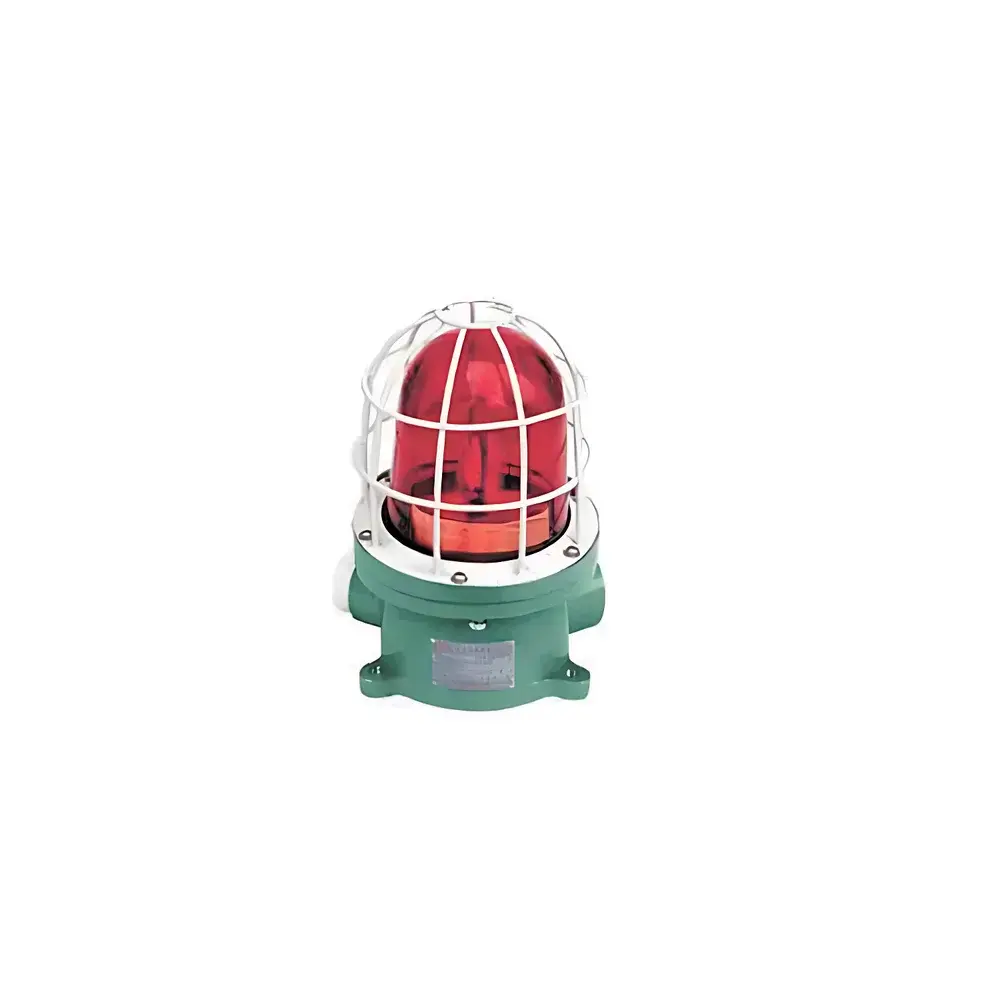
FPI BBJ Acoustic-Optic Gas Alarm
| Brand | FPI |
|---|---|
| Origin | Zhejiang, China |
| Manufacturer Type | OEM/ODM Manufacturer |
| Country of Origin | China |
| Model | BBJ |
| Pricing | Available Upon Request |
| Enclosure Material | Die-Cast Aluminum Alloy |
| Lens Material | Tempered Glass (Red/Yellow/Blue Options) |
| IP Rating | IP65 |
| Hazardous Area Certification | ATEX/IECEx Zone 1 & 2, Class I Div 1 & 2, Class II Div 1 & 2, Class III Div 1 & 2 |
| Temperature Class | T1–T6 |
| Gas Group | IIA, IIB, IIC |
| Dust Hazard Compliance | EN 60079-31 (IEC 60079-31), ATEX 2014/34/EU Annex VIII Category 2D/3D |
Overview
The FPI BBJ Acoustic-Optic Gas Alarm is a certified hazardous-area signaling device engineered for reliable visual and audible warning in environments where flammable gases, vapors, or combustible dusts may be present. Designed in strict accordance with international explosion protection standards—including IEC 60079 series, ATEX 2014/34/EU, and NEC Article 500—the BBJ integrates dual-mode alerting (stroboscopic light and high-intensity audible tone) to ensure rapid operator recognition under diverse ambient conditions, including high-noise industrial zones and low-visibility outdoor settings. Its measurement principle is not sensor-based but rather signal-actuated: the unit receives dry-contact or 4–20 mA alarm signals from external gas detection systems (e.g., catalytic bead, infrared, or electrochemical transmitters) and converts them into standardized human-perceptible warnings. This architecture decouples signaling functionality from sensing, enabling flexible system integration while maintaining intrinsic safety compliance at the field-device level.
Key Features
- Robust die-cast aluminum alloy housing providing mechanical strength, corrosion resistance, and thermal stability across –20 °C to +60 °C operating temperatures.
- Tempered glass lens available in red, yellow, or blue—optically optimized for high luminous intensity (>100 cd peak intensity) and wide viewing angle (≥120° horizontal/vertical).
- High-output acoustic module delivering ≥105 dB(A) sound pressure level at 1 m distance, compliant with ISO 8519 and IEC 60079-29-1 requirements for audible alarm effectiveness.
- IP65-rated ingress protection ensures full dust-tightness and resistance to low-pressure water jets from any direction—validated per IEC 60529.
- Stainless steel fasteners throughout eliminate galvanic corrosion risk in marine, offshore, and chemical processing environments.
- Designed for direct mounting on standard 3/4″ NPT or M20 × 1.5 threaded conduits; supports DIN rail (TS35) and surface-mount configurations.
Sample Compatibility & Compliance
The BBJ is compatible with all industry-standard gas detection control systems that provide relay closure outputs or 4–20 mA current-loop alarm signals. It does not incorporate internal gas sensors and therefore requires integration with certified gas analyzers meeting applicable performance standards (e.g., EN 45544-1 for toxic gases, EN 60079-29-1 for combustible gases). The device carries full certification for use in Zone 1 and Zone 2 (IEC/EN 60079-0, -10, -11, -14, -29-1) and Class I, II, III Division 1 & 2 locations (UL 1203, UL 60079-0, -11, -29-1). It meets temperature class T1–T6 (maximum surface temperature ≤ 85 °C for T6) and gas group IIA/IIB/IIC, including hydrogen and acetylene applications. For combustible dust environments, it complies with EN 60079-31 (Zone 21/22) and carries ATEX Category 2D and 3D markings.
Software & Data Management
As a passive signaling device, the BBJ does not include embedded firmware, network interfaces, or data logging capabilities. It operates without software dependencies and requires no configuration or calibration. Integration into centralized safety systems (e.g., DCS, SIS, or SCADA platforms) is achieved via hardwired alarm inputs. Audit trails and event logging are maintained externally by the upstream gas detection controller or safety instrumented system—ensuring full traceability in accordance with IEC 61511 and FDA 21 CFR Part 11 when deployed in regulated pharmaceutical or food-processing facilities. No cybersecurity controls apply, as the device contains no processors, memory, or communication ports.
Applications
The BBJ is routinely deployed in high-consequence industrial settings where immediate hazard notification is critical to personnel safety and process integrity. Typical applications include perimeter monitoring around LNG terminals and refinery flare stacks; area surveillance in offshore platform accommodation modules and engine rooms; vapor detection zones in petrochemical storage tank farms; confined-space entry points in wastewater treatment plants; and combustible dust monitoring in grain elevators, sugar mills, and metal powder handling facilities. Its dual-certification for both gas and dust hazards enables single-device deployment across hybrid-risk environments—reducing inventory complexity and lifecycle maintenance burden.
FAQ
Is the BBJ certified for use in hydrogen (Group IIC) environments?
Yes. The BBJ carries IECEx and ATEX certification for Group IIC, including hydrogen and acetylene, with T6 temperature classification.
Can the optical color be customized beyond red/yellow/blue?
No. Only red, yellow, and blue tempered glass lenses are factory-certified and listed on the official Ex certificate.
Does the BBJ require intrinsic safety barriers when connected to a 4–20 mA loop?
No. The BBJ’s input circuitry is non-energy-storing and classified as “simple apparatus” per IEC 60079-11; it may be connected directly to intrinsically safe loops without additional barriers.
What is the expected service life under continuous operation?
Based on accelerated life testing and field data, the LED light source maintains ≥70% lumen output after 50,000 hours; the acoustic transducer exhibits no measurable degradation after 20,000 hours of intermittent duty.
Is third-party SIL verification available for system-level safety integrity assessments?
While the BBJ itself is not SIL-rated (as it performs no safety function per IEC 61508), its failure modes and diagnostic coverage are documented in the manufacturer’s FMEDA report, supporting PFDavg calculations when integrated into SIL 2 or SIL 3 architectures.
Related Products







