
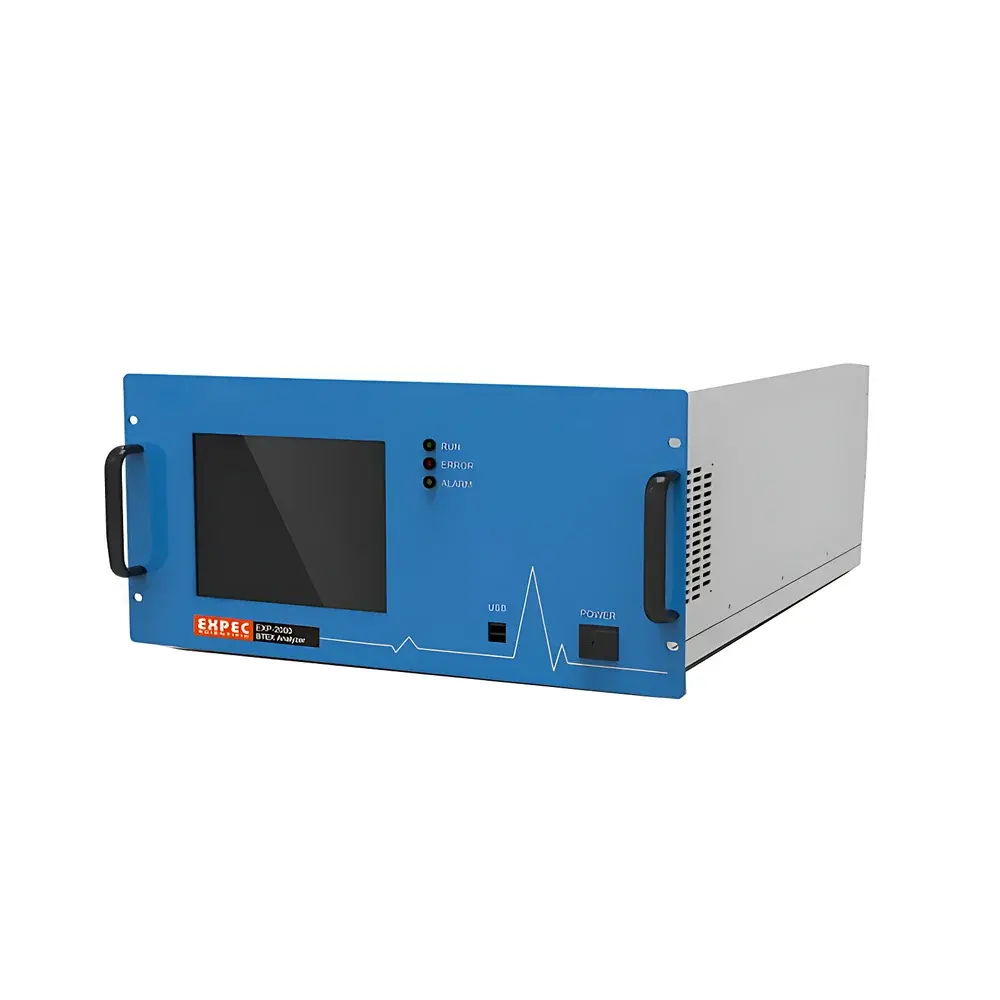
FPI Benzene Series Analyzer (Model: FPI-BTEX)
| Brand | FPI |
|---|---|
| Origin | Zhejiang, China |
| Manufacturer Type | OEM Manufacturer |
| Product Type | Online Multicomponent Gas Analyzer |
| Detection Principle | Low-Temperature Preconcentration + Thermal Desorption + Capillary GC Separation + PID Detection |
| Response Rate | >40 °C/s (Heating Ramp Rate) |
| Sampling Method | Mass-Flow-Controlled (MFC) |
| Detector | High-Sensitivity Photoionization Detector (PID) |
| Column Technology | Capillary GC with Valve-Switched Backflush |
| Carrier Gas Control | Electronic Pressure Control (EPC) |
| Compliance | Designed for Continuous Emission Monitoring (CEM) and Ambient Air Quality Monitoring per EPA TO-15 / ISO 16017-1 |
| Sample Handling | Integrated Preconcentration Trap with Direct Resistive Heating |
Overview
The FPI Benzene Series Analyzer (Model: FPI-BTEX) is an online multicomponent gas analyzer engineered for continuous, real-time quantification of benzene, toluene, ethylbenzene, xylenes (BTEX), and other C6–C10 aromatic hydrocarbons in ambient air, workplace environments, and industrial emission streams. It operates on a validated analytical sequence combining cryogenic adsorption preconcentration, rapid resistive thermal desorption, high-resolution capillary gas chromatography (GC), and selective detection via a photoionization detector (PID). This architecture conforms to the fundamental measurement paradigm outlined in U.S. EPA Method TO-15 and ISO 16017-1 for volatile organic compound (VOC) analysis—ensuring trace-level sensitivity, chromatographic fidelity, and regulatory defensibility in unattended operation.
Key Features
- Cryogenic Preconcentration & Rapid Thermal Desorption: Ambient air is drawn through a sorbent trap maintained at −10 °C to −20 °C, enabling quantitative capture of trace BTEX compounds. A direct-resistive heating element achieves a heating ramp rate exceeding 40 °C/s, ensuring sharp, narrow analyte bands upon release—minimizing peak broadening and preserving chromatographic resolution.
- Mass-Flow-Controlled Sampling (MFC): Integrated thermal-mass flow controllers deliver precise, pressure- and temperature-compensated sample introduction. This eliminates volumetric drift caused by ambient fluctuations—critical for maintaining measurement integrity across seasonal or diurnal environmental changes.
- Capillary GC with Valve-Switched Backflush: A fused-silica capillary column provides high separation efficiency for structurally similar aromatics. An automated six-port valve enables backflushing of heavy-end interferences (e.g., naphthalene, biphenyls) prior to detector entry—extending column lifetime and reducing maintenance frequency.
- High-Sensitivity PID Detection: The 10.6 eV lamp-based PID delivers superior response factors for unsaturated and aromatic hydrocarbons versus conventional flame ionization detectors (FID), particularly enhancing signal-to-noise ratios for low-concentration benzene (detection limit < 0.1 ppbv, typical).
- Electronic Pressure Control (EPC): Fully digital carrier gas regulation ensures stable retention times, reproducible peak shapes, and long-term method robustness—meeting requirements for GLP-compliant data acquisition and routine QA/QC verification.
Sample Compatibility & Compliance
The FPI-BTEX analyzer accepts gaseous samples from ambient air (0–40 °C, RH ≤ 90% non-condensing), stack emissions (diluted or conditioned), and indoor monitoring ducts. It supports automated calibration via certified permeation tubes or dynamic dilution systems traceable to NIST standards. Instrument design aligns with key regulatory frameworks including EPA Compendium Method TO-15 for ambient VOCs, ISO 16017-1 for indoor air, and EU Directive 2008/50/EC for benzene in ambient air. Data logging meets audit-trail requirements for ISO/IEC 17025 laboratories and supports optional 21 CFR Part 11-compliant software modules for pharmaceutical or industrial hygiene applications.
Software & Data Management
The embedded Linux-based control system runs FPI’s proprietary ChromaView™ acquisition and processing suite. It provides real-time chromatogram visualization, automatic peak integration using retention time locking (RTL), and configurable reporting templates (PDF/CSV). Raw data files are stored with full metadata—including MFC setpoints, trap temperatures, oven ramp profiles, and EPC pressure logs—to support retrospective method validation. Remote diagnostics, firmware updates, and alarm-triggered event logging are accessible via secure HTTPS or Modbus TCP interfaces. Optional cloud synchronization enables centralized fleet monitoring for multi-site environmental compliance programs.
Applications
- Ambient air quality monitoring networks (urban, roadside, background stations)
- Industrial fence-line monitoring for petrochemical, refinery, and solvent-use facilities
- Workplace exposure assessment in painting, printing, and adhesive application settings
- Indoor air quality audits in schools, offices, and residential buildings post-renovation
- Continuous emission monitoring (CEM) of VOC abatement system performance (e.g., thermal oxidizers, carbon beds)
- Research-grade source apportionment studies requiring speciated BTEX time-series data
FAQ
What is the typical detection limit for benzene under standard operating conditions?
Benzene detection limits range from 0.05 to 0.15 ppbv (S/N = 3), depending on sampling duration (15–60 min), trap capacity, and background interference levels.
Does the system require external calibration gases or can it use internal standards?
Both approaches are supported: certified gas cylinders (e.g., EPA Protocol Gases) for initial calibration, and optional deuterated internal standards (e.g., benzene-d6) for ongoing retention time correction and response normalization.
How often does the preconcentration trap require replacement or regeneration?
Under typical ambient monitoring conditions (20 °C, 50% RH), traps last ≥ 6 months; in high-humidity or high-particulate environments, replacement is recommended every 3–4 months or after 500 cycles.
Is the analyzer compatible with existing SCADA or EMS platforms?
Yes—Modbus TCP, OPC UA, and analog 4–20 mA output options enable seamless integration into facility-wide environmental management systems.
Can the method be modified to include additional VOCs beyond BTEX?
The GC-PID platform supports method reconfiguration for up to 30+ target VOCs (e.g., styrene, chlorobenzenes, aldehydes) via updated retention time tables and calibration curves—without hardware modification.
Related Products







