
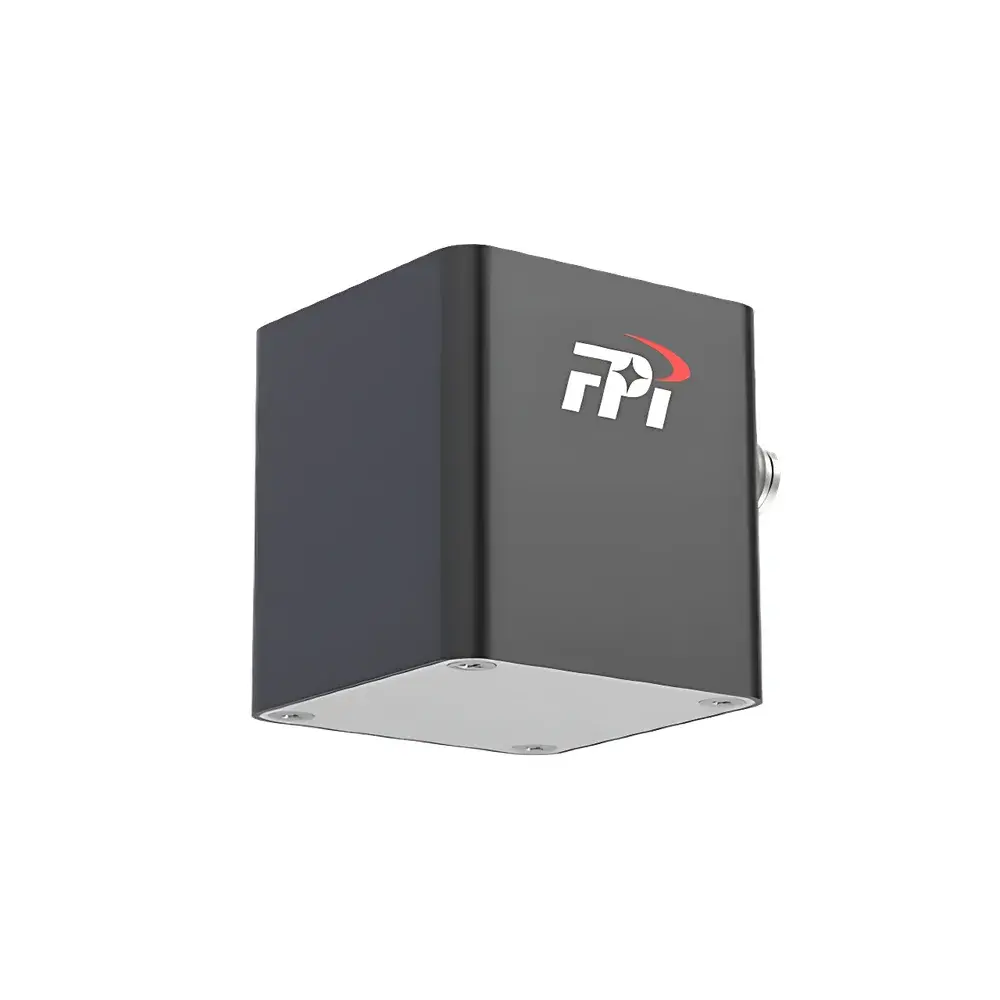
FPI BWATER-3100 60 GHz Non-Contact Radar Level Sensor for Pipe and Open-Channel Water Level Monitoring
| Brand | FPI |
|---|---|
| Origin | Zhejiang, China |
| Manufacturer Type | OEM/ODM Manufacturer |
| Country of Origin | China |
| Model | BWATER-3100 |
| Output Interface | RS485 Modbus RTU / 4–20 mA analog |
| Measurement Principle | Time-of-Flight (ToF) at 60 GHz |
| Blind Zone | ≤10 mm |
| Resolution | 1 mm |
| IP Rating | IP68 |
| Average Power Consumption | 0.3 W |
| Operating Frequency | 60 GHz |
| Installation | Top-mounted, non-contact |
| Signal Processing | Adaptive surface fluctuation filtering |
| Dimensions | Ø50 mm × H95 mm |
Overview
The FPI BWATER-3100 is a high-frequency, non-contact radar level sensor engineered for continuous, real-time water level monitoring in confined and semi-confined hydraulic environments—including stormwater and wastewater collection pipes, combined sewer overflows (CSOs), and river discharge outfalls. Operating at 60 GHz, the sensor utilizes time-of-flight (ToF) measurement principles: it emits short-duration electromagnetic pulses toward the water surface and precisely calculates the round-trip propagation delay to determine distance. This physics-based approach eliminates mechanical wear, avoids submersion-related drift or fouling, and ensures long-term stability under variable flow conditions. Unlike ultrasonic sensors, the 60 GHz millimeter-wave signal exhibits minimal atmospheric attenuation, negligible sensitivity to temperature gradients, vapor, dust, or ambient noise—making it especially suitable for humid, corrosive, or enclosed underground infrastructure where traditional contact methods fail.
Key Features
- Sub-10 mm blind zone: Enables accurate installation in shallow-depth chambers or low-clearance manholes without compromising near-surface resolution.
- IP68-rated housing: Fully submersible enclosure with reinforced sealing; certified for continuous operation under temporary water immersion up to 3 m depth, supporting deployment in flood-prone or high-humidity locations.
- 1 mm resolution at 60 GHz: High-frequency carrier enables fine spatial discrimination and robust signal-to-noise ratio—even on turbulent or aerated surfaces—without requiring stilling wells or external dampening structures.
- Adaptive dynamic filtering: Embedded firmware applies real-time surface fluctuation compensation using multi-point statistical analysis of echo amplitude and time variance, suppressing wave-induced noise while preserving true level trends.
- Ultra-low power architecture: Average power draw of 0.3 W enables multi-year operation on lithium-thionyl chloride batteries or small-area solar panels (e.g., 5 W PV + 12 Ah LiFePO₄), eliminating grid dependency in remote or off-grid sites.
- Compact top-mount design: Cylindrical form factor (Ø50 mm × 95 mm) allows direct mounting onto existing pipe access hatches or custom flanges using standard M30×1.5 threads—no structural modification required.
Sample Compatibility & Compliance
The BWATER-3100 is designed for use in municipal and industrial water conveyance systems containing fresh, brackish, or mildly contaminated water. It is insensitive to suspended solids, oil films, foam, or biofilm accumulation on the water surface—common challenges in CSO and wastewater networks. The device complies with IEC 61326-1 (EMC for industrial environments), IEC 60529 (IP68 ingress protection), and RoHS 2015/863/EU. Its analog and digital outputs support integration into SCADA platforms compliant with IEC 62443-3-3 for secure industrial communications. While not intrinsically safe certified, it meets EN 60079-0 general requirements for non-explosive atmospheres typical in aboveground or ventilated underground infrastructure.
Software & Data Management
The sensor supports dual-output configuration via factory-configurable DIP switches or PC-based commissioning software (Windows/Linux). RS485 communication uses Modbus RTU protocol (slave ID, baud rate, parity configurable), enabling seamless integration with PLCs, RTUs, or edge gateways. The 4–20 mA loop output is HART-enabled for diagnostic telemetry (e.g., signal strength, internal temperature, echo quality index). All configuration parameters and operational logs are timestamped and stored locally with battery-backed memory. When deployed in networked configurations, data can be routed through MQTT or HTTP(S) APIs to cloud-based dashboards aligned with ISO 55000 asset management frameworks or EPA-approved CMMS platforms. Audit trails meet GLP-aligned logging standards, including write-protected event timestamps and user-access metadata—supporting regulatory review under US EPA NPDES or EU WFD reporting obligations.
Applications
- Real-time level monitoring in gravity-fed stormwater and sanitary sewer pipelines to detect surcharge events and optimize pump station scheduling.
- Continuous level profiling at combined sewer overflow (CSO) structures to trigger early-warning alerts and support wet-weather control strategies per EPA CSO Control Policy.
- Discharge monitoring at permitted municipal or industrial outfalls to verify compliance with effluent volume limits and support Total Maximum Daily Load (TMDL) reporting.
- Level trending in retention/detention basins and green infrastructure assets (e.g., bioswales, infiltration trenches) for performance validation and adaptive stormwater management.
- Integration into smart city IoT networks where low-power, long-range LoRaWAN or NB-IoT gateways collect and forward level data to centralized urban drainage models.
FAQ
Is the BWATER-3100 suitable for pressurized pipe applications?
No—it is designed exclusively for open-channel or gravity-flow scenarios where the water surface is exposed to atmospheric pressure. For pressurized force mains, differential pressure or guided-wave radar solutions are recommended.
Does the sensor require periodic calibration or zero adjustment?
No field recalibration is needed. Factory-trimmed timebase and antenna gain ensure metrological consistency over the rated operating life (≥5 years). A one-time reference offset may be applied during commissioning to align with local datum.
Can it operate reliably in freezing conditions or ice-covered channels?
Yes—the 60 GHz beam penetrates thin ice layers (<5 mm) and maintains stable echo detection. However, full ice cover that obscures the water surface will result in invalid readings; supplemental thermal de-icing or mechanical breakers may be required in persistent sub-zero environments.
What is the maximum measurable range?
Standard configuration supports up to 3 m; extended-range variants (BWATER-3100-LR) offer 6 m capability with modified firmware and antenna tuning—consult technical documentation for model-specific specifications.
How is firmware updated in the field?
Via USB-C interface using FPI’s certified configuration utility; updates preserve all user settings and comply with IEC 62443-2-4 secure update protocols, including cryptographic signature verification and rollback protection.







