
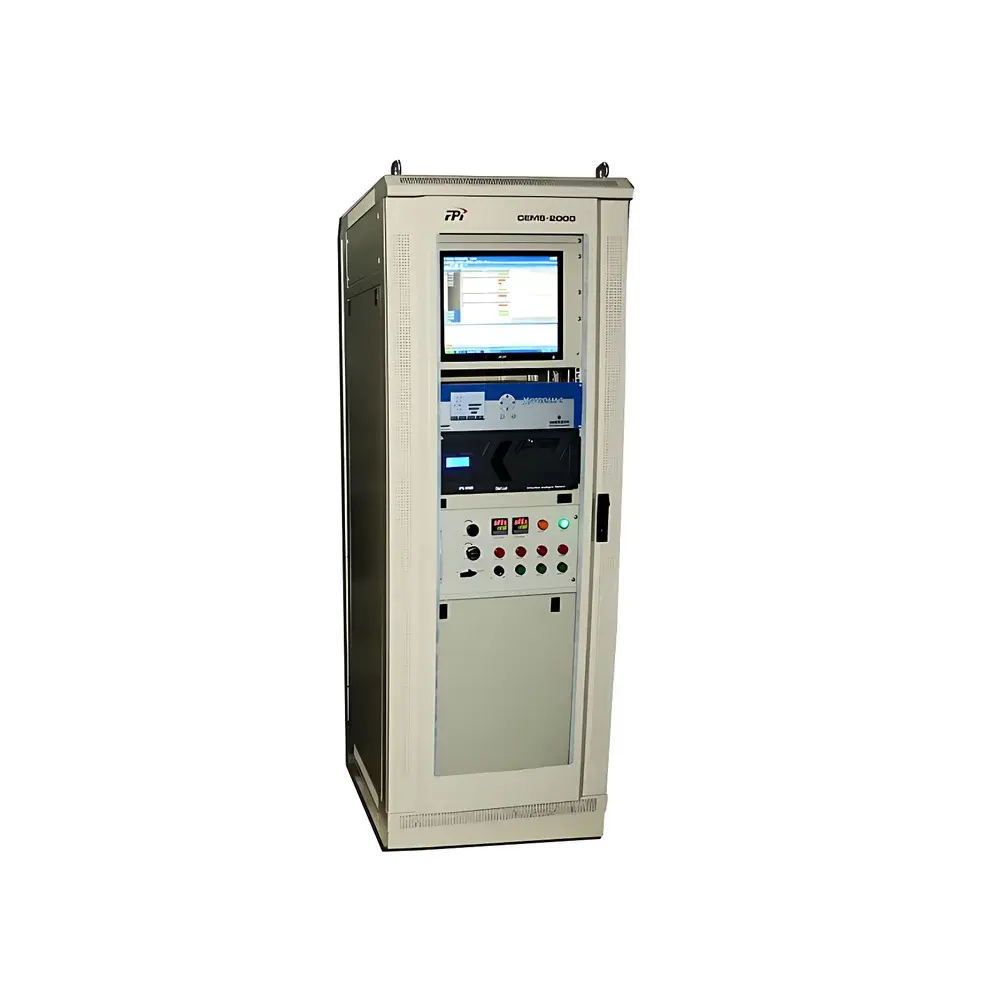
FPI CEMS-2000 B Continuous Emission Monitoring System (CEMS)
| Brand | FPI |
|---|---|
| Origin | Zhejiang, China |
| Manufacturer Type | Original Equipment Manufacturer (OEM) |
| Product Category | Domestic |
| Model | CEMS-2000 B |
| Instrument Type | Flue Gas Continuous Emission Monitoring System |
| Response Time | 4 s |
| Measured Parameters | SO₂, NO, O₂, Relative Humidity, Flue Gas Temperature, Static Pressure, Flow Velocity, Particulate Matter (PM) |
| Detection Principle | NDIR (SO₂, CO), UV Absorption (NO), Electrochemical Cell (O₂), Capacitive/Hygrometric (Humidity), PT100/Thermocouple (Temperature), Piezoresistive (Pressure), Pitot Tube or Ultrasonic (Flow Velocity), Light Scattering / Beta Attenuation (PM) |
| Communication Interface | RS485, 4–20 mA, Ethernet, Modbus TCP/RTU, OPC UA |
| Compliance | GB/T 16157, HJ 75–2017, HJ 76–2017, ISO 12039, EN 15267, EN 14181 |
Overview
The FPI CEMS-2000 B Continuous Emission Monitoring System is an industrial-grade, rack-mounted flue gas analysis platform engineered for regulatory compliance and long-term operational reliability in thermal power plants, cement kilns, waste incinerators, and steel production facilities. It implements a hot-wet extractive sampling architecture: flue gas is drawn through a heated sample line (maintained above dew point to prevent condensation), conditioned via multi-stage filtration and acid-enhanced condensate removal, and delivered to a centralized analyzer cabinet housing modular optical and electrochemical detection units. Core measurement principles include non-dispersive infrared (NDIR) spectroscopy for SO₂ and CO, ultraviolet (UV) differential optical absorption spectroscopy (DOAS) for NO, electrochemical sensing for O₂, and calibrated physical transducers for temperature, pressure, humidity, flow velocity, and particulate mass concentration. The system adheres to the fundamental metrological requirements of continuous monitoring—real-time data acquisition at ≤1-minute intervals, automatic zero/span validation, and full audit trail logging—ensuring traceability under environmental regulatory frameworks.
Key Features
- Patented acid-enhanced condensation technology: Integrated acidic solution in the chiller unit suppresses SO₂ solubility loss during water removal, reducing analyte loss from ~20% to <1%—critical for sub-50 ppm SO₂ compliance reporting per HJ 76–2017.
- UV-based NO detection: Immune to spectral interference from H₂O vapor and CO₂, delivering superior accuracy in high-humidity flue streams where NDIR-based NO measurement suffers cross-sensitivity.
- Modular analyzer architecture: Independent, field-replaceable modules for gas analysis, particulate monitoring, and process parameter sensing enable targeted maintenance, minimize downtime, and support future sensor upgrades without system replacement.
- Multi-parameter synchronization: All measured parameters—including SO₂, NO, O₂, temperature, static pressure, velocity, humidity, and PM—are time-aligned with ≤100 ms skew, enabling stoichiometric combustion efficiency calculations and mass balance verification.
- Embedded data handling engine: Onboard CPU executes real-time dilution correction (per EN 14181 QAL3), automatic calibration validation (QAL2), and dynamic range switching—eliminating reliance on external PLCs for core CEMS logic.
Sample Compatibility & Compliance
The CEMS-2000 B is validated for use across diverse flue gas matrices: coal-fired, biomass, municipal solid waste, and industrial process exhaust streams with dust loadings up to 10 g/Nm³ and moisture content up to 25% v/v. Its sampling train meets GB/T 16157–1996 for isokinetic sampling integrity and incorporates heated probe filtration (≤0.5 µm pore size) and Teflon-lined sample lines to mitigate adsorption losses. Regulatory alignment includes full conformance with China’s HJ 75–2017 (performance testing protocols) and HJ 76–2017 (technical specification for CEMS), as well as international benchmarks such as EN 15267 (type approval), ISO 12039 (SO₂/NOₓ measurement), and EN 14181 (quality assurance levels QAL1–QAL3). Data output supports mandatory integration with provincial EPA data centers via secure HTTPS/FTP upload and satisfies DCS interface requirements via redundant Modbus TCP and 4–20 mA analog outputs.
Software & Data Management
The embedded CEMS Control Software (v4.2+) provides a browser-accessible interface supporting role-based authentication (admin/operator/auditor), GLP-compliant electronic signatures, and FDA 21 CFR Part 11–aligned audit trails for all configuration changes, calibration events, and data exports. Raw sensor readings, validated hourly averages, 24-hour rolling maxima/minima, and diagnostic logs are stored locally for ≥18 months and synchronized automatically to central servers. Reporting modules generate pre-formatted compliance reports aligned with HJ 75 Annex D, including daily emission summaries, calibration verification records, and uptime/downtime statistics with cause categorization (e.g., maintenance, fault, calibration). Remote diagnostics allow OEM engineers to access live sensor diagnostics, waveform traces, and error code history—reducing mean time to repair (MTTR) by >40% versus conventional field-service models.
Applications
- Post-electrostatic precipitator (ESP) or baghouse monitoring for particulate and gaseous pollutant verification.
- Stack inlet duct monitoring to support combustion optimization and air pollution control device (APCD) performance assessment.
- Continuous compliance reporting at chimney discharge points for national and provincial environmental authorities.
- Integration into plant-wide energy management systems (EnMS) for real-time excess air ratio calculation and fuel efficiency tracking.
- Supporting environmental impact assessments (EIA) and periodic stack testing campaigns under third-party QA/QC protocols.
FAQ
What sampling method does the CEMS-2000 B employ?
It uses a hot-wet extractive sampling technique with isokinetic probe insertion, maintaining the entire sample path above the dew point to preserve volatile species integrity.
How is SO₂ measurement accuracy maintained in high-moisture flue gas?
Through patented acidified condensate removal and UV-based detection—bypassing water interference that compromises NDIR accuracy in low-concentration regimes.
Does the system support remote firmware updates and configuration changes?
Yes—via authenticated HTTPS session with rollback capability and version-controlled change logs compliant with ISO/IEC 17025 software validation requirements.
Can the CEMS-2000 B interface with legacy DCS platforms using analog signals?
Yes—eight isolated 4–20 mA outputs are provided, each configurable for any measured parameter or derived value (e.g., NOₓ = NO + NO₂), with HART protocol support.
What is the recommended calibration frequency per regulatory standards?
Zero/span calibration every 24 hours (automated), full QAL2 performance verification every 90 days, and QAL3 uncertainty assessment annually—fully documented within the onboard QA module.







