
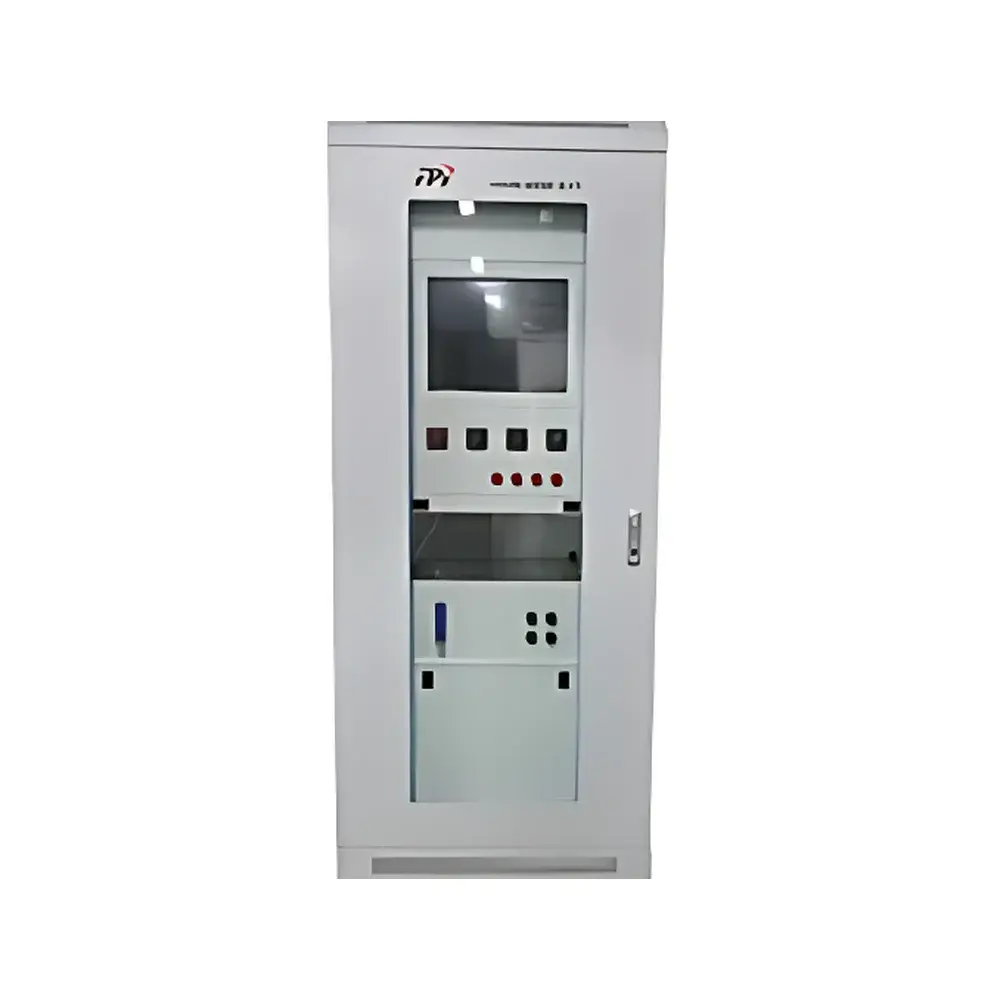
FPI CEMS-2000 B FT Fourier Transform Infrared (FTIR) Continuous Emission Monitoring System
| Brand | FPI |
|---|---|
| Origin | Zhejiang, China |
| Manufacturer Type | Original Equipment Manufacturer (OEM) |
| Country of Origin | China |
| Model | CEMS-2000 B FT |
| Instrument Type | Continuous Emission Monitoring System (CEMS) |
| Measurement Principle | Fourier Transform Infrared Spectroscopy |
| Accuracy | ≤ ±2% of Full Scale (F.S.) |
| Repeatability / Span Drift | ≤ ±2% F.S. over 7 days |
| Response Time | ≤ 180 s |
| Zero Drift | ≤ ±2% F.S. over 7 days |
| Operating Temperature | Sample Path Heated to 180 °C |
| Interferometer | Patented ROCKSOLID™ Dynamic Alignment-Free Design |
| Calibration | Automated Zero and Span Calibration |
| Compliance | Designed for EPA Method 320, ISO 12039, EN 15267-3, and applicable EU IED & US Clean Air Act requirements |
Overview
The FPI CEMS-2000 B FT is a high-integrity, extractive hot-wet continuous emission monitoring system engineered for regulatory-grade measurement of multiple gaseous pollutants in industrial flue gas streams. It employs Fourier Transform Infrared (FTIR) spectroscopy — a first-principles analytical technique based on molecular vibrational absorption signatures across the mid-infrared spectral region (typically 600–4000 cm⁻¹). Unlike filter-based or electrochemical sensors, FTIR enables simultaneous, interference-resolved quantification of up to 20+ target analytes (e.g., CO, CO₂, NO, NO₂, SO₂, NH₃, HCl, HF, CH₄, N₂O, H₂O vapor) from a single interferogram acquisition. The system utilizes a direct-extraction configuration with full-path heating maintained at 180 °C, eliminating condensation-related errors, aqueous-phase chemical reactions, and deposition of semi-volatile organic compounds (SVOCs) or heavy metals that commonly compromise cold-dry CEMS architectures. Its optical design incorporates a patented ROCKSOLID™ interferometer — a monolithic, dynamically aligned Michelson-type core with no moving mirrors or flexure hinges — ensuring long-term spectral stability under industrial vibration, thermal cycling, and mechanical shock.
Key Features
- Hot-wet extractive sampling with 180 °C heated probe, sample line, and measurement cell — prevents water condensation, acid dew point corrosion, and tar/ash fouling.
- ROCKSOLID™ interferometer: Solid-state optical architecture with zero-maintenance alignment; immune to mirror tilt-induced shear error, thermal drift, and micro-vibration artifacts.
- Multi-component real-time analysis: Simultaneous quantification of regulated and non-regulated gases without hardware reconfiguration.
- Dynamic range adaptability: Software-configurable concentration ranges per analyte, supporting both low-ppm compliance monitoring and high-percentage stack gas reporting (e.g., CO₂ at 0–20% vol).
- Integrated auto-calibration: Motorized valve manifold enables scheduled zero-air and multi-point span gas introduction without manual intervention.
- Fail-safe operational logic: Automatic power-loss recovery, purge-on-fault sequencing, and conditioned nitrogen backup purge to protect optics during shutdown or alarm conditions.
Sample Compatibility & Compliance
The CEMS-2000 B FT is validated for use in high-dust, high-moisture, and thermally variable flue gas environments typical of municipal solid waste (MSW) incineration, coal-fired and biomass power plants, cement kilns, and catalytic reduction (SCR/SNCR) ducts. Its heated filtration — featuring a proprietary stacked-orifice probe filter — achieves >99.9% particulate removal down to 0.3 µm while sustaining >12-month maintenance intervals under ash loadings exceeding 10 g/m³. The system meets performance criteria specified in U.S. EPA Performance Specification 15 (PS-15) for FTIR CEMS, European Standard EN 15267-3 (QAL1 certification framework), and ISO 12039 for stationary source emissions. Data integrity conforms to 21 CFR Part 11 audit trail requirements when integrated with compliant data acquisition software, supporting GLP/GMP-aligned QA/QC workflows.
Software & Data Management
The embedded control software provides ISO/IEC 17025-aligned instrument diagnostics, spectral quality assurance (SNR monitoring, baseline flatness validation), and automated interference correction using reference spectra libraries (HITRAN, GEISA). All raw interferograms and processed spectra are time-stamped and archived with metadata (temperature, pressure, flow rate, calibration status). The system supports Modbus TCP, OPC UA, and DNP3 protocols for seamless integration into plant DCS/SCADA networks. Optional cloud-connected firmware enables remote spectral health monitoring, predictive maintenance alerts (e.g., optical throughput decay trend analysis), and over-the-air calibration model updates compliant with EU MRV and U.S. EPA e-CFR Subpart F reporting timelines.
Applications
- Municipal solid waste and hazardous waste incinerators requiring simultaneous detection of acid gases (HCl, HF), nitrogen oxides, and dioxin/furan surrogate markers (e.g., benzene, chlorobenzene).
- Coal- and biomass-fired power stations subject to MATS, NSPS Subpart UUUU, and EU IED Annex VIII monitoring mandates.
- Industrial boilers and process heaters operating under Tier II GHG reporting obligations (CO₂, CH₄, N₂O).
- Carbon capture readiness assessment: High-precision CO₂ and O₂ co-monitoring with <0.1% relative uncertainty for mass balance verification.
- DeNOx system optimization: Real-time NH₃ slip monitoring with sub-ppm detection limits and <60 s dynamic response for closed-loop SCR control.
FAQ
What regulatory standards does the CEMS-2000 B FT comply with?
It satisfies U.S. EPA PS-15, EN 15267-3 QAL1, ISO 12039, and ASTM D6348 for FTIR-based stack gas analysis. System-level certification documentation includes TÜV SÜD or VDI/VDE 3919 test reports.
Can the system measure ammonia (NH₃) reliably in high-dust flue gas?
Yes — the 180 °C hot-wet path prevents NH₃ adsorption on wet surfaces or reaction with SO₃/H₂SO₄ aerosols, while the FTIR spectral resolution (0.5 cm⁻¹) resolves NH₃’s characteristic ν₁/ν₃ bands unambiguously even in presence of H₂O and CO₂ interferences.
Is the ROCKSOLID interferometer field-serviceable?
No — it is a sealed, factory-aligned monolithic unit with no user-serviceable optical components. Mean time between failures (MTBF) exceeds 10 years under continuous operation per IEC 61508 SIL2 reliability modeling.
How frequently must calibration gases be introduced?
Per EN 14181 QA Level 2 requirements, automatic zero/span checks occur every 24 hours; full multi-point calibration is recommended weekly or after maintenance events, with traceability to NIST-certified gas standards.
Does the system support remote diagnostics and software updates?
Yes — via secure TLS 1.2 encrypted Ethernet connection, enabling spectral health telemetry, firmware patch deployment, and spectral library expansion without site visit.
Related Products







