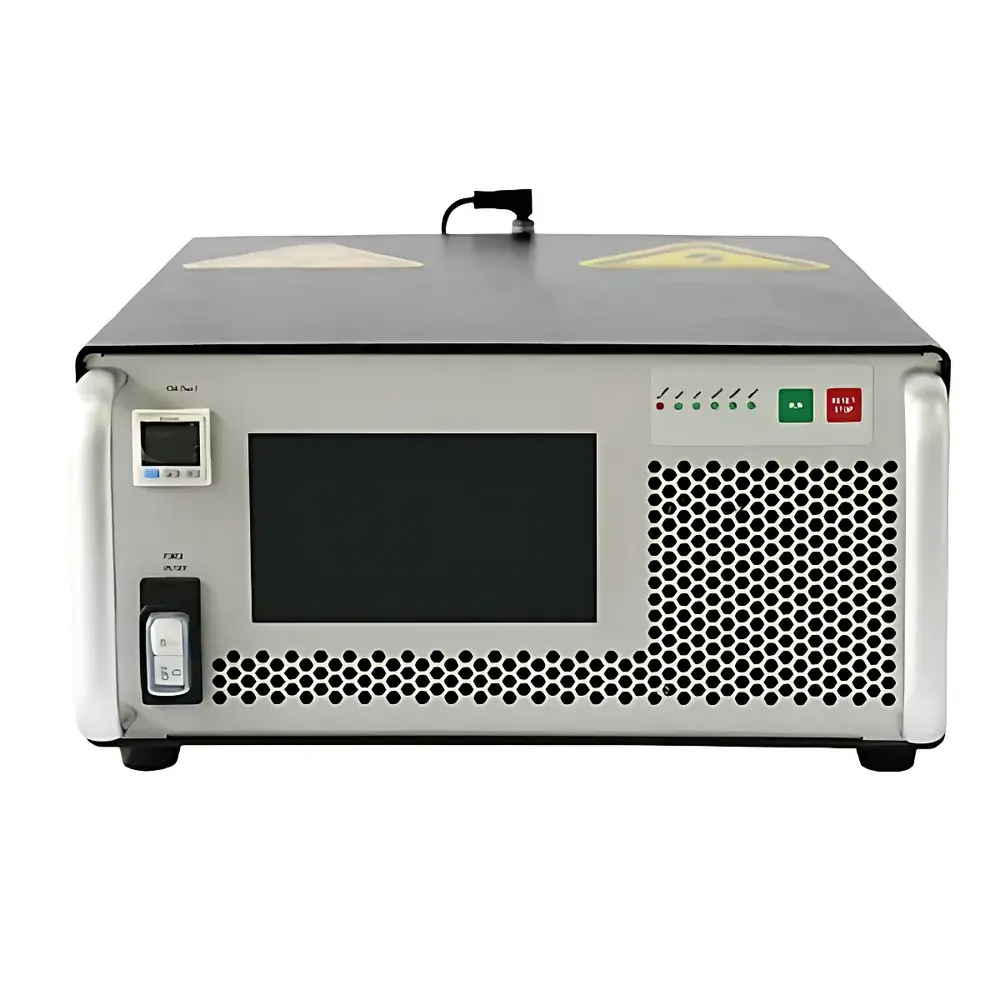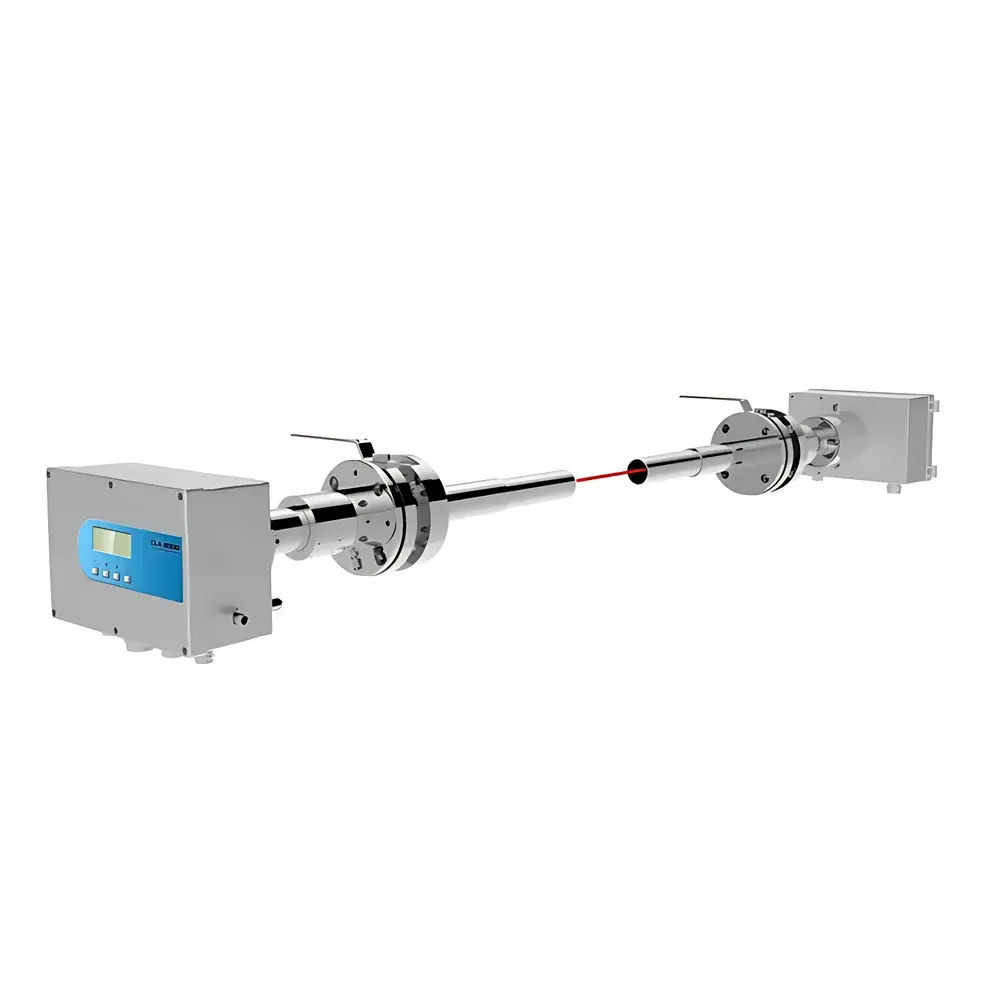
FPI CLA-8000 Laser Combustion Analyzer
| Brand | FPI |
|---|---|
| Origin | Zhejiang, China |
| Manufacturer Type | Original Equipment Manufacturer (OEM) |
| Country of Origin | China |
| Model | CLA-8000 |
| Pricing | Available upon Request |
Overview
The FPI CLA-8000 Laser Combustion Analyzer is a high-performance, in-situ gas concentration monitoring instrument engineered for continuous, real-time analysis of combustion gases in industrial furnace and boiler environments. It employs Tunable Diode Laser Absorption Spectroscopy (TDLAS)—a mature, physics-based optical sensing technique—where a narrow-linewidth semiconductor laser beam traverses the process gas stream, and species-specific absorption features (e.g., CO, O₂, H₂O, CH₄, NH₃) are quantified via Beer–Lambert law modeling. Unlike extractive systems requiring complex sample conditioning (filtration, cooling, dilution), the CLA-8000 operates directly across the hot, dusty, and corrosive flue or furnace cross-section, eliminating transport delay, condensation artifacts, and calibration drift associated with sampling lines. Its optical path is configured for cross-stack or probe-based installation, supporting measurement of gas temperatures up to 1500 °C and ambient housing operation above 70 °C—enabling true process-integrated metrology without thermal quenching or chemical interference.
Key Features
- In-situ, non-contact measurement with zero sample extraction or pre-treatment—reducing maintenance burden and system failure points.
- High-temperature optical interface rated for direct exposure to process gases up to 1500 °C; transmitter/receiver housings engineered for ambient operation ≥70 °C.
- Integrated positive-pressure explosion-proof enclosure compliant with IEC 60079-1 and GB 3836.1/GB 3836.5 standards for use in Zone 1/21 hazardous areas.
- Fully modular architecture: optical transceiver, signal processing unit, and power management module are field-replaceable without system shutdown or recalibration.
- Dual-wavelength referencing and real-time spectral baseline correction mitigate interference from particulate scattering, window fouling, and thermal emission background.
- Embedded self-diagnostic routines monitor laser wavelength stability, photodetector responsivity, and optical alignment integrity—generating actionable fault logs per IEC 61508 SIL 2 functional safety guidelines.
Sample Compatibility & Compliance
The CLA-8000 is validated for continuous monitoring of key combustion species—including oxygen (O₂), carbon monoxide (CO), water vapor (H₂O), methane (CH₄), ammonia (NH₃), and hydrogen sulfide (H₂S)—in flue gas, syngas, cement kiln exhaust, and steel reheating furnace atmospheres. It meets EN 15267-3 for automated measuring systems used in emissions monitoring (AMS), supports traceability to NIST-traceable gas standards, and delivers data compatible with EPA Method 3A, ISO 14064-1 GHG accounting protocols, and EU Industrial Emissions Directive (IED) reporting requirements. Its design adheres to electromagnetic compatibility (EMC) per IEC 61326-1 and environmental robustness per IEC 60529 IP66 for outdoor panel mounting.
Software & Data Management
The analyzer integrates with FPI’s proprietary FusionView™ Process Analytics Suite, providing web-based configuration, real-time spectral visualization, and multi-channel trend logging. All measurement data—including raw absorbance spectra, temperature-compensated concentration outputs, and diagnostic status flags—are timestamped and stored locally on an industrial-grade SD card (≥16 GB) with configurable retention policies. The system supports OPC UA (IEC 62541) and Modbus TCP protocols for seamless integration into DCS/SCADA platforms. Audit trails, user access control (role-based), and electronic signatures comply with FDA 21 CFR Part 11 and EU Annex 11 requirements for regulated manufacturing environments operating under GMP/GLP frameworks.
Applications
- Real-time air-to-fuel ratio optimization in coal-, gas-, and biomass-fired boilers to improve thermal efficiency and reduce NOₓ/CO emissions.
- Combustion stoichiometry control in cement clinker kilns and lime calciners for consistent product quality and energy savings.
- Ammonia slip monitoring downstream of SCR systems in power plants and waste-to-energy facilities.
- Process safety interlock support for inerting and purge verification in metallurgical furnaces and chemical reactors.
- Continuous emissions monitoring (CEMS) backup or redundancy for regulatory compliance where extractive analyzers face reliability challenges.
FAQ
Does the CLA-8000 require periodic calibration with certified gas standards?
No—its TDLAS architecture relies on absolute spectroscopic line parameters (HITRAN database) and internal wavelength referencing; only annual verification using traceable reference cells is recommended per ISO/IEC 17025.
Can it measure multiple gases simultaneously?
Yes—multi-species capability is achieved through time-multiplexed or frequency-modulated laser scanning across distinct absorption lines; up to five gases can be quantified concurrently within a single optical path.
Is the system compatible with existing plant cybersecurity policies?
Yes—the embedded Linux OS supports TLS 1.2 encryption, configurable firewall rules, and secure remote access via SSH or HTTPS; firmware updates require digital signature validation.
What is the typical optical path length range supported?
Standard configurations support 0.5 m to 5 m path lengths; custom optical designs (e.g., retro-reflective or folded-path) extend effective pathlengths up to 20 m for low-concentration detection.
How does the analyzer handle heavy dust loading or slag deposition on optical windows?
It incorporates active purge air channels with particle-filtered, pressure-regulated flow (≥5 L/min) and optional ultrasonic window cleaning modules—validated for PM₁₀ concentrations up to 10 g/m³.