
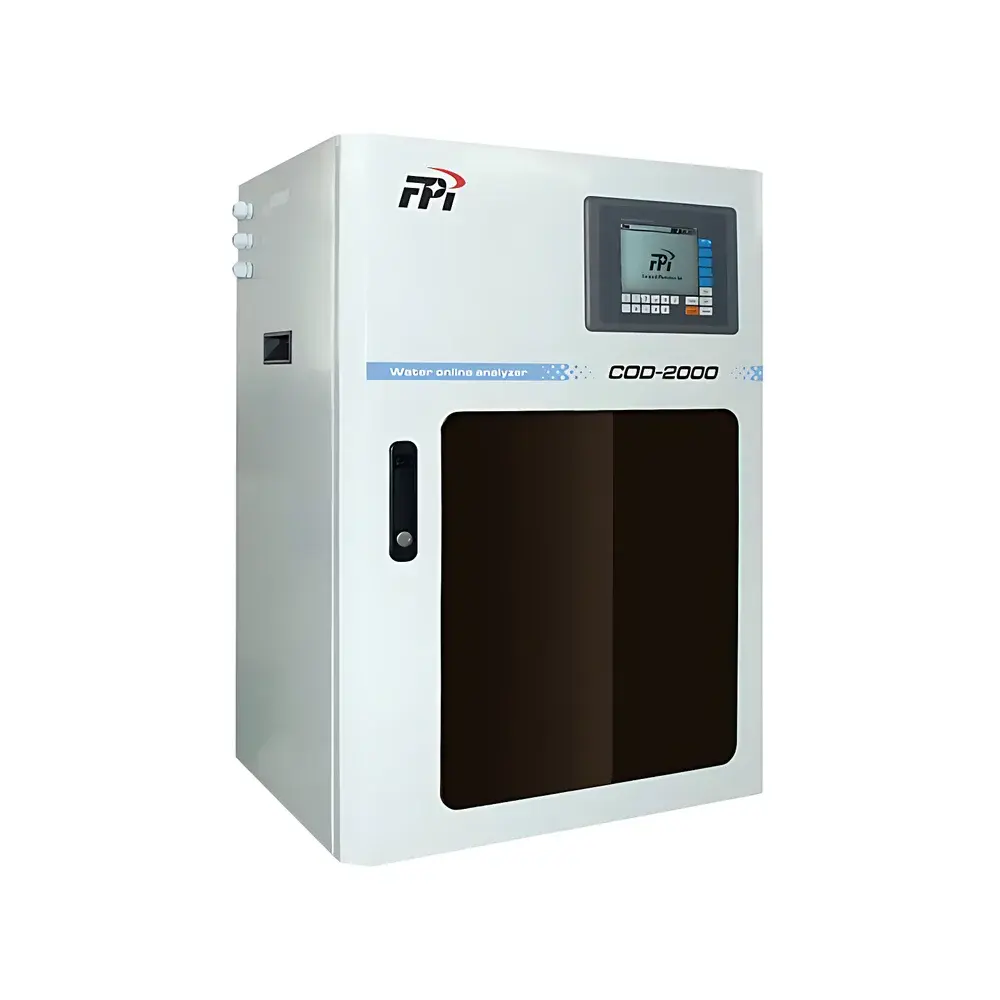
FPI COD-2000 Online Chemical Oxygen Demand Analyzer
| Brand | FPI |
|---|---|
| Origin | Zhejiang, China |
| Manufacturer Type | Original Equipment Manufacturer (OEM) |
| Product Category | Domestic |
| Model | COD-2000 |
| Instrument Type | Online Analyzer |
| Measurement Principle | Potassium Dichromate Oxidation–Spectrophotometric Method |
| Measurement Range | 0–200 / 0–500 / 0–2000 mg/L COD |
| Accuracy | ≤ ±10% of reading |
| Repeatability | ≤ 3% RSD |
| Limit of Detection | 10 mg/L COD |
| Zero Drift (24 h) | ±5 mg/L |
| Maintenance Interval | Up to 30 days without service intervention |
| Reagent Consumption | <10%–20% of conventional segmented flow systems |
Overview
The FPI COD-2000 Online Chemical Oxygen Demand Analyzer is an industrial-grade, fully automated water quality monitoring instrument engineered for continuous, unattended operation in effluent discharge channels, municipal wastewater treatment plants, and industrial pretreatment units. It implements the standardized potassium dichromate oxidation–spectrophotometric method—fully compliant with Chinese national standard GB 11914–1989 “Water Quality—Determination of Chemical Oxygen Demand—Dichromate Method” and environmental industry standard HJ/T 399–2007 “Water Quality—Rapid Digestion Spectrophotometric Method for COD Determination.” The analyzer subjects pre-filtered water samples to high-temperature (≥165 °C), high-pressure (≥0.3 MPa) digestion in a sealed quartz reaction chamber, ensuring complete oxidation of organic compounds under rigorously controlled conditions. Post-digestion, the Cr3+ concentration is quantified via dual-wavelength photometry (typically 600 nm and 700 nm) to eliminate interferences from turbidity and residual chloride. This principle delivers robust correlation with reference laboratory results while maintaining field-deployable reliability.
Key Features
- Patented sequential injection analysis (SIA) platform minimizes reagent usage to 10–20% of conventional flow-injection or segmented-flow systems—reducing operational cost and hazardous waste generation.
- Non-contact, high-precision syringe pump system enables stable volumetric delivery of sample and reagents without elastomeric tubing wear, eliminating calibration drift due to pump tube fatigue.
- Hermetically sealed, PTFE-lined high-pressure digestion module achieves >95% oxidation efficiency for refractory organics (e.g., pyridine, benzene derivatives), validated against certified reference materials (CRMs) per ISO/IEC 17025 protocols.
- Real-time reagent level monitoring with predictive low-level alerts prevents instrument downtime and ensures data continuity—critical for regulatory compliance reporting.
- Flexible measurement scheduling: supports fixed-interval (e.g., hourly), event-triggered (e.g., flow-rate synchronized), and demand-based sampling modes—adaptable to intermittent discharge profiles.
- Integrated temperature-compensated photometer with thermally stabilized LED light source and silicon photodiode detector ensures long-term optical stability across ambient temperatures from 5 °C to 40 °C.
Sample Compatibility & Compliance
The COD-2000 accommodates raw or filtered influent/effluent samples with suspended solids ≤50 mg/L and chloride concentrations up to 2000 mg/L (with optional chloride compensation algorithm). It meets CE marking requirements for electromagnetic compatibility (EN 61326-1) and safety (EN 61010-1). Data integrity complies with GLP/GMP-aligned audit trail functionality—including user login logs, method versioning, and timestamped raw absorbance records. While not FDA 21 CFR Part 11–certified out-of-the-box, its firmware architecture supports electronic signature integration and data export in ASTM E1382-compliant CSV/Excel formats for third-party LIMS ingestion.
Software & Data Management
The embedded Linux-based controller runs FPI’s proprietary CODView™ firmware (v3.2+), accessible via secure HTTPS web interface or Modbus TCP/RTU protocol. All measurements are time-stamped with NTP-synchronized UTC and stored locally (8 GB internal eMMC) for ≥90 days. Remote diagnostics include real-time status dashboards for digestion temperature, optical path cleanliness, reagent pressure, and system error codes. Data export supports scheduled FTP/SFTP push, MQTT streaming to cloud SCADA platforms, and direct integration with EPA-approved EMS systems (e.g., EnviroData, ABB Ability™).
Applications
- Continuous regulatory monitoring of point-source discharges under China’s “National Pollutant Discharge Permit System” and EU IED Directive Annex II requirements.
- Process control feedback in biological treatment units (e.g., A/O, MBR) to optimize aeration energy use and sludge retention time.
- Early-warning detection of toxic shock loads in industrial park wastewater networks—triggering alarm outputs to PLCs or DCS systems.
- Performance verification of on-site advanced oxidation processes (AOPs) and membrane filtration systems.
- Long-term trend analysis for environmental impact assessments (EIAs) and sustainability reporting (GRI 306, CDP Water Security).
FAQ
Does the COD-2000 require daily manual calibration?
No—factory-calibrated optical and thermal subsystems maintain traceability for ≥30 days; optional weekly auto-zero and span verification using certified standard solutions is recommended for QA/QC.
Can it operate in high-chloride industrial wastewater?
Yes—equipped with built-in chloride interference correction based on AgNO3 precipitation kinetics modeling; validated up to 2000 mg/L Cl− per HJ/T 399–2007 Annex B.
What maintenance tasks are required monthly?
Visual inspection of digestion chamber seals, cleaning of optical windows with isopropanol, and replacement of particulate filter cartridges—average labor time: <15 minutes.
Is remote firmware update supported?
Yes—via signed OTA packages delivered over TLS 1.2-encrypted connection; rollback capability ensures system recovery after failed updates.
How is data security ensured during transmission?
All network communications enforce TLS 1.2+ encryption; local storage uses AES-256 full-disk encryption; role-based access control (RBAC) restricts configuration changes to authorized personnel only.
Related Products







