
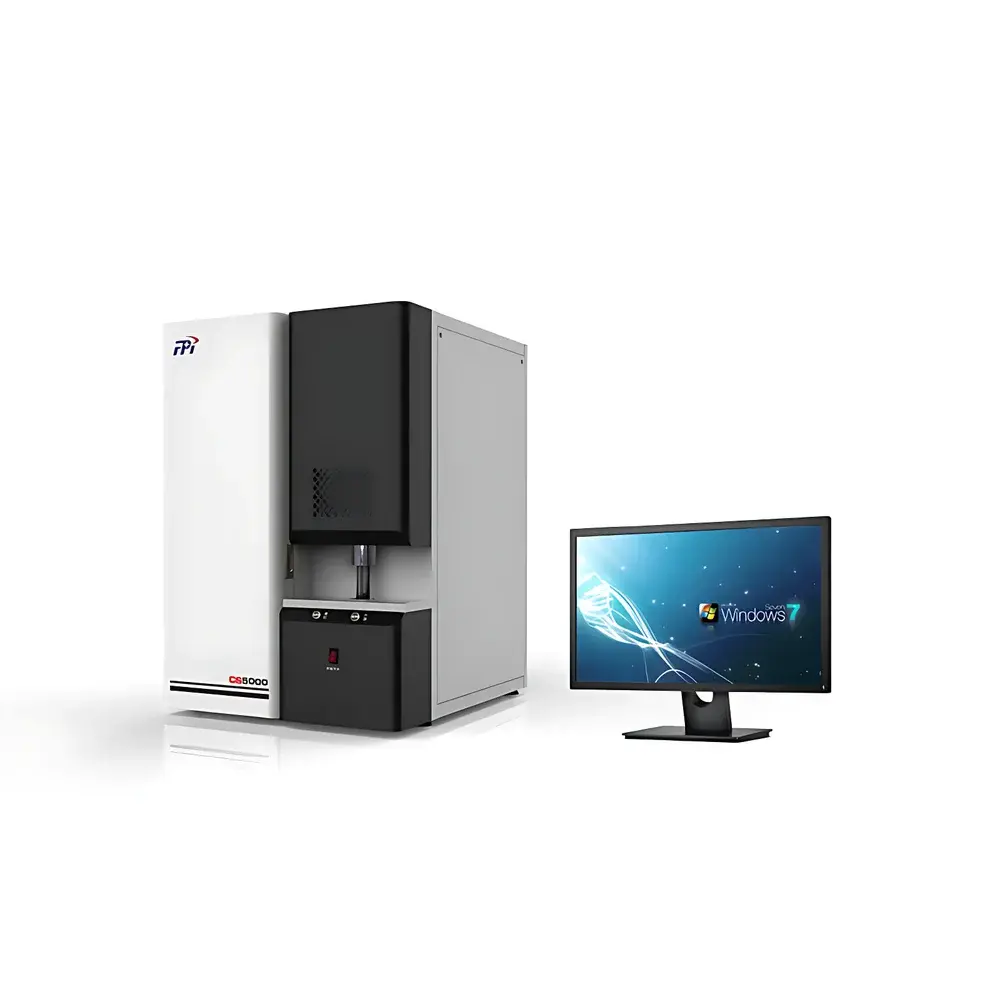
FPI CS5000 High-Frequency Infrared Carbon-Sulfur Analyzer
| Brand | FPI |
|---|---|
| Origin | Zhejiang, China |
| Manufacturer Type | OEM Manufacturer |
| Model | CS5000 |
| Measurement Principle | Non-Dispersive Infrared (NDIR) Absorption |
| Heating System | High-Frequency Induction Furnace |
| Carbon Range | 0.00001–12.0 wt% |
| Sulfur Range | 0.00001–45.0 wt% |
| Sensitivity | 0.000001 wt% |
| Precision | ±1.0 ppm (C/S) or RSD ≤ 0.5% (C), ≤ 1.0% (S) |
| Analysis Time | 20–40 s |
| Dimensions | 650 × 790 × 920 mm (W×D×H) |
| Weight | 150 kg |
| Power Supply | AC 220 V ±10%, 50 Hz, voltage fluctuation < ±0.2% |
Overview
The FPI CS5000 High-Frequency Infrared Carbon-Sulfur Analyzer is a laboratory-grade elemental combustion analyzer engineered for precise, reproducible quantification of total carbon (C) and sulfur (S) in solid inorganic and metallurgical samples. It operates on the principle of high-frequency induction combustion followed by non-dispersive infrared (NDIR) spectroscopic detection—complying with fundamental ASTM E1019, ISO 15350, and GB/T 20123 standards for combustion-based elemental analysis. Solid samples are fully oxidized in a controlled argon/oxygen atmosphere within a sealed quartz crucible, generating CO2 and SO2 gases proportional to their C and S content. These gases pass sequentially through optimized infrared absorption cells, where dual-wavelength NDIR detectors measure absorbance at characteristic wavelengths (4.26 µm for CO2, 7.35 µm for SO2). Integrated temperature-, pressure-, and flow-compensated signal processing ensures long-term baseline stability and minimizes environmental drift.
Key Features
- High-frequency induction furnace with solid-state RF generator (20 kHz), delivering stable thermal power up to 3.5 kW and enabling programmable ramp-and-hold temperature profiles for heterogeneous or refractory materials.
- Dual-channel NDIR detection system featuring gold-plated, thermostatically stabilized gas cells, narrow-band interference filters (FWHM ≤ 10 nm), and low-noise pyroelectric sensors with lifetime > 10 years.
- Modular gas handling architecture: multi-stage mass-flow-controlled carrier gas delivery; integrated high-efficiency particulate filtration; optional catalytic converter (CO → CO2) and SO3 scrubber (SO2 → SO3) for enhanced recovery and compliance with occupational exposure limits (OSHA PEL, ACGIH TLV).
- Fully automated furnace head with tool-free dual-brush mechanical cleaning, high-pressure ash ejection, and heated ceramic filter to prevent sulfur adsorption and improve low-level recovery (especially critical for < 10 ppm S).
- Embedded ARM-based control platform running uClinux OS, supporting real-time sampling at up to 200 kS/s, deterministic interrupt handling, and hardware-level audit trail logging per ICH GCP and FDA 21 CFR Part 11 requirements.
Sample Compatibility & Compliance
The CS5000 accommodates a broad spectrum of solid matrices without dilution or pre-treatment: ferrous and non-ferrous metals (steels, cast irons, Al/Cu/Zn alloys), ores and concentrates (Fe, Mn, Ni, Mo), refractories (SiC, MgO, Al2O3), cementitious materials (clinker, slag, fly ash), coals and cokes, polymers (carbon black-filled elastomers), ceramics, and geological specimens (soils, sediments). All sample introduction uses standardized ceramic or graphite crucibles (5–1000 mg load range). The system meets GLP/GMP documentation requirements via time-stamped, user-authorized method logs, electronic signature support, and tamper-evident data archiving. Optional validation packages include IQ/OQ documentation aligned with ISO/IEC 17025 and USP .
Software & Data Management
The proprietary CS-Analyzer software runs natively on Windows 7/10 (64-bit) and provides full instrument control, calibration management, and statistical reporting. Key capabilities include: multi-point linear/non-linear calibration with residual error mapping; user-defined channel libraries with independent gain/offset and background correction; batch analysis mode with auto-weight import from RS232/USB-connected analytical balances; customizable report templates exportable to Excel (.xlsx) or PDF with embedded metadata (operator ID, timestamp, method version, raw spectra). Audit trail functionality records all parameter changes, calibration events, and result modifications with immutable timestamps and user attribution—fully compliant with FDA 21 CFR Part 11 Subpart B for electronic records and signatures.
Applications
This analyzer serves quality control laboratories in steel production (ASTM A751), foundry operations (ISO 9442), mining (ASTM D3176), cement manufacturing (ASTM C114), and catalyst R&D (e.g., hydrodesulfurization support characterization). It supports regulatory testing for RoHS-compliant electronics (Br, Cl, S screening), ASTM D4294 sulfur-in-fuel verification, and environmental monitoring of coal ash leachates. Its sub-ppm sensitivity enables trace sulfur detection in high-purity nickel alloys used in semiconductor equipment components, while its upper-range capability (>40% S) supports pyrite-rich ore assay and desulfurization efficiency studies.
FAQ
What combustion atmosphere does the CS5000 use?
Pure oxygen or oxygen/argon mixtures—automatically regulated via mass flow controllers to optimize combustion efficiency and minimize oxide formation.
Can the system analyze liquid or powder samples directly?
No—only solid samples in crucibles; powders must be pelletized or mixed with tungsten or tin accelerator; liquids require prior evaporation and residue ignition.
Is method validation support available?
Yes—FPI provides IQ/OQ protocols, linearity verification kits (NIST-traceable C/S standards), and uncertainty budget templates per EURACHEM/CITAC guidelines.
How is dust management handled during analysis?
A three-stage filtration system captures >99.9% of particulates: ceramic pre-filter, high-temp metal mesh, and final membrane filter—all automatically purged into an external ash collection box.
Does the software support networked deployment?
Yes—client-server architecture allows centralized database hosting, remote diagnostics via encrypted TCP/IP, and role-based access across multiple instruments in a single lab network.




