
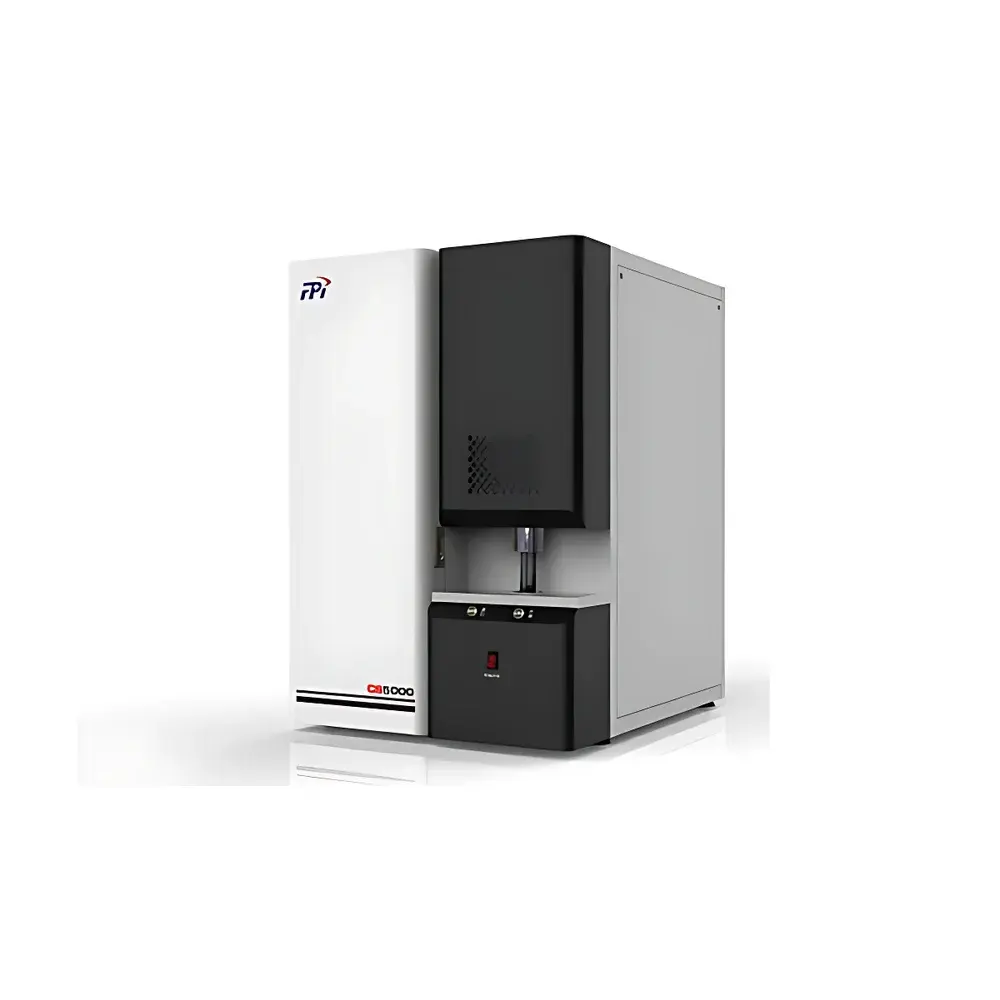
FPI CS5000 High-Frequency Infrared Carbon-Sulfur Analyzer
| Brand | FPI |
|---|---|
| Origin | Zhejiang, China |
| Manufacturer Type | Authorized Distributor |
| Domestic Product | Yes |
| Model | CS5000 |
| Measurement Principle | Infrared Absorption Spectroscopy |
| Heating System | High-Frequency Induction Furnace |
| Carbon Range | 0.00001–12 wt% |
| Sulfur Range | 0.00001–45 wt% |
| Sensitivity | 0.000001 wt% |
| Precision | ±1.0 ppm |
| Analysis Time | 20–40 s |
| Furnace Output Power | Adjustable (0–2.5 kW typical for HF induction) |
Overview
The FPI CS5000 High-Frequency Infrared Carbon-Sulfur Analyzer is a precision elemental analyzer engineered for quantitative determination of total carbon (C) and total sulfur (S) in solid metallic and non-metallic materials—including steels, cast irons, alloys, ceramics, ores, and refractory compounds. It operates on the fundamental principle of non-dispersive infrared (NDIR) absorption spectroscopy: following complete combustion in a high-frequency induction furnace, evolved CO2 and SO2 gases are swept through dedicated infrared gas cells, where their characteristic absorption bands at 4.26 µm (CO2) and 7.35 µm (SO2) are measured with high spectral selectivity. The instrument integrates thermal oxidation, gas conditioning, optical detection, and real-time signal processing into a single compact platform—designed to meet ISO 4935, ASTM E1019, and GB/T 20123 requirements for routine metallurgical and quality control laboratories.
Key Features
- High-frequency induction furnace with solid-state RF generator (up to 2.5 kW), delivering stable, reproducible combustion temperatures up to 1800 °C without vacuum tubes or consumable electrodes
- Programmable temperature ramping (pre-ignition, ignition, post-combustion phases) to optimize oxidation efficiency across heterogeneous sample matrices
- Automated dual-brush furnace head cleaning system—tool-free, fully motorized—reducing maintenance downtime by >70% versus manual disassembly
- Integrated high-pressure ash ejection and external dust collection bin, preventing internal particulate accumulation and minimizing sulfur adsorption losses
- Heated filter assembly upstream of the IR cells maintains consistent gas-phase composition and improves sulfur recovery by >98.5% for low-sulfur steels and sulfides
- Modular gas path architecture featuring imported mass flow controllers, pressure-regulated sampling lines, and optional catalytic converter (CO → CO2) and SO3 scrubber modules for enhanced speciation accuracy and compliance with OSHA PEL and EPA Method 29 emission limits
- Dual-range infrared detection cells (high-sensitivity low-concentration and high-capacity high-concentration) with gold-plated, thermostatically stabilized gas chambers and temperature/pressure/flow compensation algorithms
Sample Compatibility & Compliance
The CS5000 accommodates sample masses from 0.1 g to 1.0 g (depending on matrix and expected C/S content), compatible with standard ceramic crucibles and tungsten or tin additives per ASTM E1019 protocols. It supports analysis of ferrous and non-ferrous metals, cementitious materials, geological samples, and high-purity ceramics. All hardware and firmware comply with CE electromagnetic compatibility (EMC) Directive 2014/30/EU and RoHS 2011/65/EU. Data integrity functions—including audit trail logging, user role-based access control (Level 1–4), and electronic signature support—align with FDA 21 CFR Part 11 and GLP/GMP documentation requirements when configured with optional software validation packages.
Software & Data Management
The CS5000 runs on a dedicated Windows 7 Professional-based analytical suite (upgradable to Windows 10 IoT LTSB via firmware update). Core capabilities include multi-variable regression calibration (intensity vs. certified reference material concentration), batch weighing integration with Mettler Toledo, Sartorius, and Shimadzu balances, and priority-sample queuing for urgent QA/QC submissions. The software implements full traceability: every analysis records operator ID, calibration status, furnace parameters, gas flow metrics, raw IR absorbance spectra, and environmental sensor data (ambient T/P). Reports export natively to .xlsx with customizable templates; statistical summaries (RSD%, bias vs. CRM, control charting) are auto-generated. Remote diagnostics, networked result forwarding (via TCP/IP or RS-232), and context-sensitive online help are embedded—enabling centralized lab management across multi-instrument sites.
Applications
Typical use cases include incoming raw material verification (e.g., scrap metal sorting), melt-process monitoring in electric arc and induction furnaces, final product certification for ASTM A29/A370 steel grades, and failure analysis of sulfide-induced embrittlement in pipeline steels. The CS5000 is routinely deployed in third-party testing labs accredited to ISO/IEC 17025, foundry QC departments maintaining IATF 16949, and R&D centers developing low-carbon alloy systems (e.g., ultra-low-carbon IF steels, high-strength low-alloy HSLA variants). Its sub-ppm sensitivity and <2% RSD at 10 ppm S enables qualification of specialty alloys used in aerospace turbine disks and nuclear-grade zirconium cladding.
FAQ
What sample preparation is required prior to analysis?
Solid samples must be homogeneous, dry, and free of surface oil or coating. Milling to ≤80 mesh is recommended for alloys; no acid digestion or fusion is needed.
Can the CS5000 analyze liquid or powder samples directly?
No—only solid specimens are supported. Powders must be pelletized with binder; liquids require pre-evaporation and residue carbonization in inert atmosphere.
Is method validation support available for regulatory submissions?
Yes—FPI provides IQ/OQ documentation templates, linearity/precision/recovery test protocols, and optional GxP-compliant validation services under ISO 17025 scope.
How often does the infrared detector require recalibration?
Under normal operation, zero/span checks are performed automatically before each run; full optical calibration is recommended annually or after major maintenance.
Does the system support LIMS integration?
Yes—via ASTM E1382-compliant ASCII output or configurable OPC UA server module for direct connection to major LIMS platforms including LabWare, STARLIMS, and Thermo Fisher SampleManager.
Related Products




