
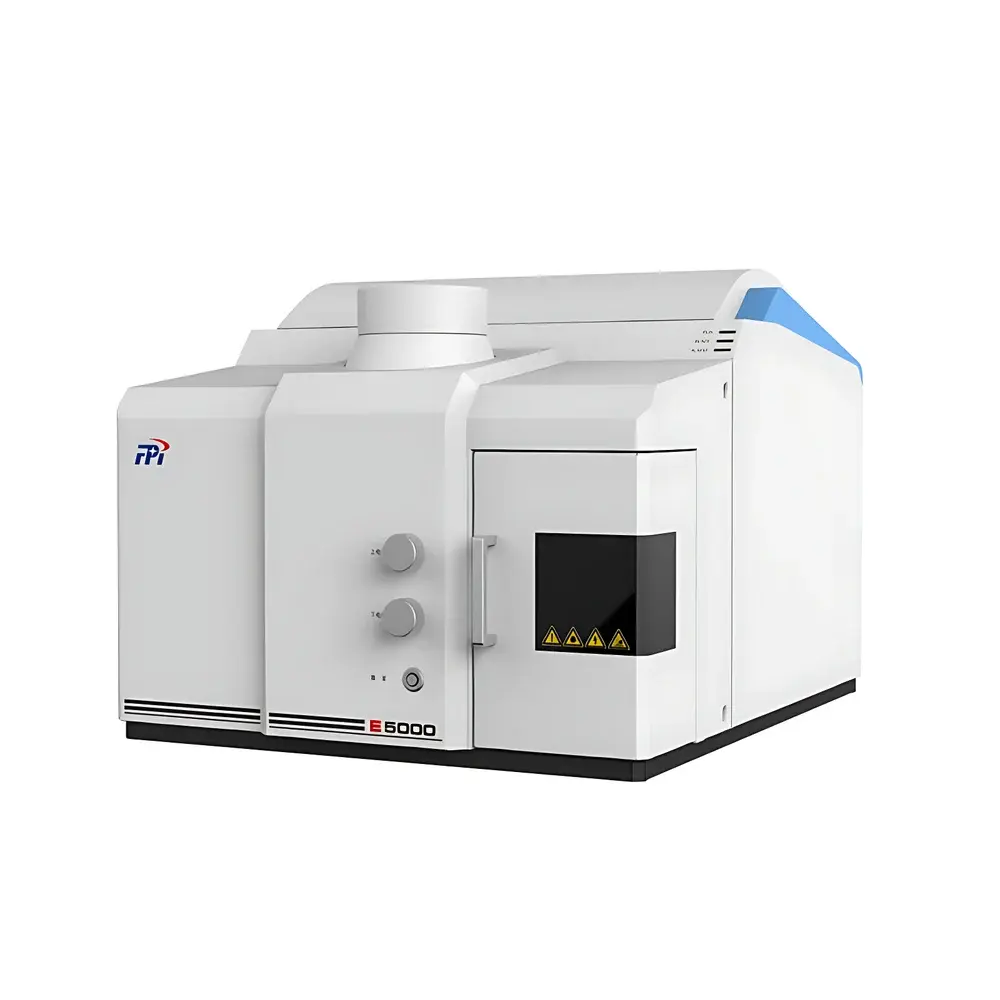
FPI E5000 Arc-Excited Direct-Reading Optical Emission Spectrometer
| Brand | FPI |
|---|---|
| Origin | Zhejiang, China |
| Manufacturer Type | Original Equipment Manufacturer (OEM) |
| Instrument Type | Benchtop |
| Excitation Source | High-Power Programmable DC Arc |
| Detector | Back-Illuminated CCD Array |
| Focal Length | 400 mm |
| Grating Groove Density | 2400 lines/mm |
| Wavelength Range | 190–680 nm |
| Spectral Coverage | Full-Spectrum Simultaneous Acquisition |
| Optical Design | Paschen-Runge Mount with Fixed, Thermally Stabilized Vacuum- or Purged-Optics Chamber |
| Cooling | Integrated Water-Cooled Electrode & Arc Source |
| Safety Interlocks | Real-Time Monitoring of Cooling Flow, Exhaust Ventilation, Torch Chamber Door Status, and Thermal Sensors |
Overview
The FPI E5000 Arc-Excited Direct-Reading Optical Emission Spectrometer is a benchtop analytical instrument engineered for rapid, precise, and interference-resolved elemental analysis of solid powdered samples without dissolution or pelletization. It operates on the fundamental principle of arc-excited atomic emission spectroscopy (AES): a high-current DC electric arc vaporizes and atomizes conductive or graphite-mixed powder samples, generating excited-state atoms and ions that emit characteristic photons upon relaxation. These emissions are dispersed by a high-resolution Paschen-Runge optical system and captured simultaneously across the full spectral range (190–680 nm) using a back-illuminated charge-coupled device (CCD) array. Unlike sequential or PMT-based spectrometers, the E5000’s full-spectrum architecture enables true multi-element quantification in a single exposure—eliminating mechanical wavelength scanning and maximizing duty cycle efficiency. Designed specifically for metallurgical QC labs, geological survey units, and materials R&D facilities, the E5000 delivers laboratory-grade accuracy in a compact footprint compliant with ISO/IEC 17025 operational environments.
Key Features
- Patented high-power digitally controlled DC arc source with programmable current (up to 20 A), voltage (up to 60 V), and pulse frequency—enabling optimization for trace, minor, and major element detection in diverse matrices.
- Automated infrared laser-guided electrode alignment system ensuring sub-5 µm positional repeatability and eliminating manual calibration drift between analyses.
- Thermally stabilized Paschen-Runge optical bench with 400 mm focal length, 2400 grooves/mm holographic grating, and all-reflective optical path—minimizing chromatic aberration and thermal wavelength shift.
- Anti-blooming, deep-depletion CCD detector with dynamic integration capability—delivering >10⁵:1 linear dynamic range and effective suppression of pixel saturation during high-intensity line acquisition.
- Integrated water-cooling circuit for both arc generator and electrode holder—maintaining thermal equilibrium under continuous operation and reducing inter-run signal drift to <0.3% RSD over 8 hours.
- Hardware-enforced safety interlocks including flow sensors for coolant, pressure switches for exhaust ducts, magnetic door sensors for spark chamber access, and real-time thermal monitoring at six critical nodes—fully documented in audit-ready event logs.
Sample Compatibility & Compliance
The E5000 accepts pressed powders, fused beads, and conductive metal filings directly—requiring no acid digestion or dilution. Sample preparation follows ASTM E1085 (Standard Practice for Analysis of Metals by Arc Emission Spectroscopy) and ISO 11576 (Metallic materials — Determination of chemical composition — Arc/spark emission spectrometry). Its optical design conforms to IEC 61000-6-3 (EMC immunity) and IEC 61010-1 (Safety requirements for electrical equipment). Data integrity meets FDA 21 CFR Part 11 requirements via electronic signatures, audit trails, and role-based user permissions embedded in firmware. All calibration and validation records—including wavelength calibration, intensity stability checks, and background correction verification—are stored with time stamps and operator IDs.
Software & Data Management
The E5000 runs FPI SpectraSuite v4.x—a Windows-based platform supporting GLP/GMP workflows. It provides hierarchical user roles (Operator, Analyst, Administrator), method version control, and automated calibration curve generation using certified reference materials (CRMs) traceable to NIST SRMs. The software implements advanced spectral processing algorithms: multi-peak Gaussian fitting for overlapping lines, adaptive background subtraction (left/right/slope modes), and intelligent interference correction using reference line ratios. Drift compensation employs internal standard normalization (e.g., Fe II 238.204 nm for steel matrices) combined with periodic recalibration against stored reference spectra. Raw spectral data (.spe binary format) and processed results (.csv/.xlsx) are exportable; audit logs record every parameter change, spectrum acquisition, and report generation with SHA-256 hash integrity verification.
Applications
- Quantitative analysis of alloy composition in stainless steels, aluminum alloys, and nickel-based superalloys—covering C, S, P, B, Sn, As, Pb, and rare earth elements (Ce, La, Nd) at ppm-level detection limits.
- Geochemical screening of ore concentrates and exploration core samples—measuring major oxides (SiO₂, Al₂O₃, Fe₂O₃) alongside trace metals (Cu, Zn, Mo, U) without fusion.
- Quality assurance of battery cathode powders (LiCoO₂, NMC, LFP)—monitoring transition metal stoichiometry and contaminant levels (Na, K, Ca, Mg).
- Environmental solid waste characterization per EPA Method 6010D—analyzing heavy metals (Cd, Cr, Ni, Hg) in fly ash and slag matrices.
- Research applications requiring spectral library expansion—leveraging full-spectrum acquisition to identify unknown emission lines and develop custom calibrations for novel materials.
FAQ
What sample forms are compatible with the E5000?
Powdered solids (e.g., ores, ceramics, catalysts), graphite-mixed samples, pressed pellets, and conductive metal turnings. No liquid or dissolved samples.
Does the E5000 require vacuum or inert gas purging of the optical chamber?
Yes—it supports either high-purity argon purge or sealed vacuum operation to minimize O₂/N₂ absorption below 200 nm, ensuring accurate measurement of C, P, S, and N.
How is calibration maintained over long-term operation?
Through built-in wavelength calibration using Hg/Ne lamp references, intensity stabilization via internal quartz lamp, and software-driven drift correction using internal standard lines and periodic CRM reanalysis.
Can the E5000 comply with ISO/IEC 17025 accreditation requirements?
Yes—the system includes full traceability of CRMs, documented uncertainty budgets per element, inter-laboratory comparison reporting templates, and complete audit trail functionality meeting ILAC-G8:2023 guidelines.
Is method development supported for non-standard matrices?
Yes—SpectraSuite provides open access to raw spectral data, customizable peak integration windows, multi-line ratio algorithms, and exportable Python-compatible spectral arrays for external modeling.
Related Products




