
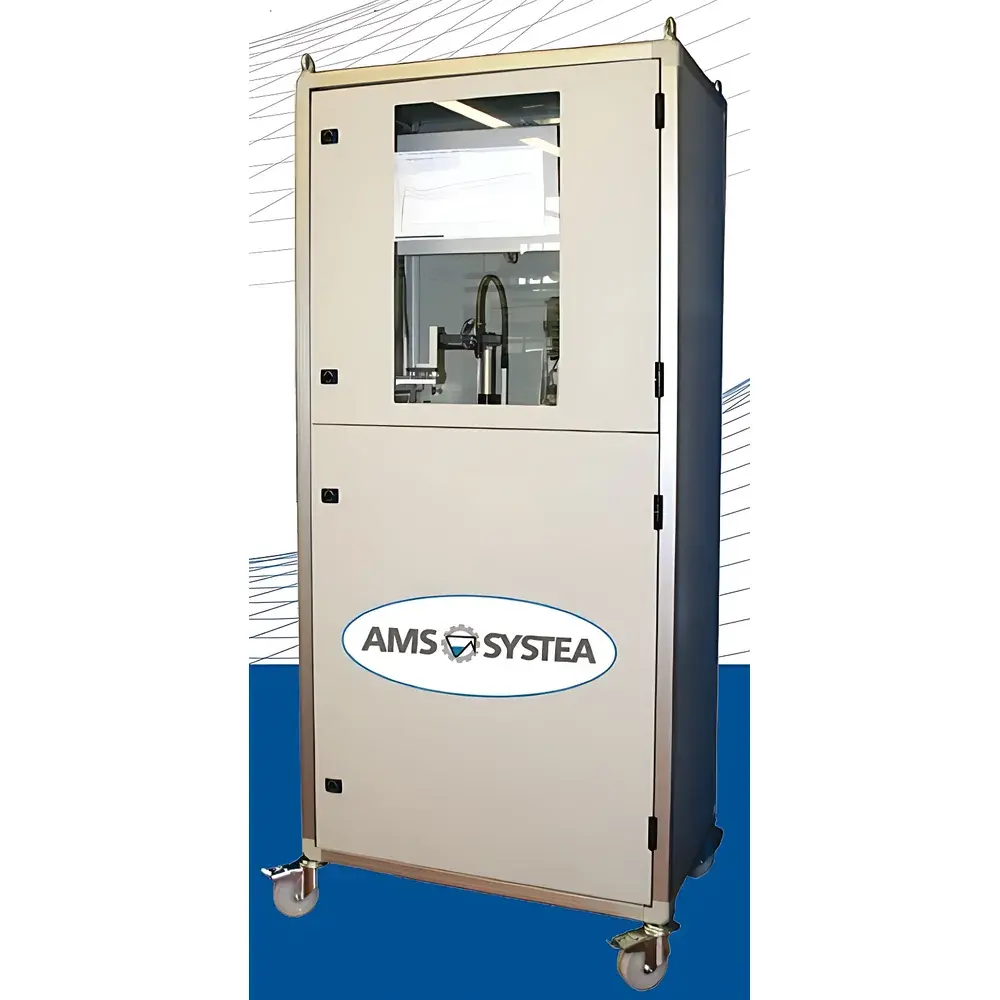
FPI EasyChem Online Integrated Water Quality Analyzer
| Brand | FPI |
|---|---|
| Origin | Zhejiang, China |
| Manufacturer Type | Original Equipment Manufacturer (OEM) |
| Country of Origin | China |
| Model | EasyChem Online |
| Instrument Type | Online Water Quality Analyzer |
| Detection Principle | Discrete Analysis with Photometric and Fluorescence Detection |
| Maximum Parameters | 15 |
| Form Factor | Integrated Benchtop Unit |
| Compliance | Designed for ISO 5667, ASTM D1293, EPA 150.1–150.3, and GB/T 5750 series applications |
Overview
The FPI EasyChem Online Integrated Water Quality Analyzer is an engineered solution for continuous, unattended multi-parameter water quality monitoring in municipal drinking water systems, wastewater treatment plants, industrial effluent streams, and environmental surface water networks. It employs discrete analysis—a highly reproducible analytical architecture where each sample is processed in an isolated reaction cuvette—combined with dual-mode optical detection (visible-range spectrophotometry and selective fluorescence excitation/emission). Unlike flow-injection or segmented-flow analyzers, the discrete platform eliminates cross-contamination risks, enables precise reagent dosing control, and supports method-specific incubation times for reactions requiring kinetic development (e.g., nitrate reduction, orthophosphate molybdate complex formation). The system operates as a fully integrated benchtop station—housing sampling, filtration, reagent storage, thermal conditioning, reaction modules, optical detection cells, and waste management within a single enclosure—minimizing footprint while maintaining analytical integrity under field-deployable conditions.
Key Features
- Discrete analysis architecture with individual cuvette-based reaction vessels ensures high inter-sample repeatability (RSD < 2.5% at mid-range concentrations) and eliminates memory effects between sequential measurements.
- Robust robotic arm handling system enables automated aspiration, reagent addition, mixing, incubation, and photometric readout—supporting up to 15 independently configurable parameters without hardware modification.
- Integrated temperature-controlled reaction chamber (±0.2 °C stability) maintains consistent kinetics for colorimetric and enzymatic assays across ambient fluctuations from 5 °C to 40 °C.
- Modular reagent cartridge design allows pre-filled, barcode-scanned consumables with shelf-life tracking and automated low-reagent alerts compliant with GLP audit requirements.
- Self-cleaning fluidic pathways with programmable backflush cycles reduce maintenance frequency and extend service intervals between calibrations.
- IP54-rated enclosure with corrosion-resistant internal materials (316 stainless steel fittings, PTFE tubing, borosilicate glass cuvettes) ensures operational reliability in humid, chemically aggressive environments.
Sample Compatibility & Compliance
The EasyChem Online accepts raw, filtered, or clarified aqueous samples with turbidity ≤ 100 NTU and total suspended solids ≤ 50 mg/L. It supports direct injection of drinking water, treated wastewater, river/lake water, and cooling tower make-up water without prior dilution in most standard configurations. All measurement protocols are aligned with internationally recognized standard methods: pH per ISO 10523 and ASTM D1293; nitrate/nitrite per EPA Method 353.2 and ISO 10304-1; phosphate per ISO 6878 and APHA 4500-P E; COD via dichromate digestion per ISO 6060 and EPA 410.4; ammonia via salicylate method per ISO 7150-1. The system’s data acquisition firmware complies with FDA 21 CFR Part 11 requirements for electronic records and signatures when deployed in regulated utilities or contract laboratories.
Software & Data Management
The embedded Linux-based control software provides real-time status visualization, method scheduling, QC flagging (e.g., drift correction, blank deviation, calibration failure), and automatic report generation in PDF/CSV formats. Remote access is supported via secure TLS 1.2-enabled web interface or OPC UA server integration for SCADA and MES connectivity. Audit trails record all user actions, parameter changes, calibration events, and instrument errors with timestamped, immutable entries—fully traceable for ISO/IEC 17025 accreditation audits. Data export supports Modbus TCP and MQTT protocols for seamless ingestion into cloud-based environmental data platforms (e.g., AWS IoT Core, Azure IoT Hub).
Applications
- Real-time compliance monitoring of drinking water treatment plants against WHO guidelines and national regulatory thresholds (e.g., GB 5749-2022).
- Process optimization in activated sludge and membrane bioreactor (MBR) systems through simultaneous NH₄⁺-N, NO₂⁻-N, NO₃⁻-N, and PO₄³⁻ tracking.
- Early warning detection of nutrient spikes or organic loading shifts in watershed intake stations.
- Support for ISO 5667-3-compliant routine surveillance programs in reservoirs and distribution networks.
- Automated validation of disinfection by-product precursors (e.g., DOC, UV₂₅₄) in source water assessment workflows.
FAQ
What sample throughput can be expected for a 10-parameter configuration?
Typical cycle time is 12–18 minutes per full suite, depending on incubation durations; priority parameters may be scheduled asynchronously to reduce latency for critical indicators like free chlorine or pH.
Is the system compatible with existing telemetry infrastructure?
Yes—Modbus RTU over RS-485, Modbus TCP, and MQTT v3.1.1 are natively supported; optional cellular (LTE-M/NB-IoT) or fiber-optic communication modules are available for remote deployment.
How frequently must calibration standards be verified?
Initial calibration verification is recommended every 7 days under continuous operation; automated daily zero/span checks with NIST-traceable standards reduce manual intervention while satisfying ISO/IEC 17025 intermediate checks requirements.
Can custom assay methods be implemented?
Yes—the open method editor supports user-defined reaction sequences, wavelength selection, kinetic curve fitting algorithms, and limit-of-detection calculations—subject to optical and thermal constraints of the platform.
What maintenance tasks require certified technician involvement?
Annual optical alignment verification, photometer dark-current recalibration, and robotic arm positional calibration must be performed by FPI-certified service engineers; all other consumable replacements and cleaning procedures are operator-executable via guided touchscreen workflows.







