
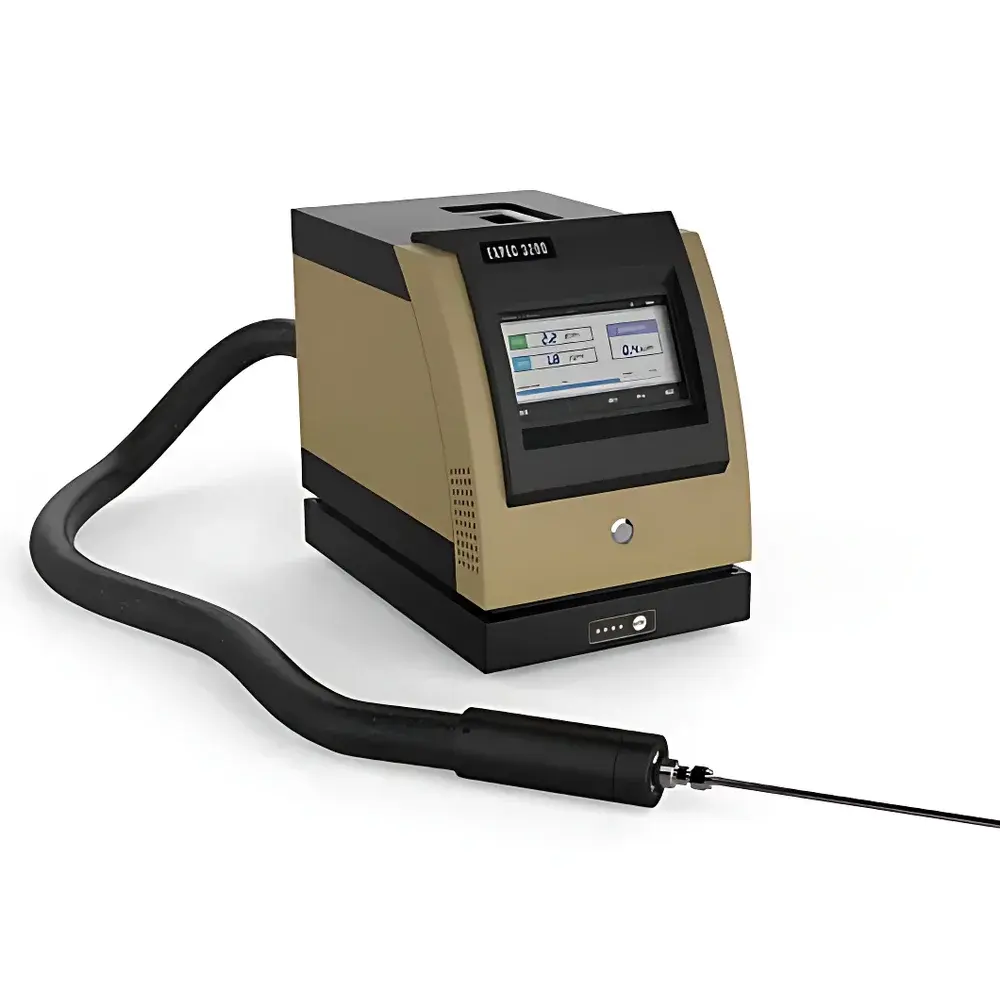
FPI EXPEC 3200 Portable Non-Methane Hydrocarbons (NMHC) and Aromatic Hydrocarbons Analyzer
| Brand | FPI |
|---|---|
| Origin | Zhejiang, China |
| Manufacturer Type | Original Equipment Manufacturer (OEM) |
| Product Type | Portable Gas Chromatograph |
| Application Scope | General-purpose Environmental Emission Monitoring |
| Compliance Standards | HJ 1012, HJ 38, HJ 604, GB 37822–2019 |
| Detection Principle | High-Temperature Heated Sample Transfer + Flame Ionization Detection (FID) |
| Detection Limit | Sub-ppb Level for Total Hydrocarbons, Methane, and BTEX |
| Integrated Power Supply | Rechargeable Lithium Battery (≥4 h continuous operation with heated line) |
| Data Output | Raw Chromatograms & Quantitative Results Exportable in Standard Formats (e.g., .csv, .cdf) |
| Certification | China Metrology Accreditation (CPA), Compatible with CMA Reporting Requirements |
| Sample Introduction | Dual-Stage Filtered Sampling Pump + Fixed-Volume Loop Injection |
| Column Configuration | Capillary GC Column Optimized for C1–C8 Hydrocarbons |
| Detector Temperature | Up to 180 °C |
| Sample Line Temperature | Heated to 180 °C |
| Dimensions & Portability | Integrated All-in-One Chassis with Carrying Handle |
| Optional Accessories | Android Tablet Interface, High-Pressure Gas Cylinders, Metal Hydride Hydrogen Generators |
Overview
The FPI EXPEC 3200 is a field-deployable, fully integrated gas chromatograph engineered for on-site quantification of non-methane hydrocarbons (NMHC), methane, and aromatic compounds—including benzene, toluene, ethylbenzene, and xylenes (BTEX)—in stack emissions and fugitive sources. It operates on the principle of temperature-controlled capillary gas chromatography coupled with high-sensitivity flame ionization detection (FID). Unlike conventional lab-based GC systems, the EXPEC 3200 incorporates active thermal management throughout the entire sample path: from the inlet filter through the quantitative loop, separation column, and detector—each maintained at up to 180 °C. This design eliminates condensation, adsorption, and carryover effects commonly observed with high-boiling-point or high-concentration VOCs, ensuring quantitative accuracy and reproducibility under real-world ambient and industrial conditions. The instrument meets the technical specifications defined in Chinese environmental standards HJ 1012–2018 (Method for Determination of Non-Methane Hydrocarbons in Exhaust Gas from Stationary Sources by Gas Chromatography), as well as HJ 38–2017, HJ 604–2017, and GB 37822–2019 (VOC Emission Control Standard for Industrial Coating Processes).
Key Features
- Fully self-contained architecture: integrates carrier gas (N₂ or air), hydrogen supply (compressed cylinder or metal hydride generator), calibration gas reservoir, rechargeable lithium battery pack, heated sampling line (180 °C), and GC-FID analysis module within a single portable chassis.
- Zero external power dependency: supports ≥4 hours of uninterrupted operation—including simultaneous heating of the 3-meter sample line and detector—without connection to 220 V AC mains, enhancing personnel safety in hazardous or remote locations.
- Field-optimized workflow: cold-start capability enables immediate analysis upon arrival; no warm-up recalibration required between sampling points, reducing turnaround time during multi-point emission surveys.
- Regulatory-grade data integrity: compliant with China’s CPA (China Metrology Accreditation) requirements; generates timestamped raw chromatograms (.cdf format) and quantitative reports exportable for audit-ready CMA-certified laboratory reporting.
- Modular interface options: supports wireless control via Android tablet or smartphone; configurable for integration with external pressure regulators, high-pressure gas cylinders, or solid-state hydrogen generators.
Sample Compatibility & Compliance
The EXPEC 3200 is validated for direct analysis of undiluted or diluted exhaust gas streams from stationary sources (e.g., chemical reactors, coating lines, printing facilities) and ambient air samples collected from fenceline or community monitoring sites. Its dual-stage particulate and moisture filtration system ensures robustness against particulate-laden or humid samples. The method validation aligns with HJ 1012’s specified recovery ranges (85–115%), repeatability (RSD ≤5%), and linearity (r² ≥0.999 over 0.05–100 ppmv). While not explicitly certified to ISO 10156 or ASTM D6348, its operational parameters and data handling protocols are compatible with GLP-aligned workflows and support traceability per ISO/IEC 17025:2017 documentation requirements.
Software & Data Management
Embedded firmware provides real-time chromatogram visualization, peak integration, and automatic NMHC calculation (Total Hydrocarbons – Methane). Data files conform to ASTM E1947-compliant chromatographic data format (CDF), enabling import into third-party software such as OpenLab CDS or Chromeleon. Audit trails record operator ID, method version, calibration history, and environmental metadata (temperature, pressure, flow rate). All raw acquisitions are write-protected and stored with SHA-256 checksums to satisfy integrity verification needs in regulated environments.
Applications
- Compliance monitoring of VOC emissions from petrochemical, pharmaceutical, and surface coating industries per GB 37822–2019.
- Source identification and apportionment studies using BTEX fingerprinting in urban air quality investigations.
- Leak detection and repair (LDAR) programs requiring rapid, repeatable field measurements at valve stems, flanges, and pump seals.
- Mobile monitoring campaigns using vehicle-mounted or backpack-configured deployments.
- Validation of continuous emission monitoring systems (CEMS) via periodic reference method audits per HJ 1012–2018 Annex B.
FAQ
Does the EXPEC 3200 require external gas supplies to operate?
No—it includes internal high-pressure N₂ (or synthetic air) and H₂ reservoirs; optional external gas manifolds may be used for extended missions.
Can raw chromatograms be exported for independent reprocessing?
Yes—full-resolution .cdf files containing analog detector output, timing metadata, and calibration coefficients are accessible via USB or Wi-Fi.
Is the system suitable for unattended overnight operation?
Not natively—the current battery capacity supports ≤4 h runtime; however, external DC power input (12–24 V) enables extended deployment.
What maintenance intervals are recommended for field use?
FID nozzle cleaning and column bake-out every 50 analyses; particulate filter replacement after 200 hr of cumulative sampling time.
Does the instrument support automated calibration sequences?
Yes—programmable multi-point calibration using internal standard gases; calibration verification checks can be scheduled at user-defined intervals.





