
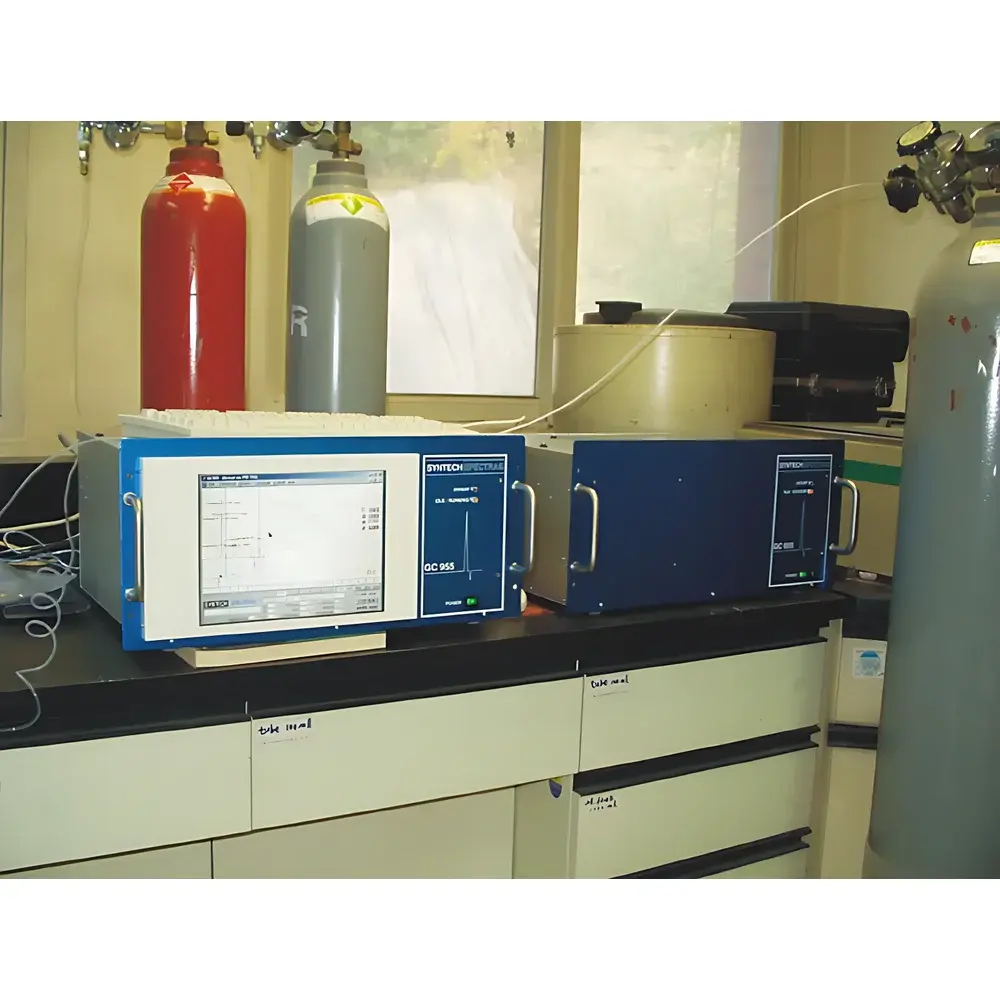
FPI GC955-615/815 Online Dual-Detector Gas Chromatograph for Toxic Hydrocarbon and VOC Monitoring
| Brand | FPI (Fortune Photonics Instrumentation) |
|---|---|
| Origin | Netherlands |
| Manufacturer Type | Original Equipment Manufacturer (OEM) |
| Product Category | Imported Instrument |
| Model | GC955-615/815 |
| Detection Principle | Gas Chromatography with Dual FID/PID Detection |
| Instrument Type | Online Continuous Analyzer |
| Configuration | Modular VOC Monitoring System |
| Detection Range | 0–300 ppb (user-selectable) |
| Detection Limit | 0.4 µg/m³ (trans-2-butene) |
| Repeatability | <3% RSD at 10 ppb (trans-2-butene) |
| Analysis Cycle | 30 minutes |
| Operating Temperature | 5–40 °C |
| Operating Humidity | 20–95% RH |
| Power Supply | 220 VAC ±10% |
| Carrier Gas Flow Control | MFC (0–10 mL/min) |
| Preconcentrator Thermal Desorption Time | <10 s |
| Calibration | 5-point manual + automated sensitivity verification |
| Data Interface | Analog (4–20 mA) and digital (RS-485, Modbus TCP) compliant |
Overview
The FPI GC955-615/815 is a fully automated, online gas chromatographic system engineered for continuous, unattended monitoring of toxic hydrocarbons and volatile organic compounds (VOCs) in ambient air, fence-line emissions, and industrial process environments. It implements dual detection architecture—flame ionization detection (FID) for broad-spectrum hydrocarbon quantification and photoionization detection (PID) for enhanced sensitivity toward aromatic and unsaturated compounds—including benzene, chlorinated ethenes, alkenes, and sulfur-containing odorants. The instrument operates on the fundamental principle of gas-phase separation via capillary column chromatography followed by selective, real-time detection. Its design adheres to the operational requirements of regulatory-grade environmental monitoring networks, supporting compliance with EU Directive 2008/50/EC, US EPA Method TO-17 and TO-15, and ISO 16017-1 for VOC analysis in ambient air.
Key Features
- Dual-detector configuration (FID + PID) enables simultaneous quantification of total hydrocarbons and compound-specific toxicants with orthogonal selectivity.
- Modular platform architecture allows field-configurable deployment: GC955-615 targets high-boiling C6–C12 species (e.g., xylenes, styrene, chlorobenzenes), while GC955-815 is optimized for low-boiling C2–C5 compounds (e.g., butadiene, isoprene, vinyl chloride, chloroethane).
- Integrated cryogenic preconcentration with low-carbon thermal desorption (<10 s ramp time) ensures sub-ppb detection limits without compromising cycle time.
- Programmable ten-port valve switching enables seamless transition between sampling, preconcentration, backflushing, and analytical elution phases—extending column lifetime and minimizing maintenance intervals.
- Mass flow controller (MFC)-regulated carrier gas delivery compensates for ambient temperature and pressure fluctuations, maintaining retention time stability (<0.05 min drift over 72 h).
- Onboard micro-stepper syringe pump delivers precise, reproducible injection volumes independent of sample matrix pressure or humidity.
- Self-diagnostic firmware logs internal status (valve actuation, detector baseline, heater performance), supports remote troubleshooting via Ethernet, and triggers configurable alarms for calibration drift or hardware fault.
Sample Compatibility & Compliance
The GC955-615/815 is validated for direct analysis of undiluted ambient air samples collected via stainless-steel or electropolished tubing. It accommodates variable particulate loadings (C12), preventing column fouling during extended unattended operation. The system meets GLP-compliant data integrity requirements: all calibration events, parameter changes, and diagnostic logs are timestamped and stored locally with audit-trail capability. It supports 21 CFR Part 11–compliant electronic records when integrated with validated LIMS or SCADA platforms using signed digital certificates and role-based access control.
Software & Data Management
The embedded Linux-based acquisition engine runs FPI ChromaControl v4.x firmware, offering browser-accessible configuration (HTTPS), real-time chromatogram visualization, and method scheduling. Raw chromatographic data (peak area, retention time, baseline noise) are exported in ASTM E1394-compliant ASCII format. Integrated Modbus TCP and RS-485 interfaces enable bidirectional communication with central air quality management systems (e.g., TEOM, Beta Attenuation Monitors). Automated calibration verification checks detector response stability every 24 h against a stored standard mixture; deviations >5% trigger alert notifications and optional re-calibration. All raw spectra, integration parameters, and QC flags are archived with SHA-256 checksums for forensic traceability.
Applications
- Urban and industrial ambient air quality networks tracking ozone precursors (e.g., isoprene, trans-2-pentene, 1,3-butadiene).
- Fence-line monitoring at petrochemical facilities for fugitive emissions of benzene, chloroform, tetrachloroethylene, and 1,2-dichloroethane.
- Real-time assessment of landfill gas composition (methane/non-methane hydrocarbons, vinyl chloride, H₂S analogs).
- Compliance verification for EU Industrial Emissions Directive (IED) Annex I installations requiring continuous VOC reporting.
- Research applications in atmospheric chemistry involving speciated VOC flux measurements and photochemical modeling input.
FAQ
What standards does the GC955-615/815 comply with for regulatory reporting?
It supports method equivalency to EPA TO-15 and ISO 16017-1 through documented validation protocols including MDL determination, linearity verification (R² ≥ 0.999), and inter-laboratory precision studies.
Can the system operate unattended for extended periods?
Yes—designed for >30 days of continuous operation with scheduled auto-calibration, remote diagnostics, and alarm-triggered SMS/email notifications via optional gateway module.
Is method transfer possible between GC955-615 and GC955-815 configurations?
Method files are platform-independent; only column selection, temperature program, and detector gain settings require adjustment to accommodate boiling point differences.
How is data integrity ensured during power interruption?
Non-volatile flash memory retains all configuration, calibration history, and last 72 h of chromatographic data; system resumes acquisition from last known state upon reboot.
Does the instrument support dynamic range extension beyond 300 ppb?
Yes—via programmable sample dilution (1:2 to 1:100) using the onboard mass flow-controlled bypass loop, maintaining quantitative accuracy across four orders of magnitude.
Related Products







