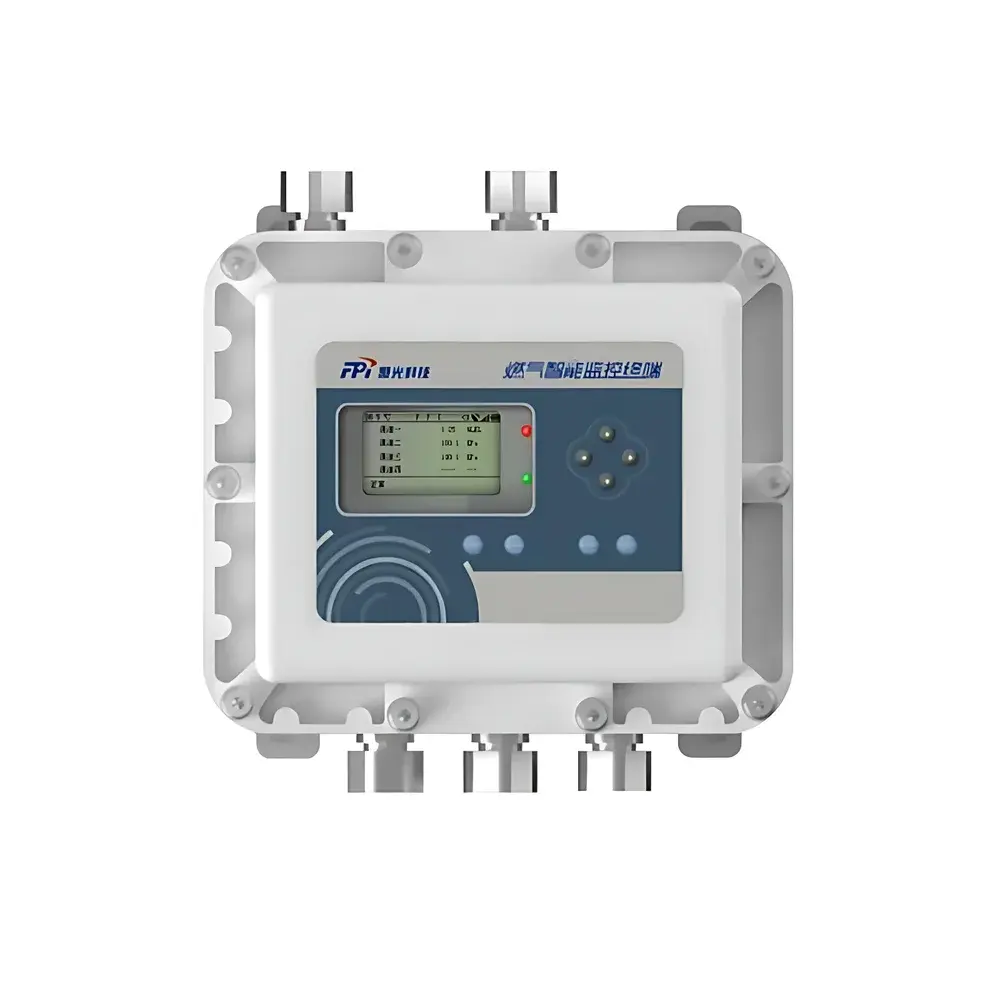
FPI GRTU-100 Intelligent Gas Monitoring Terminal
| Brand | FPI |
|---|---|
| Origin | Zhejiang, China |
| Manufacturer Type | Original Equipment Manufacturer (OEM/ODM) |
| Country of Origin | China |
| Model | GRTU-100 |
| Pricing | Available upon Request |
Overview
The FPI GRTU-100 Intelligent Gas Monitoring Terminal is a purpose-built edge device engineered for continuous, real-time supervision of critical operational parameters across urban natural gas distribution networks. Designed in accordance with the functional architecture of Industrial Internet of Things (IIoT) systems for utility infrastructure, the GRTU-100 functions as a field-deployable data acquisition and telemetry unit—capable of acquiring analog and digital signals from industrial-grade transmitters (e.g., pressure, temperature, flow), performing local logic processing, and transmitting time-synchronized measurement records via GPRS to centralized SCADA or cloud-based monitoring platforms. Its core measurement capability is not analytical (i.e., it does not perform gas composition analysis), but rather supervisory: it ensures integrity, continuity, and traceability of process variables—including line pressure (kPa or bar), ambient/line temperature (°C), and volumetric or differential flow (Nm³/h or m³/h)—at strategic nodes such as pressure regulating stations, regulator cabinets, and valve pits. The terminal operates within an ambient temperature range of –25 °C to +60 °C and meets IP67 ingress protection requirements for underground or outdoor enclosures.
Key Features
- Multi-mode power architecture: Supports simultaneous or fallback operation across three independent sources—220 V AC mains supply, monocrystalline solar panel input (12–24 V DC), and internal rechargeable lithium-ion battery pack (rated ≥18 Ah), enabling uninterrupted operation under grid outage or low-light conditions.
- Industrial-grade I/O flexibility: Equipped with 4–20 mA analog inputs (up to 8 channels), RS485 serial interface compliant with Modbus RTU/ASCII protocols, and discrete digital inputs for alarm status monitoring (e.g., door open, power failure).
- Local human-machine interface (HMI): Integrated monochrome LCD display with tactile keypad for on-site configuration, real-time channel value viewing, unit selection (e.g., kPa vs. MPa), range scaling, and zero/span calibration coefficient adjustment—no external PC required.
- Embedded GNSS positioning: Integrated GPS/GLONASS module delivers geotagged telemetry with ≤5 m CEP accuracy; supports configurable geofencing logic to trigger tamper alerts when device displacement exceeds user-defined radius.
- Dual-path alarm notification: Primary alert delivery via GPRS to central server; automatic failover to SMS gateway (via integrated SIM slot) upon communication timeout or network loss—ensuring regulatory-compliant event reporting latency & redundancy.
- Extended autonomy design: Battery-backed operation sustains full functionality—including sensor excitation, data logging (≥30 days buffered storage), and periodic GPRS transmission—for up to 6 months without external power, verified per IEC 60068-2-1/2 environmental stress testing profiles.
Sample Compatibility & Compliance
The GRTU-100 interfaces natively with standard 4–20 mA two-wire transmitters used across gas utilities—including Rosemount 3051S, Endress+Hauser Promass, and Honeywell ST3000 series—as well as pulse-output flow meters and digital pressure switches. It complies with GB/T 19001–2016 (ISO 9001:2015), GB/T 2423.1–2008 (cold test), and GB/T 2423.2–2008 (dry heat test). Electromagnetic compatibility conforms to GB/T 17626.2–2018 (ESD), GB/T 17626.3–2016 (radiated RF immunity), and GB/T 17626.4–2018 (EFT/burst). For deployment in Class I, Division 2 hazardous locations, optional ATEX/IECEx-certified enclosure variants are available upon request.
Software & Data Management
Field configuration and firmware updates are performed via USB-C or RS232 port using FPI’s proprietary GRTU Configuration Utility (Windows/Linux CLI). Telemetry data follows a structured JSON payload format aligned with MQTT v3.1.1 or HTTP POST protocols, supporting TLS 1.2 encryption and configurable reporting intervals (1–3600 seconds). All configuration changes, alarm events, and communication logs are timestamped and stored locally with SHA-256 hashed audit trails—enabling compliance with GLP/GMP documentation requirements and facilitating forensic review during incident investigations. Optional integration with FPI’s CloudGas™ platform provides dashboard visualization, historical trend analysis, and automated report generation (PDF/CSV) meeting ISO 55001 asset management framework conventions.
Applications
- Real-time pressure monitoring at medium-pressure (0.2–0.4 MPa) regulator stations to prevent overpressure events impacting downstream low-pressure networks.
- Temperature-compensated flow validation in custody transfer points where thermal expansion affects volumetric metering accuracy.
- Remote surveillance of unstaffed valve pits to detect unauthorized access, mechanical damage, or environmental anomalies (e.g., flooding, extreme cold).
- Performance benchmarking of pressure-reducing valves by correlating upstream/downstream pressure differentials with flow rate trends over seasonal load cycles.
- Supporting predictive maintenance programs through statistical analysis of parameter drift (e.g., gradual pressure drop indicating filter clogging or regulator wear).
FAQ
Does the GRTU-100 support LoRaWAN or NB-IoT connectivity?
No—the standard GRTU-100 implements GPRS (2G/3G fallback) as its primary wide-area telemetry interface. LoRaWAN and NB-IoT variants are available under custom OEM program (lead time: 12 weeks).
Can the device store data locally if cellular connectivity is lost?
Yes—it retains up to 30 days of 1-minute interval measurements in non-volatile flash memory, with automatic resynchronization upon network recovery.
Is the GPS module capable of indoor positioning?
No—GPS functionality requires unobstructed sky view; indoor or underground installation mandates external active GPS antenna extension kit.
What cybersecurity certifications does the device hold?
It adheres to IEC 62443-3-3 SL1 requirements for secure boot, encrypted configuration storage, and role-based local access control; third-party penetration testing reports are available under NDA.
How is calibration traceability maintained?
Each unit ships with factory calibration certificate referencing national metrology standards (CNAS-accredited); field recalibration tools and procedures comply with JJG 882–2019 (pressure transmitter verification regulation).
Related Products