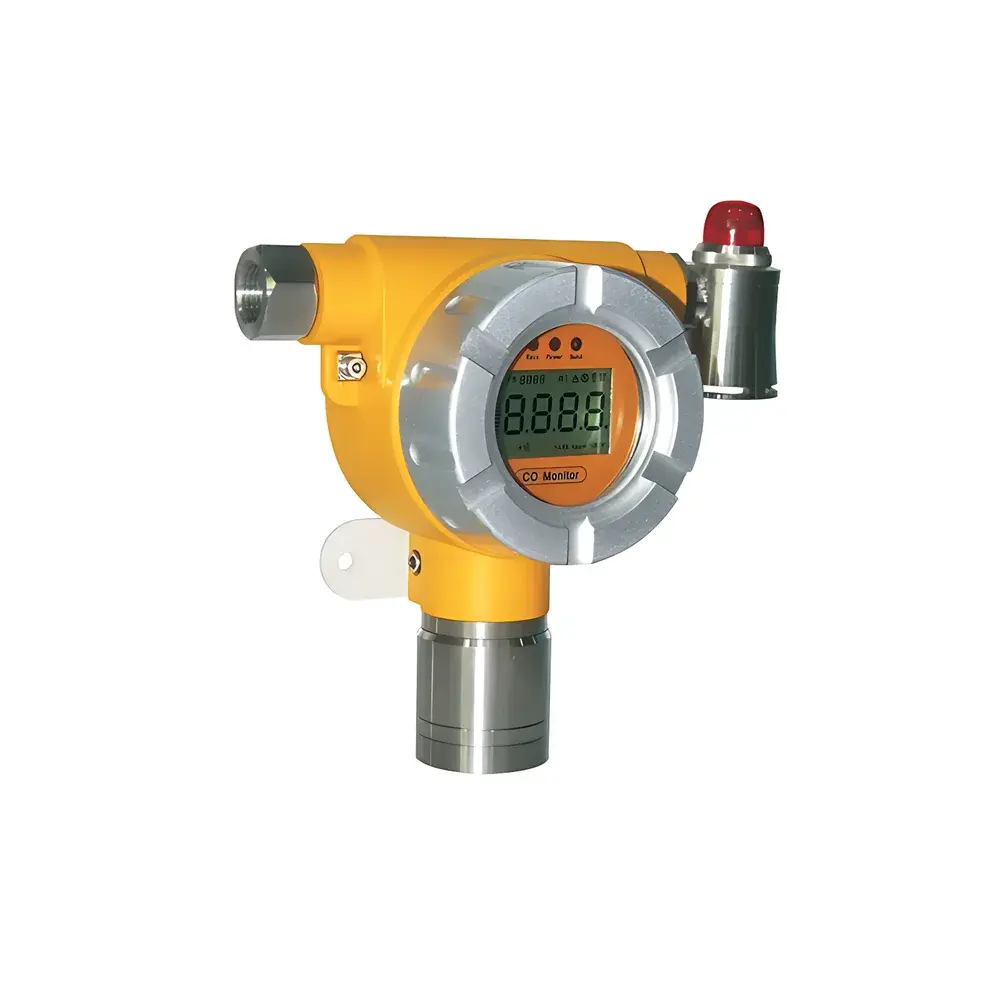
FPI GT-1030 Intrinsically Safe LED Display Gas Detector Transmitter
| Brand | FPI |
|---|---|
| Origin | Zhejiang, China |
| Manufacturer Type | Manufacturer |
| Country of Origin | Domestic (China) |
| Model | GT-1030 |
| Pricing | Upon Request |
Overview
The FPI GT-1030 is an intrinsically safe, explosion-proof gas detection transmitter engineered for continuous monitoring of combustible gases in hazardous industrial environments. Certified to Ex d IIC T6 Gb (IEC 60079-1), it complies with international standards for use in Zone 1 and Zone 2 classified areas—locations where explosive gas atmospheres may occur during normal operation or infrequently under fault conditions. The instrument operates on the catalytic combustion principle, utilizing high-stability imported pellistor sensors optimized for hydrocarbon detection (e.g., methane, propane, hydrogen). Its robust aluminum alloy housing, IP65-rated enclosure, and integrated thermal compensation algorithm ensure long-term measurement stability across ambient temperatures ranging from −20 °C to +50 °C. Designed as a fixed-point, wall- or pipe-mounted transmitter, the GT-1030 delivers real-time concentration data via analog output and supports local visual indication through high-brightness LED display—enabling rapid operator assessment without reliance on remote SCADA interfaces.
Key Features
- Explosion-proof certification per IEC 60079-1 (Ex d IIC T6 Gb), suitable for Zone 1/2 installations in petrochemical, metallurgical, and power generation facilities
- Imported catalytic bead sensor with over-range protection circuitry to prevent sensor poisoning and extend service life
- Dual-mode display: high-luminance LED (standard) with optional LCD variant; visible at distances up to 10 meters under ambient lighting
- Smart infrared bidirectional communication for zero-contact configuration, calibration, and diagnostics—no need to open the enclosure during routine maintenance
- Standard 4–20 mA three-wire current loop output with HART protocol support (optional), compatible with DCS, PLC, and safety instrumented systems (SIS)
- Integrated relay outputs (SPDT, 250 VAC/3 A) for direct actuation of ventilation fans, solenoid valves, or shutdown interlocks
- Onboard audible and visual alarm interface supporting external horn strobes compliant with IEC 61000-4-2/4-3 EMI immunity requirements
Sample Compatibility & Compliance
The GT-1030 is calibrated for common combustible gases including but not limited to methane (CH₄), propane (C₃H₈), hydrogen (H₂), and gasoline vapors. Sensor cross-sensitivity profiles are documented per ISO 16000-23 and ASTM D5402 for trace-level interference assessment. The device conforms to electromagnetic compatibility (EMC) requirements per EN 61326-1 (industrial environment), functional safety guidelines aligned with IEC 61508 SIL 2 hardware fault tolerance, and installation practices referenced in IEC 60079-14. It supports compliance workflows for process safety management (PSM) under OSHA 1910.119 and is routinely deployed in facilities requiring adherence to API RP 14C, NFPA 72, and China’s GB 50493–2019 standard for flammable and toxic gas detection design.
Software & Data Management
Configuration and calibration are managed via FPI’s proprietary IR handheld configurator (model FPI-IR-PRO), which stores device parameters, calibration logs, and bump test records locally. All configuration changes generate timestamped audit trails compliant with GLP and FDA 21 CFR Part 11 requirements when used in regulated environments. While the GT-1030 itself does not embed firmware-based data logging, its 4–20 mA output integrates seamlessly with third-party historian platforms (e.g., Emerson DeltaV, Honeywell Experion, Siemens Desigo CC) for trend analysis, alarm suppression logic, and automated report generation. Firmware updates are performed offline using certified engineering workstations following change control procedures defined in ISO 9001:2015 Clause 8.5.1.
Applications
- Continuous hydrocarbon vapor monitoring in refinery process units, compressor stations, and LNG loading berths
- Combustible gas surveillance in coke oven battery zones, sintering plants, and blast furnace tuyere areas within integrated steel mills
- Real-time leak detection in semiconductor fab utility tunnels carrying hydrogen, silane, or ammonia
- Fixed-point monitoring for city gate stations, pressure regulation skids, and underground gas distribution manholes
- Integration into major hazard installation (MHI) monitoring systems per EU Seveso III Directive and China’s “Regulations on the Safety Management of Hazardous Chemicals”
FAQ
What certifications does the GT-1030 hold for hazardous area installation?
It carries Ex d IIC T6 Gb certification per IEC 60079-1 and meets GB 3836.1–2010 / GB 3836.2–2010 for domestic deployment in China.
Can the GT-1030 detect toxic gases such as H₂S or CO?
No—it is specifically configured for combustible gases using catalytic combustion technology; toxic gas detection requires electrochemical or PID-based variants (e.g., FPI GT-2000 series).
Is remote calibration supported without physical access to the device?
Yes—via infrared bidirectional communication using the FPI-IR-PRO configurator, enabling zero-entry calibration verification in live hazardous zones.
Does the unit support Modbus RTU or other digital fieldbus protocols?
Standard configuration includes 4–20 mA analog output only; Modbus RTU or HART digital overlay is available as a factory-configurable option.
What is the recommended calibration interval under typical industrial conditions?
FPI recommends functional bump testing every 30 days and full span calibration every 6 months, per ISA-TR84.00.07 and manufacturer’s maintenance schedule.