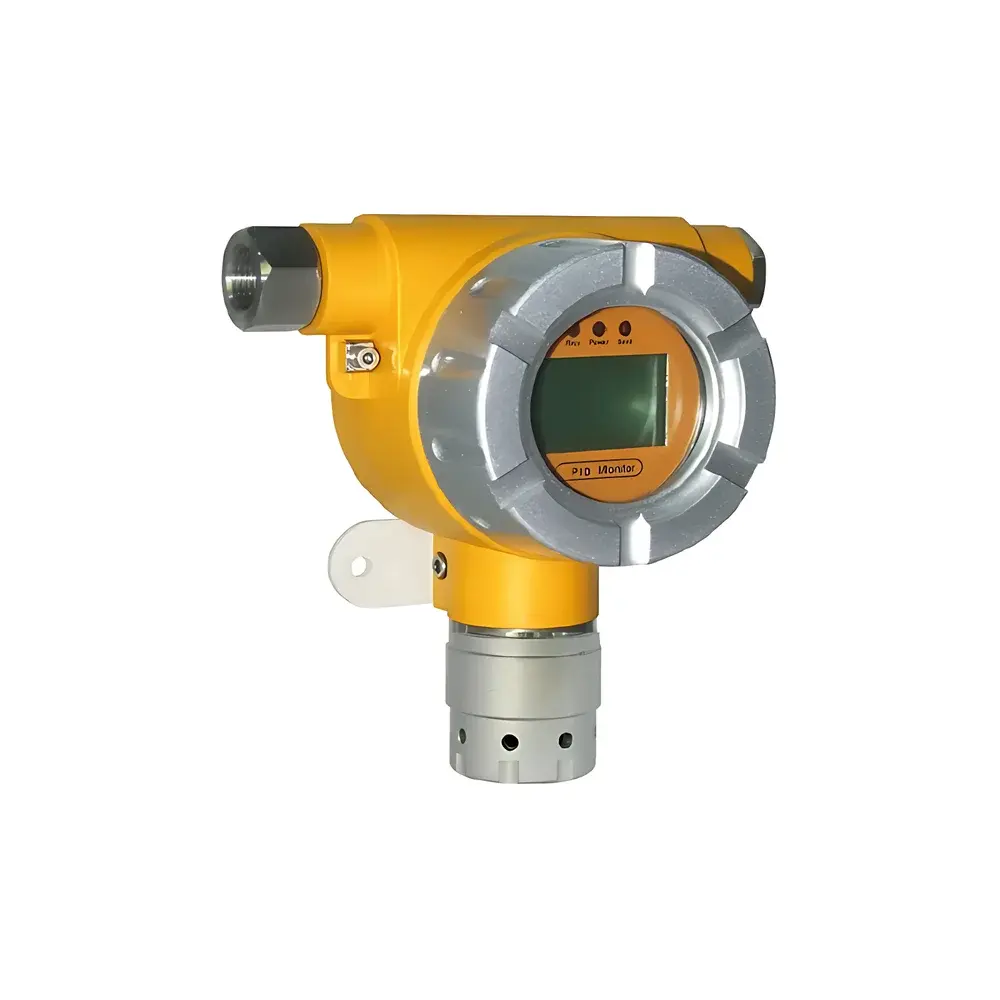
FPI GT-1040 Photoionization Detector (PID) for VOC Leak Detection
| Brand | FPI |
|---|---|
| Origin | Zhejiang, China |
| Manufacturer Type | Original Equipment Manufacturer (OEM) |
| Country of Origin | China |
| Model | GT-1040 |
| Pricing | Available Upon Request |
| Certification | Ex d II CT6 Gb |
| Operating Zones | Zone 1 & Zone 2 Hazardous Areas |
| Response Time (T90) | <10 s |
| Sensor Type | Imported High-Stability PID Sensor |
| Compensation | Integrated Temperature & Concentration Compensation |
| Enclosure | Corrosion-Resistant Multi-Layer Surface Treatment |
| Alarm Output | Integrated Visual-Audible Alarm Module |
| Communication | Infrared Bidirectional Remote Control with Display (No-Open-Cover Maintenance) |
Overview
The FPI GT-1040 Photoionization Detector (PID) is an intrinsically robust, fixed-mount gas detection instrument engineered for continuous real-time monitoring and rapid alarm response to volatile organic compounds (VOCs) in industrial process environments. Based on the photoionization principle—where ultraviolet (UV) photons (typically 10.6 eV lamp energy) ionize VOC molecules in sampled air—the GT-1040 generates a proportional current signal calibrated to concentration (ppm or ppb). Its design prioritizes operational safety in classified hazardous locations, complying fully with IEC 60079-0 and IEC 60079-1 for flameproof enclosure (Ex d II CT6 Gb), enabling deployment in Zone 1 (explosive gas atmosphere likely during normal operation) and Zone 2 (explosive atmosphere unlikely, if occurring, will persist only briefly). The instrument is not intended for ambient air quality research or laboratory-grade speciation but rather for plant-wide leak detection, perimeter monitoring, and confined space entry support within petrochemical, pharmaceutical, coating, and semiconductor manufacturing facilities.
Key Features
- Fast-response detection with T90 ≤ 10 seconds—enabling timely personnel evacuation and process interlock activation in dynamic emission scenarios.
- Integrated temperature and concentration compensation algorithms mitigate drift caused by ambient thermal fluctuation and humidity-induced sensor baseline shift, ensuring stable calibration integrity over extended field service intervals.
- Multi-stage corrosion-resistant surface treatment—including electrophoretic coating, passivation, and UV-stabilized polymer sealing—enhances long-term durability in high-humidity, acidic, or saline industrial atmospheres (e.g., offshore platforms, wastewater treatment plants).
- Built-in dual-mode alarm system: high-intensity LED strobe (≥120 cd) and 95 dB(A) audible horn compliant with IEC 61000-4-2 ESD immunity requirements.
- Infrared bidirectional remote interface with integrated OLED display allows full configuration, zero/span calibration verification, and event log review without opening the explosion-proof housing—reducing maintenance downtime and eliminating ignition risk during servicing.
Sample Compatibility & Compliance
The GT-1040 is optimized for detection of C2–C12 hydrocarbons (e.g., benzene, toluene, xylene), chlorinated solvents (e.g., trichloroethylene), ketones (e.g., acetone), and amines—compounds with ionization potentials below 10.6 eV. It does not detect methane, ethane, formaldehyde, or CO₂. All electrical interfaces conform to EN 61326-1 (EMC for industrial environments) and EN 61000-6-2/6-4. Mechanical construction adheres to IP66 ingress protection rating. Documentation includes full traceable factory calibration certificates per ISO/IEC 17025-accredited procedures and supports audit readiness for OSHA 1910.120 (HAZWOPER), EPA Method 21 (leak detection), and internal GLP/GMP site protocols.
Software & Data Management
The GT-1040 outputs 4–20 mA analog signal (HART-enabled) and Modbus RTU via RS-485 for integration into DCS, SCADA, or centralized gas monitoring systems. Optional FPI CloudLink gateway enables encrypted MQTT-based telemetry with time-stamped event logging (alarm triggers, calibration actions, fault codes). Data retention complies with FDA 21 CFR Part 11 requirements when deployed with validated audit trail modules—supporting electronic signature, user role-based access control, and immutable record archiving for regulatory submissions.
Applications
- Real-time leak detection at flanges, valves, pumps, and compressors in refineries and chemical processing units.
- Perimeter fence-line monitoring to verify compliance with local VOC emission limits (e.g., EU Industrial Emissions Directive 2010/75/EU).
- Pre-entry verification for maintenance crews entering tanks, reactors, or ductwork where residual solvent vapors may accumulate.
- Continuous monitoring in paint spray booths, adhesive application zones, and cleaning stations where intermittent high-concentration VOC plumes occur.
- Integration with emergency shutdown systems (ESD) to initiate ventilation override or process isolation upon threshold exceedance.
FAQ
What VOCs can the GT-1040 reliably detect?
It detects most aromatic, olefinic, and saturated VOCs with ionization energies <10.6 eV—including benzene, styrene, isopropanol, and methyl ethyl ketone—but excludes permanent gases (e.g., CH₄, CO) and low-IP compounds like H₂S or NH₃ that require electrochemical or IR sensing.
Is field calibration required, and how often?
Zero and span verification using certified calibration gas (e.g., 100 ppm isobutylene in N₂) is recommended every 3–6 months depending on exposure history; the infrared remote interface supports full calibration without enclosure breach.
Can the GT-1040 be integrated into existing safety instrumented systems (SIS)?
Yes—via its SIL2-capable 4–20 mA output with fail-safe diagnostics (HART device status reporting), it interfaces directly with SIS logic solvers meeting IEC 61511 requirements.
Does the unit support data logging onboard?
No internal SD card or memory; however, all real-time readings and alarm events are transmitted continuously via analog or digital output for external historian storage.
What is the expected service life of the UV lamp and sensor?
The imported 10.6 eV lamp has a rated lifetime of ≥6,000 operating hours; the PID sensor module is field-replaceable and typically maintains metrological stability for 18–24 months under typical industrial conditions.
Related Products