
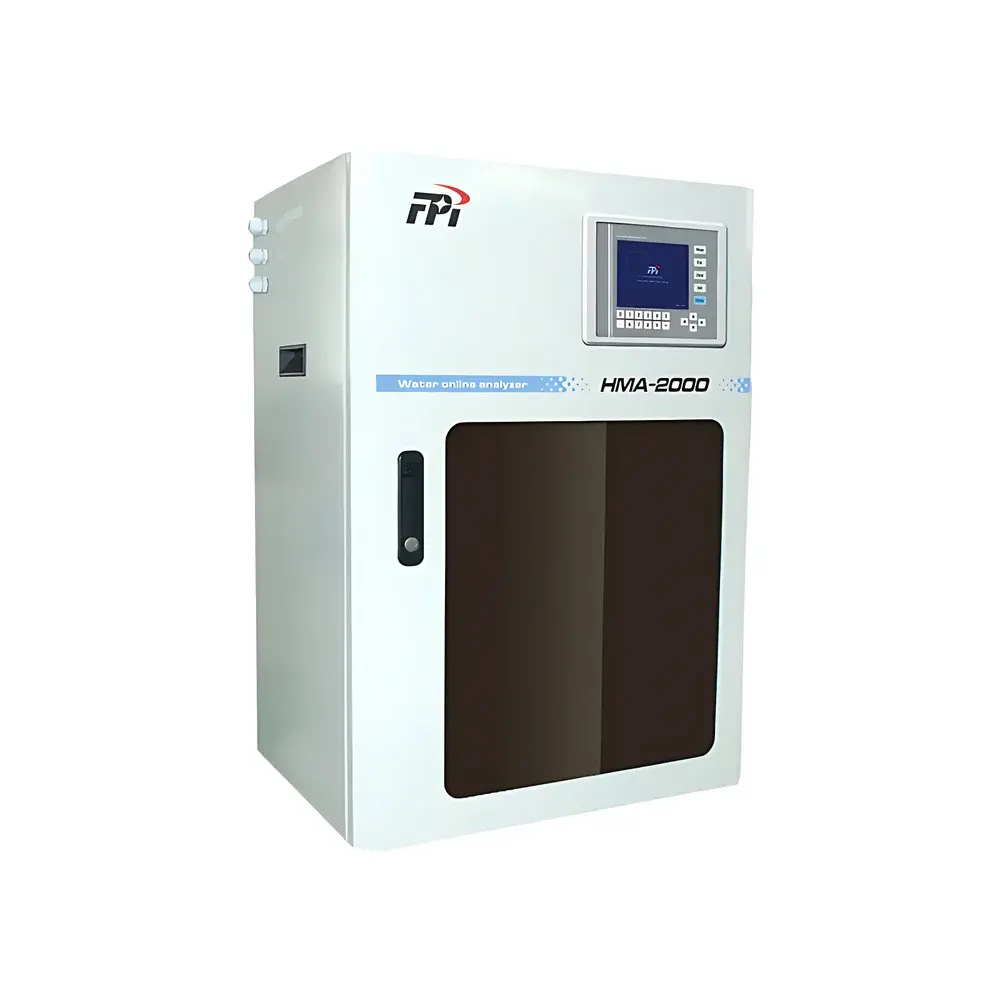
FPI HMA-2000 Series Online Anodic Stripping Voltammetry (ASV) Heavy Metals Analyzer for Pb and Cd
| Brand | FPI |
|---|---|
| Origin | Zhejiang, China |
| Manufacturer | FPI (Original Equipment Manufacturer) |
| Model | HMA-2000 Series |
| Instrument Type | Online Analyzer |
| Detection Principle | Anodic Stripping Voltammetry (ASV) |
| Target Metals | Lead (Pb), Cadmium (Cd) |
| Detection Time | Zero Drift (24 h): ±5% F.S. |
| Resolution | 0.0001 mg/L |
| Sample Throughput | Continuous online operation with programmable measurement intervals |
| Reagent Consumption | <20% of conventional flow-injection ASV systems |
| Digestion | Sealed high-temperature high-pressure digestion module (up to 180 °C, 2 MPa) |
| Compliance | Designed for ISO 17294-2, EPA Method 200.8, and ASTM D3559–22 compatibility |
Overview
The FPI HMA-2000 Series Online Anodic Stripping Voltammetry (ASV) Heavy Metals Analyzer is an engineered solution for continuous, real-time quantification of trace-level lead (Pb) and cadmium (Cd) in aqueous environmental matrices. It operates on the electrochemical principle of anodic stripping voltammetry—a two-step process comprising controlled electrochemical preconcentration (reduction) of target metal ions onto a mercury-film or bismuth-film working electrode, followed by oxidative stripping under precisely ramped potential conditions. The resulting current peaks—characteristic in both position (Ep) and magnitude (ip)—are directly proportional to metal concentration per the Randles–Sevcik equation. Unlike optical or atomic absorption techniques, ASV delivers sub-pptr detection sensitivity without requiring inert gas shielding or high-power plasma sources, making it uniquely suited for unattended, low-maintenance deployment in remote or resource-constrained monitoring stations.
Key Features
- Patented sequential injection analysis (SIA) platform minimizes reagent consumption to 10–20% of conventional ASV flow systems—reducing operational cost and hazardous waste generation.
- Non-contact volumetric dosing via high-precision syringe pumps ensures long-term stability in sample and electrolyte delivery; no pump tubing fatigue or calibration drift over extended cycles.
- Integrated sealed high-temperature, high-pressure digestion module (rated to 180 °C and 2 MPa) achieves near-complete oxidation of organometallic complexes and particulate-bound metals, enabling total recoverable Pb/Cd determination per EPA 200.8 requirements.
- Real-time reagent level monitoring with audible/visual alerts prevents instrument downtime due to reagent exhaustion—critical for compliance-driven continuous emission monitoring systems (CEMS).
- Configurable measurement protocols—including fixed-interval, event-triggered, and adaptive sampling—support dynamic regulatory reporting needs across wastewater discharge points, drinking water intakes, and surface water reference sites.
Sample Compatibility & Compliance
The HMA-2000 accepts raw influent, clarified effluent, filtered surface water, and potable water samples with turbidity ≤ 100 NTU and suspended solids ≤ 50 mg/L. Integrated filtration and pH adjustment modules ensure matrix stabilization prior to digestion. All wetted components are chemically resistant (PTFE, PEEK, borosilicate glass), minimizing adsorption losses and cross-contamination. The system architecture supports audit-ready data integrity: full electronic records of calibration events, method parameters, maintenance logs, and raw voltammograms are time-stamped and cryptographically signed. It is designed to meet GLP/GMP data handling expectations and aligns with FDA 21 CFR Part 11 requirements for electronic records and signatures when deployed in regulated utilities.
Software & Data Management
The embedded Linux-based control unit runs FPI’s ASV-OS v4.x firmware, providing local touchscreen operation and secure remote access via TLS-encrypted web interface. Data output includes peak current (nA), peak potential (mV), calculated concentration (µg/L), detection status flags, and QC metrics (e.g., electrode renewal count, background current deviation). Raw voltammograms are exportable in IEEE CDF format for third-party electrochemical modeling. Integration with SCADA, LIMS, and national environmental monitoring platforms (e.g., China’s MEP-EMIS, US EPA’s CDX) is supported through Modbus TCP, OPC UA, and HTTP RESTful APIs. Automated daily calibration verification using certified multi-element standard solutions ensures traceability to NIST SRM 1643e.
Applications
- Continuous compliance monitoring at industrial wastewater discharge outlets—particularly electroplating, battery manufacturing, and mining facilities subject to local heavy metals discharge limits (e.g., China’s GB 8978–1996, EU IED Annex I).
- Early-warning surveillance of municipal wastewater treatment plant (WWTP) influent and effluent streams to detect illicit discharges or process upsets.
- Long-term trend analysis in rivers, lakes, and reservoirs under national surface water quality assessment programs (e.g., China’s “Blue Sky and Clear Water” initiative, USGS NWIS).
- Source water protection for drinking water treatment plants—enabling rapid response to contamination events involving Pb/Cd from legacy infrastructure or agricultural runoff.
FAQ
What sample pretreatment is required before analysis?
No manual filtration or acidification is needed—the system performs inline coarse filtration (50 µm), UV digestion (optional), and high-pressure thermal digestion automatically.
Can the analyzer be calibrated remotely?
Yes—remote calibration is supported via secure HTTPS session with dual-factor authentication; all calibration steps are logged with digital signatures.
Is mercury used in the electrode system?
The standard configuration employs a renewable bismuth-film electrode (BiFE) to eliminate mercury handling; optional mercury-film electrodes are available for research-grade validation studies.
How often does the working electrode require renewal?
Electrode renewal is fully automated and occurs after every 20–50 analyses depending on matrix fouling; typical service interval exceeds 6 months under municipal wastewater conditions.
Does the system support simultaneous detection of other metals beyond Pb and Cd?
The HMA-2000 Series is optimized for dual-parameter Pb/Cd; expansion to Cu, Zn, and As requires hardware revision (HMA-2000+ variant) and updated firmware licensing.







