
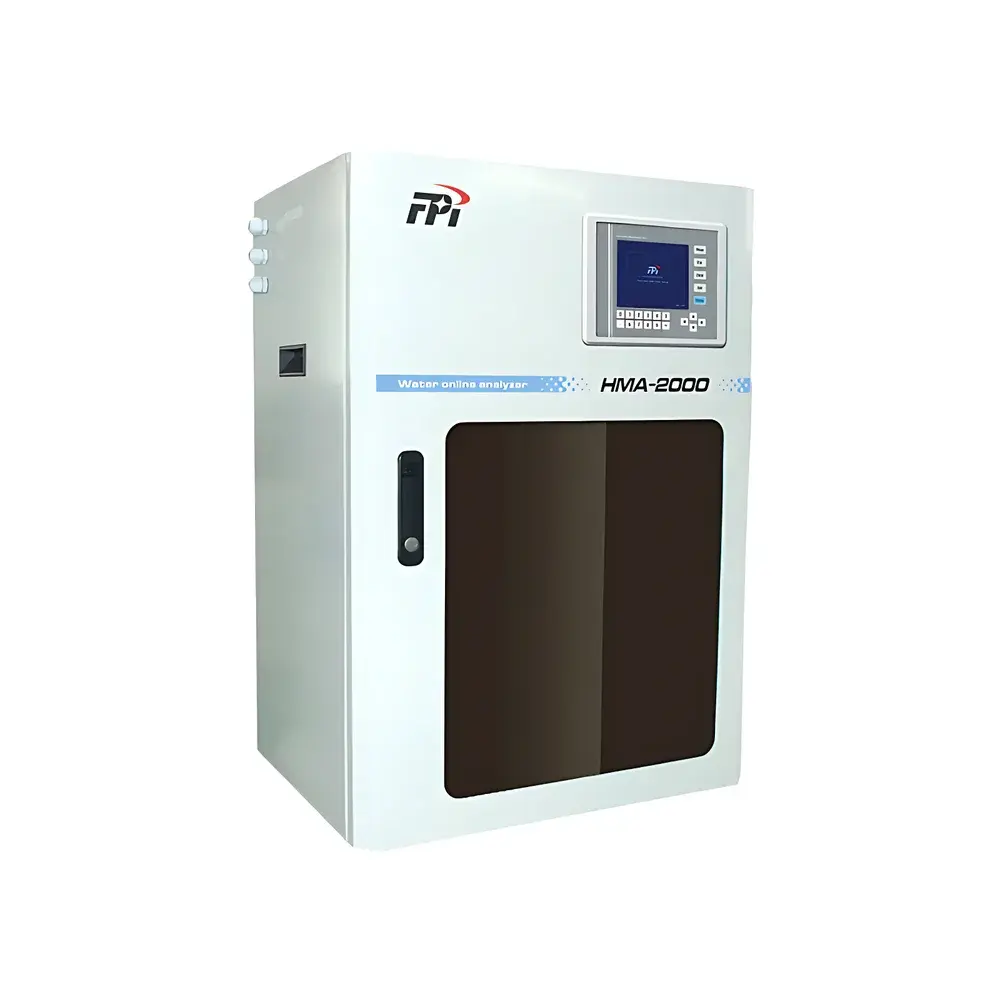
FPI HMA-2000 Single-Parameter Heavy Metals Online Analyzer Based on Anodic Stripping Voltammetry
| Brand | FPI |
|---|---|
| Origin | Zhejiang, China |
| Manufacturer Type | Original Equipment Manufacturer (OEM) |
| Country of Origin | China |
| Model | HMA-2000 |
| Instrument Type | Online Analytical System |
| Detection Principle | Anodic Stripping Voltammetry (ASV) |
| Target Metals | Pb, Cd, As, or Hg (configurable per unit) |
| Zero Drift | ±5% F.S. |
| Accuracy/Precision | ±10% |
| Resolution | 0.0001 mg/L |
Overview
The FPI HMA-2000 is a dedicated single-parameter online analyzer engineered for continuous, real-time quantification of trace heavy metals—including lead (Pb), cadmium (Cd), arsenic (As), or mercury (Hg)—in aqueous environmental matrices. It operates on the electrochemical principle of anodic stripping voltammetry (ASV), a well-established technique recognized in ASTM D3559, ISO 11969, and EPA Method 7063 for ultra-trace metal analysis. In ASV, target metal ions are first electrochemically pre-concentrated (reduced and deposited) onto a working electrode surface under controlled potential, followed by oxidative stripping (dissolution) via a precisely ramped or stepped potential waveform. The resulting current peaks are directly proportional to analyte concentration, enabling sub-ppb detection capability without reliance on optical or radioactive detection methods.
Key Features
- Optimized ASV detection architecture delivering a method detection limit (MDL) of ≤0.5 µg/L for all configured analytes—validated under representative field water matrices including municipal wastewater, surface water, and source drinking water.
- Integrated high-pressure, high-temperature (up to 180 °C / 1.2 MPa) microwave-assisted digestion module ensures complete oxidation and speciation conversion of organometallic complexes and particulate-bound fractions, supporting total metal quantification per ISO 17294-2 requirements.
- Patented sequential injection analysis (SIA) platform minimizes reagent consumption to 10–20% of conventional flow-injection systems, reducing operational cost and hazardous waste generation while maintaining hydraulic stability across extended unattended operation.
- Non-contact volumetric metering via high-precision stepper-driven syringe pumps eliminates mechanical wear, pump tube replacement cycles, and associated calibration drift—critical for long-term reproducibility in regulatory monitoring applications.
- Real-time onboard reagent level monitoring with configurable low-volume alerts prevents system idle time and safeguards analytical integrity during multi-day autonomous deployment.
- Flexible measurement scheduling—including fixed-interval, event-triggered, and adaptive cycle modes—enables synchronization with discharge events, diurnal flow patterns, or compliance reporting windows.
Sample Compatibility & Compliance
The HMA-2000 accepts raw influent or filtered water samples (0.45 µm nominal pore size) with turbidity ≤100 NTU and total suspended solids ≤150 mg/L. It complies with CE marking directives for electromagnetic compatibility (2014/30/EU) and low-voltage safety (2014/35/EU). Its analytical performance aligns with the data quality objectives (DQOs) outlined in EU Water Framework Directive (2000/60/EC) Annex V for priority hazardous substances and supports adherence to China’s HJ 636–2012 and US EPA NPDES permit monitoring requirements. Full audit trail functionality—including user login logs, method version history, and raw voltammogram storage—is available to meet GLP and ISO/IEC 17025 documentation expectations.
Software & Data Management
The embedded firmware (v3.2+) supports Modbus TCP, OPC UA, and 4–20 mA analog output for seamless integration into SCADA and DCS environments. Data export formats include CSV and XML with timestamped metadata (UTC-aligned), peak identification flags, and QC parameter annotations (e.g., baseline noise, deposition charge, peak symmetry). Optional cloud-based remote diagnostics and predictive maintenance analytics are accessible via secure TLS 1.2–encrypted HTTPS interface. All software modules conform to FDA 21 CFR Part 11 requirements for electronic records and signatures when deployed with role-based access control and electronic audit trails enabled.
Applications
- Continuous compliance monitoring at industrial effluent discharge points subject to local environmental permits (e.g., zinc plating, battery manufacturing, mining leachate).
- Real-time surveillance of municipal wastewater treatment plant (WWTP) influent and effluent streams for early warning of toxic shock loads.
- Long-term trend analysis of heavy metal concentrations in rivers, lakes, and reservoirs as part of national ambient water quality assessment programs.
- Early detection of contamination events in protected drinking water sources—particularly where legacy pollution or geogenic arsenic poses public health risk.
- Supporting research-grade validation studies requiring high-frequency temporal resolution (e.g., diurnal cycling, stormwater runoff characterization).
FAQ
What metals can the HMA-2000 measure simultaneously?
The HMA-2000 is a single-parameter instrument: each unit is factory-configured for one specific element—Pb, Cd, As, or Hg—and cannot be reconfigured in-field.
Is sample filtration required prior to analysis?
Yes. A 0.45 µm inline filter is mandatory upstream of the analyzer inlet to prevent electrode fouling and ensure consistent deposition kinetics.
How often does the working electrode require cleaning or replacement?
Under typical operation with filtered surface water, the bismuth-film or mercury-film electrode requires manual regeneration every 7–14 days; full replacement is recommended after ≥1,000 measurement cycles.
Does the system support remote calibration verification?
Yes—via automated spike recovery tests using onboard standard solutions, with results logged and reportable alongside routine measurements.
Can the HMA-2000 be integrated into existing telemetry networks?
Yes—through native Modbus RTU over RS-485 or Modbus TCP/IP, with configurable polling intervals and alarm thresholds aligned to regional regulatory frameworks.
Related Products







