
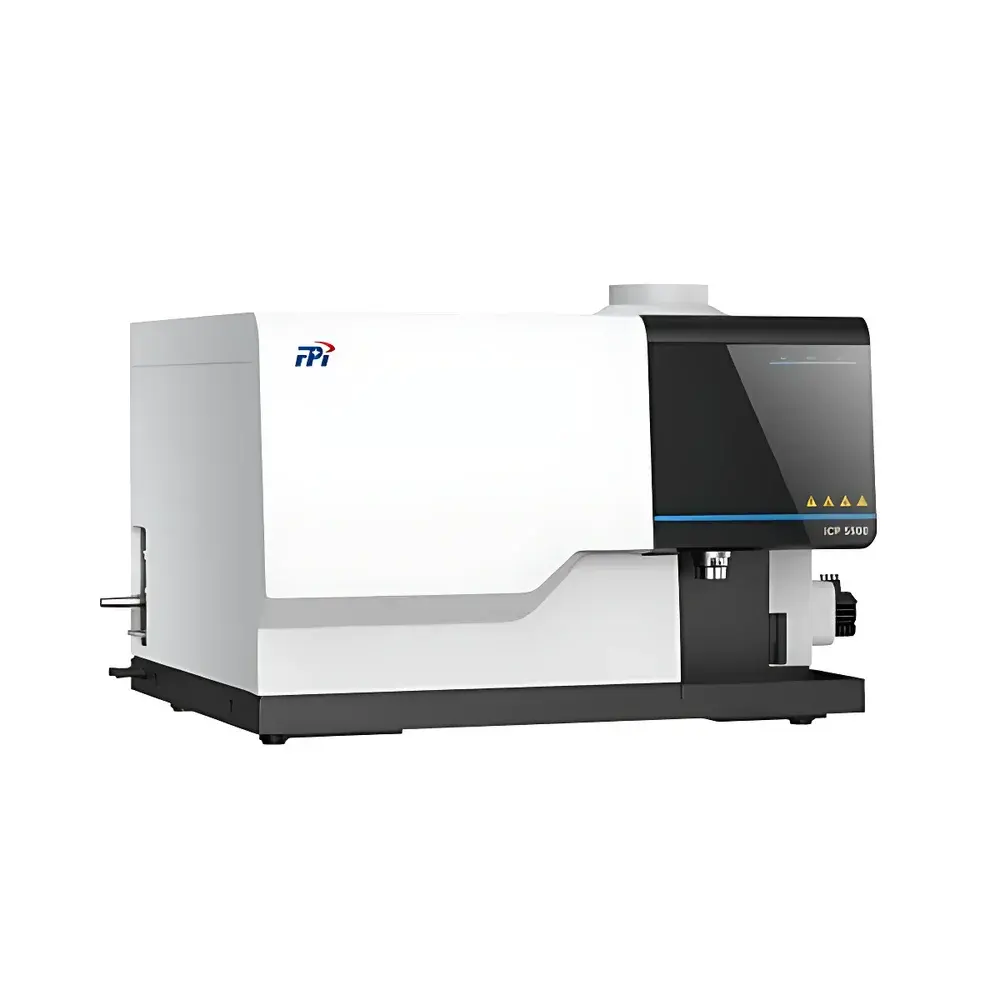
FPI ICP-5500 Inductively Coupled Plasma Optical Emission Spectrometer
| Brand | FPI |
|---|---|
| Origin | Zhejiang, China |
| Model | ICP-5500 |
| Detector | High-resolution overflow-resistant CCD |
| RF Source | All-solid-state self-excited 27.12 MHz generator |
| Optical System | Precision thermostatically controlled Czerny–Turner monochromator with holographic grating |
| Gas Control | Integrated automatic argon flow management module |
| Standby Mode | iStandby (reduces Ar consumption by >50%) |
| Calibration | Real-time full-spectrum calibration using interference-free Ne emission lines |
| Sample Introduction | Multi-channel high-precision peristaltic pump with integrated nebulizer and spray chamber |
| Compliance | Designed to support ISO/IEC 17025, ASTM D1976, EPA Method 200.7, USP <232>/<233>, and GLP/GMP data integrity requirements |
| Software | FPI-SpectraSuite v4.x with 21 CFR Part 11-compliant audit trail, electronic signatures, and raw data archiving |
Overview
The FPI ICP-5500 Inductively Coupled Plasma Optical Emission Spectrometer is an analytical instrument engineered for precise, multi-element quantitative and semi-quantitative determination of metals and selected non-metals in liquid samples. It operates on the principle of inductively coupled plasma optical emission spectroscopy (ICP-OES), wherein sample aerosols are atomized, ionized, and excited in a high-temperature (~6,000–10,000 K) argon plasma generated by a radiofrequency (RF) induction coil. Emitted photons from electronically excited atoms and ions are dispersed via a high-fidelity Czerny–Turner optical system and detected across the ultraviolet–visible–near-infrared spectrum (165–900 nm) using a high-resolution, overflow-resistant charge-coupled device (CCD) detector. This enables simultaneous acquisition of full spectral profiles, supporting robust background correction, inter-element interference assessment, and long-term signal stability—critical for routine environmental, pharmaceutical, geological, and industrial quality control laboratories.
Key Features
- All-solid-state, self-excited 27.12 MHz RF generator delivering stable plasma power output with enhanced tolerance to matrix-induced load variations, including high-salt or organic solvent-based samples.
- Precision thermostatically controlled optical bench maintaining temperature stability within ±0.1 °C, minimizing thermal drift of spectral line positions and ensuring reproducible wavelength registration over extended operation cycles.
- Integrated argon gas management system with real-time pressure and flow feedback control, eliminating manual regulator adjustments and improving plasma ignition reliability and sample introduction consistency.
- iStandby low-power mode reducing argon consumption by more than 50% during idle periods without compromising optical alignment or detector readiness—validated for overnight and weekend unattended operation.
- Real-time full-spectrum calibration utilizing neon (Ne) emission lines at known wavelengths (e.g., 446.73 nm, 540.05 nm, 640.22 nm), enabling continuous correction of minor grating thermal shifts and maintaining spectral fidelity across multi-day analytical campaigns.
- Multi-channel peristaltic pump with independent tubing paths for sample, internal standard, and rinse solutions—configured for seamless method switching, automated dilution, and cross-contamination minimization.
Sample Compatibility & Compliance
The ICP-5500 accommodates aqueous solutions, acid-digested environmental matrices (soil, sludge, water), digested biological tissues, pharmaceutical excipients, catalyst residues, and semiconductor-grade reagents. Sample introduction supports both concentric glass and V-groove nebulizers, paired with cyclonic or Scott-type spray chambers. The system meets essential regulatory design expectations for analytical instrumentation used in accredited testing facilities: it supports ISO/IEC 17025 method validation workflows, complies with EPA Method 200.7 for drinking water analysis, aligns with ASTM D1976 for petroleum products, and facilitates adherence to USP Chapters (Elemental Impurities – Limits) and (Elemental Impurities – Procedures). Instrument software includes configurable audit trails, user access levels, and electronic signature capabilities compliant with FDA 21 CFR Part 11 for regulated environments operating under GLP or GMP frameworks.
Software & Data Management
FPI-SpectraSuite v4.x provides a modular, Windows-based platform for instrument control, spectral acquisition, quantitative calibration (including internal standardization, standard addition, and matrix-matched calibration), and report generation. Raw spectral data are stored in vendor-neutral HDF5 format with embedded metadata (wavelength, integration time, RF power, gas flows, detector temperature). The software implements automated spectral deconvolution for overlapping peaks (e.g., Fe 238.204 nm / Cr 238.203 nm), background subtraction using polynomial or multi-point algorithms, and dynamic linear range extension via dual-exposure acquisition. All user actions—including method edits, calibration updates, and result approvals—are logged with timestamps, operator IDs, and change descriptions, satisfying traceability requirements for regulatory audits.
Applications
The ICP-5500 serves as a core elemental analyzer in diverse sectors: environmental labs quantifying trace metals (As, Cd, Pb, Hg) in wastewater per EPA protocols; pharmaceutical QA/QC teams verifying elemental impurity profiles in active pharmaceutical ingredients (APIs); geochemical laboratories determining rare earth element (REE) patterns in rock digests; and materials science facilities assessing dopant concentrations in battery cathode precursors or metal-organic frameworks. Its high spectral resolution and real-time calibration also support research applications such as speciation studies (when coupled with HPLC), kinetic monitoring of leaching processes, and multi-isotope ratio screening via isotopic emission line intensity ratios.
FAQ
What plasma gas is required for operation?
High-purity argon (≥99.996%) is mandatory for plasma generation, nebulization, and auxiliary gas flow. Optional nitrogen sheath gas capability is not included in the base configuration.
Does the system support hydride generation or laser ablation interfaces?
The ICP-5500 is configured for solution nebulization only. Hydride generation (HG) and laser ablation (LA) accessories are available as optional third-party integrations but require hardware and software modifications beyond factory specifications.
How is wavelength calibration verified during routine use?
Calibration is continuously monitored using multiple neon emission lines; verification reports can be scheduled daily or per batch and exported as PDF or CSV for quality records.
Is remote diagnostics supported?
Yes—FPI-SpectraSuite includes secure remote access functionality with TLS-encrypted communication, enabling technical support engineers to perform health checks and firmware updates with user consent and session logging.
What maintenance intervals are recommended for the RF torch and detector?
Torch inspection is advised every 500 operational hours; CCD detector vacuum integrity and cooling performance are validated annually via built-in diagnostic routines and recorded in the maintenance logbook.





