
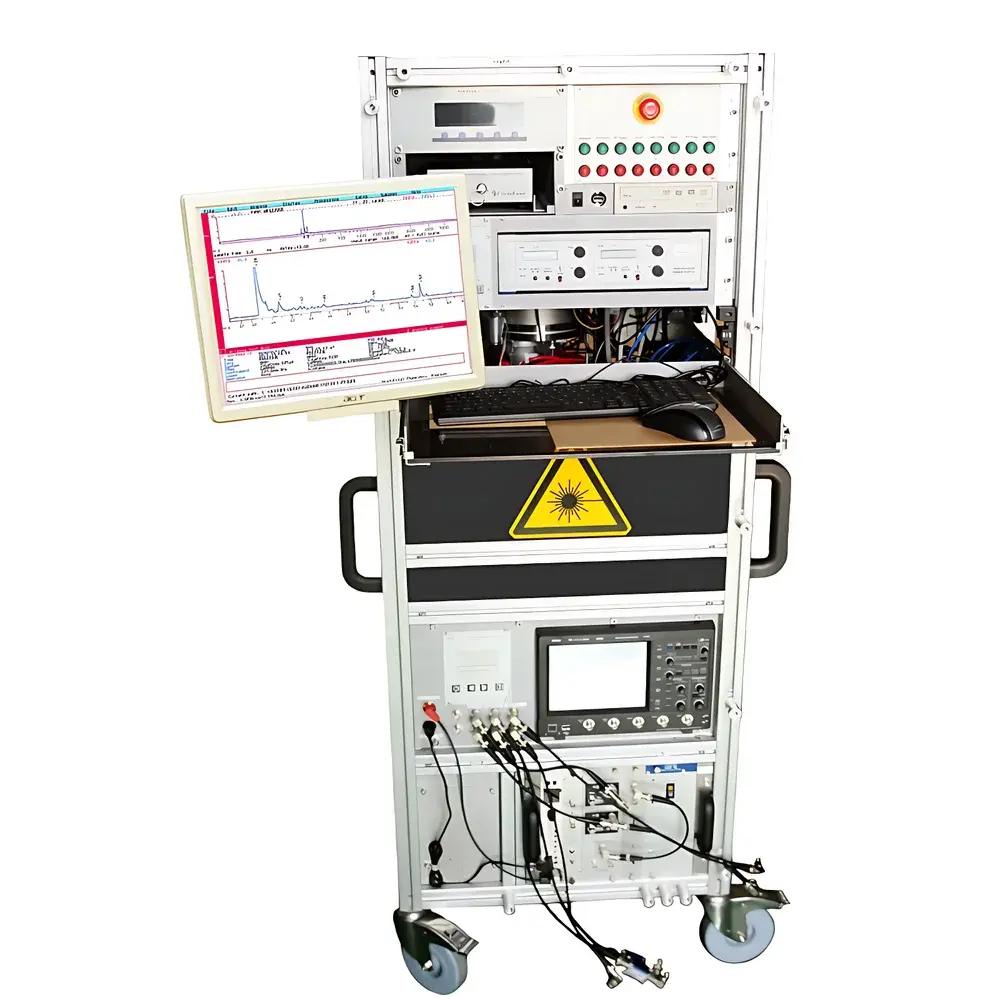
FPI LAMPAS-3.0 Online Single-Particle Aerosol Mass Spectrometry System
| Brand | FPI (Focus Photonics Inc.) |
|---|---|
| Origin | Zhejiang, China |
| Manufacturer Type | OEM Manufacturer |
| Region of Origin | Domestic (China) |
| Model | LAMPAS-3.0 |
| Pricing | Upon Request |
Overview
The FPI LAMPAS-3.0 Online Single-Particle Aerosol Mass Spectrometry System is an advanced real-time analytical platform engineered for the simultaneous measurement of aerodynamic diameter and chemical composition of individual airborne particulate matter (PM2.5, PM1, ultrafine particles). Based on laser ablation aerosol mass spectrometry (LA-AMS) coupled with time-of-flight mass spectrometry (TOF-MS), the system implements a well-established single-particle analysis paradigm originally developed through two decades of collaborative research between Focus Photonics Inc. and Justus Liebig University Giessen (Germany). It operates via continuous ambient air sampling, followed by particle sizing in a dual-laser scattering detection zone, synchronized laser desorption/ionization (LDI), and high-mass-resolution detection of both positive and negative ions in a reflectron-enhanced TOF-MS. This architecture enables unambiguous classification of particle types—including sulfate, nitrate, ammonium, organic carbon, elemental carbon, metals, biological fragments, and halogenated species—without offline sample preparation or ensemble averaging artifacts.
Key Features
- Real-time, continuous online monitoring with sub-second particle detection duty cycle and ≤1-minute temporal resolution for statistical robustness
- Direct single-particle introduction via aerodynamic lens-based inlet, eliminating filter collection bias and preserving native particle morphology
- Simultaneous dual-polarity ion detection (positive and negative mode) within a single acquisition event
- Integrated aerodynamic sizing using two orthogonal 405 nm continuous-wave lasers, calibrated against NIST-traceable PSL standards
- High particle transmission efficiency (>60% for 200–1000 nm particles) enabled by differential pumping architecture and optimized vacuum interface design
- Compact, rack-mountable footprint (≤1.2 m3) suitable for mobile laboratories, rooftop monitoring stations, and cleanroom-integrated deployments
- Robust thermal and mechanical stability ensuring <±0.5% mass accuracy drift over 72-hour unattended operation
Sample Compatibility & Compliance
The LAMPAS-3.0 accepts ambient air, stack emissions, chamber-generated aerosols, and laboratory-simulated particulate streams without dilution or pre-filtration. It supports particles ranging from ~80 nm to >2 µm in aerodynamic diameter, including hygroscopic, refractory, volatile, and semi-volatile species. The system complies with ISO 29201:2017 (ambient air quality — measurement of aerosol mass concentration), aligns with EPA OTM-41 recommendations for real-time source apportionment, and meets essential requirements for GLP-compliant data acquisition under ISO/IEC 17025:2017. Instrument control software includes full audit trail functionality compliant with FDA 21 CFR Part 11 for electronic records and signatures where required.
Software & Data Management
The proprietary LAMPAS Control Suite provides integrated instrument control, real-time spectral visualization, and automated particle classification via unsupervised machine learning (k-means clustering, hierarchical agglomerative clustering). Raw TOF-MS spectra are stored in HDF5 format with embedded metadata (timestamp, pressure, temperature, flow rate, laser energy). Batch processing supports peak deconvolution, mass calibration refinement, and spectral library matching against the AMS-SPAM database and custom reference libraries. Export options include netCDF, CSV, and MATLAB-compatible structures for integration with atmospheric modeling tools (e.g., CMAQ, CAMx) and receptor modeling frameworks (e.g., PMF, UNMIX). All data handling adheres to FAIR principles (Findable, Accessible, Interoperable, Reusable).
Applications
- Environmental monitoring networks: Real-time source apportionment of urban PM2.5, identification of secondary organic aerosol (SOA) formation pathways, and characterization of new particle formation (NPF) events
- Mobile emission studies: On-road plume profiling of diesel, gasoline, and electric vehicle exhaust; brake/tire wear particle fingerprinting
- Industrial process control: In-line monitoring of nanoparticle synthesis, semiconductor wafer cleaning effluents, and pharmaceutical dry powder inhaler aerosols
- Health-relevant aerosol science: Inhalation toxicology studies on metal oxide nanoparticles, bioaerosol viability assessment, and oxidative potential mapping
- Climate-relevant research: Ice-nucleating particle (INP) typing, black carbon mixing state analysis, and volcanic ash composition tracking
- Biomedical applications: Exhaled breath condensate particle phenotyping and surgical smoke composition analysis
FAQ
What particle size range can the LAMPAS-3.0 detect?
It measures aerodynamically sized particles from approximately 80 nm to over 2 µm, with optimal sensitivity between 150 nm and 1.2 µm.
Does the system require sample collection or filtration prior to analysis?
No. It performs direct, real-time analysis of individual particles from ambient air without filters, impactors, or solvent extraction.
How is mass calibration maintained during long-term unattended operation?
Automatic internal calibration using pulsed laser-induced ion signals from residual air components (e.g., N2+, O2+, H2O+) is performed every 15 minutes, supplemented by daily external standard checks.
Can the system distinguish internally mixed versus externally mixed particles?
Yes. Single-particle mass spectra allow unambiguous determination of mixing state at the individual particle level, enabling quantitative assessment of coating thickness and core-shell morphology.
Is the software compatible with third-party atmospheric modeling platforms?
Yes. Native export formats (netCDF, CSV) and documented APIs support seamless integration with CMAQ, CAMx, PMF, and Python-based analysis pipelines (e.g., PySpectra, AerosolPy).
Related Products







