
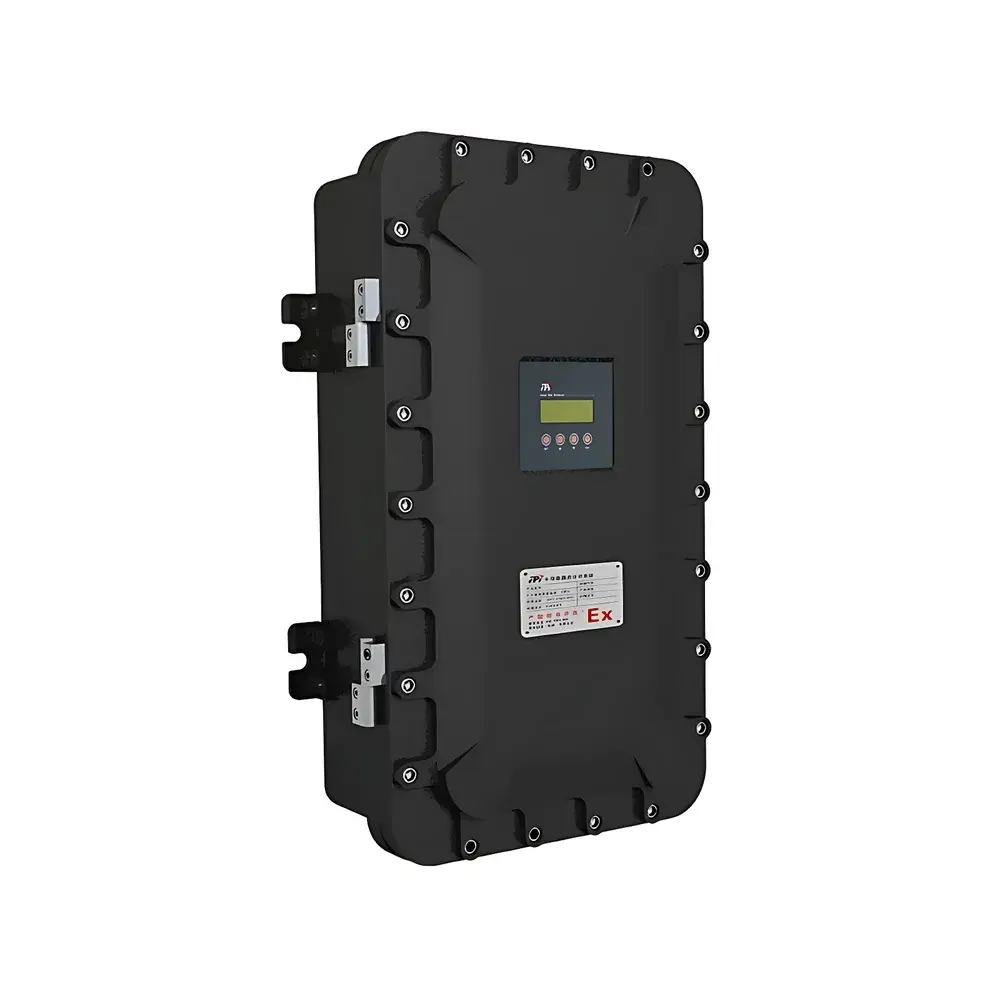
FPI LGA-4500IC Laser-Based Trace Gas Analyzer
| Brand | FPI |
|---|---|
| Origin | Zhejiang, China |
| Manufacturer Type | Original Equipment Manufacturer (OEM) |
| Country of Manufacture | China |
| Model | LGA-4500IC |
| Pricing | Available upon Request |
Overview
The FPI LGA-4500IC Laser-Based Trace Gas Analyzer is a high-performance, in-situ optical gas monitoring system engineered for continuous, real-time quantification of trace-level gaseous species in demanding industrial process and ambient air environments. It employs Tunable Diode Laser Absorption Spectroscopy (TDLAS) — a well-established, physics-based measurement principle grounded in Beer-Lambert law — combined with a Herriott multi-pass cell architecture to achieve path lengths exceeding 100 meters within a compact optical cavity. This dual-technology integration significantly enhances effective absorbance signal strength, enabling sub-part-per-trillion (sub-ppt) detection limits for target analytes such as methane (CH₄), hydrogen sulfide (H₂S), ammonia (NH₃), carbon monoxide (CO), hydrogen fluoride (HF), and other infrared-active gases. Designed for permanent installation in hazardous locations, the LGA-4500IC delivers stable, drift-free operation without consumables or calibration gases under normal operating conditions.
Key Features
- Herriott-type multipass optical cavity with configurable path length (up to 120 m equivalent), delivering exceptional signal-to-noise ratio (SNR) and detection sensitivity down to low-ppt levels for select gases
- Single-beam, direct-absorption TDLAS architecture with wavelength modulation spectroscopy (WMS) for robust interference rejection and immunity to optical misalignment or window fouling
- Integrated intrinsically safe and explosion-proof (Ex d IIB T4 Gb / Ex tb IIIC T130°C Db) enclosure compliant with IEC 60079-0, -1, and -31 standards for Zone 1/21 deployment
- Real-time response time (T₉₀) < 5 seconds for most target gases, supporting rapid process control feedback loops and fugitive emission detection
- Modular optical head and electronics unit design enables flexible mounting configurations — including extractive, in-situ cross-stack, and open-path variants — with minimal field alignment requirements
- Self-diagnostic firmware with continuous internal reference monitoring, automatic baseline correction, and laser wavelength lock verification
Sample Compatibility & Compliance
The LGA-4500IC is optimized for gaseous samples with low particulate loading (< 10 mg/m³) and dew point below instrument operating temperature (−20 °C to +50 °C ambient). It supports sample temperatures up to 200 °C when equipped with optional heated probe assemblies. The analyzer meets electromagnetic compatibility (EMC) requirements per EN 61326-1 (industrial environment) and environmental protection standards per EN 60529 (IP66-rated enclosure). While not certified for regulatory compliance reporting under EPA Method 21 or ISO 15848-1 out-of-the-box, its measurement stability and traceability support validation protocols aligned with ISO/IEC 17025 laboratory accreditation frameworks. Data integrity features include audit-trail-enabled configuration logging and timestamped raw spectral records.
Software & Data Management
The embedded Linux-based firmware provides a web-accessible interface (HTTPS, TLS 1.2) for remote configuration, spectral visualization, and real-time concentration trending. Optional FPI GasVision™ software suite enables automated calibration curve generation using NIST-traceable reference standards, multi-gas interference correction matrices, and batch export of time-series data in CSV or NetCDF format. All operational logs, alarm events, and spectral snapshots are stored locally on industrial-grade microSD card with configurable retention policies. The system supports Modbus TCP, OPC UA (PubSub over UDP), and MQTT v3.1.1 protocols for seamless integration into DCS, SCADA, and cloud-based IIoT platforms. Audit trail functionality satisfies basic ALCOA+ principles for data integrity in non-GxP environments.
Applications
- Continuous monitoring of H₂S and mercaptans in natural gas transmission pipelines and custody transfer stations
- Fugitive emission detection (FED) at flanges, valves, and compressors in petrochemical refineries per LDAR programs
- Ammonia slip monitoring downstream of SCR systems in power generation and waste-to-energy plants
- HF and CO tracking in aluminum smelting and fluorination process units
- Ambient air quality surveillance near industrial fence lines for early warning of accidental releases
- Process optimization and catalyst health assessment in syngas production and Fischer–Tropsch reactors
FAQ
What gases can the LGA-4500IC measure?
The analyzer is configurable for any gas with absorption lines in the 1.3–2.0 µm or 3.0–4.0 µm near- to mid-infrared bands. Standard configurations include CH₄, H₂S, NH₃, CO, HF, HCl, and C₂H₂. Custom wavelengths require factory alignment and spectral validation.
Does it require zero/span calibration during routine operation?
No. The system uses fundamental spectroscopic parameters and internal reference cells for long-term stability; periodic verification with certified gas standards (e.g., every 3–6 months) is recommended for QA/QC but not mandatory for basic operation.
Can it operate in high-humidity or corrosive gas streams?
Yes — with appropriate inlet conditioning (e.g., thermoelectric cooler, sintered metal filter, and corrosion-resistant sampling probe). Optional heated sample lines and purge-air isolation maintain optical path integrity in condensing or acidic environments.
Is the LGA-4500IC suitable for EPA Method 21 compliance surveys?
It is not pre-certified for Method 21, but its response time, sensitivity, and repeatability meet or exceed Method 21 performance criteria when validated per ASTM D6522 and operated within specified environmental constraints.
What is the typical maintenance interval?
Optical alignment is factory-set and does not require field adjustment. Recommended preventive maintenance includes quarterly inspection of purge filters, annual verification of laser output power and detector responsivity, and biennial replacement of desiccant in internal dry-air supply modules.
Related Products







