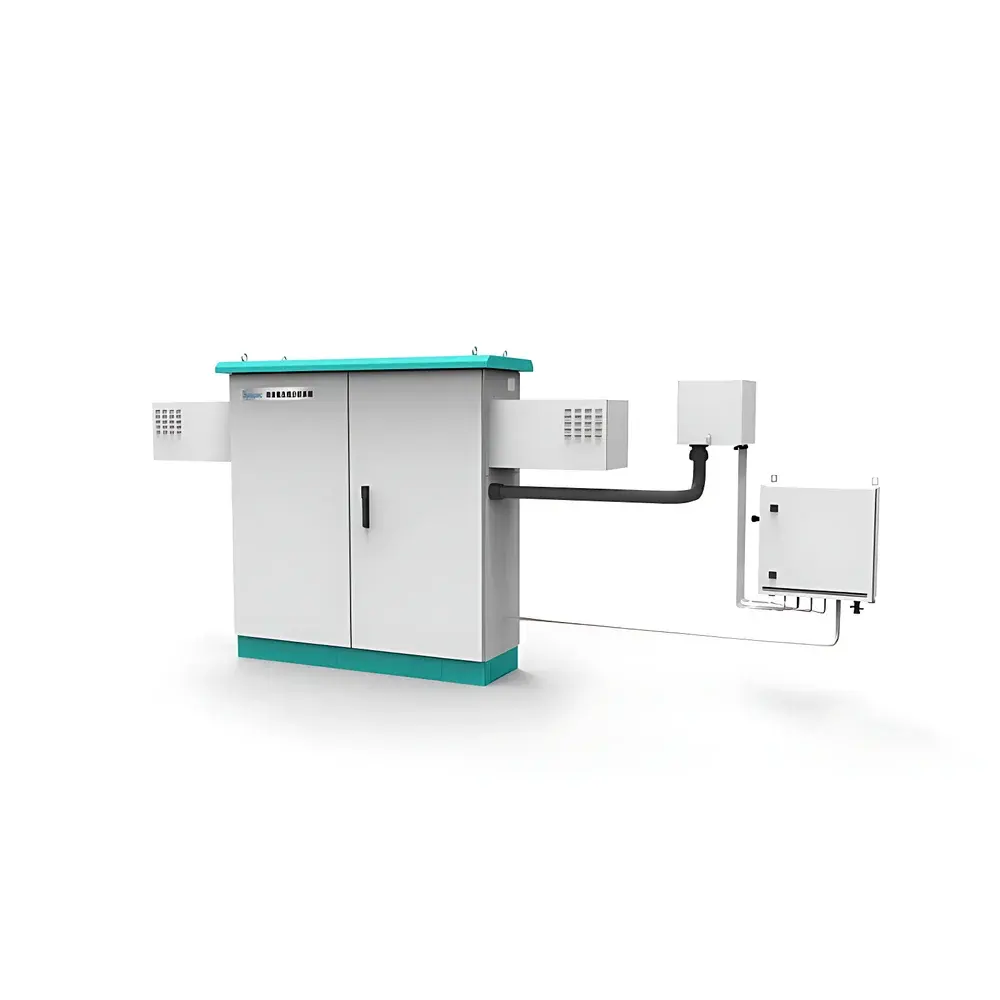
FPI LGA-5500 In-Situ Trace Ammonia Online Monitor for SCR/SNCR DeNOₓ Systems
| Brand | FPI |
|---|---|
| Origin | Zhejiang, China |
| Manufacturer Type | Original Equipment Manufacturer (OEM) |
| Country of Origin | China |
| Model | LGA-5500 |
| Pricing | Upon Request |
Overview
The FPI LGA-5500 is an in-situ trace ammonia online monitoring system engineered for continuous, real-time quantification of ammonia slip downstream of selective catalytic reduction (SCR) or selective non-catalytic reduction (SNCR) denitrification reactors in thermal power plants, cement kilns, and other high-temperature industrial flue gas streams. Unlike extractive sampling systems that suffer from condensation, ammonium salt deposition, and transport delay, the LGA-5500 employs a bypass-configured, high-temperature optical path architecture based on tunable diode laser absorption spectroscopy (TDLAS) at near-infrared wavelengths (typically 1530–1540 nm). This principle enables direct, non-contact measurement of NH₃ concentration with sub-ppm detection limits (≤0.5 ppmv typical), high spectral selectivity, and immunity to interferences from H₂O, CO₂, NOₓ, SO₂, and particulate matter—critical for stable closed-loop ammonia injection control in compliance with emission limit values (ELVs) under EU IED, US EPA MATS, and China’s GB 13223–2011.
Key Features
- True in-situ TDLAS measurement with dual-beam optical configuration for drift compensation and long-term stability
- Full-path high-temperature heating (≥190 °C) maintained throughout sample cell, optical windows, and beam path to prevent NH₄HSO₄/NH₄NO₃ formation and dew point-related errors
- Integrated high-flow jet sampling module with dynamic pressure regulation, ensuring representative gas capture even under fluctuating flue gas velocity (5–25 m/s) and negative pressure (−5 to −15 kPa)
- Automated periodic purge cycle using instrument-grade N₂ or compressed air to clear optical windows without manual intervention or downtime
- Ruggedized stainless-steel housing rated IP65, designed for continuous operation in ambient temperatures ranging from −20 °C to +60 °C and relative humidity up to 95% non-condensing
- Embedded microprocessor with dual-core ARM Cortex-A9, supporting local data logging (≥30 days at 1-second resolution) and Modbus TCP/RTU, Profibus DP, and 4–20 mA analog output interfaces
Sample Compatibility & Compliance
The LGA-5500 is validated for use in flue gases containing up to 20 vol% H₂O, ≤1000 mg/m³ total suspended particulates (TSP), and operating temperatures up to 180 °C at the probe location. It meets electromagnetic compatibility requirements per IEC 61326-1 (industrial environment) and safety standards per IEC 61010-1. While not intrinsically safe certified, optional ATEX Zone 2 / Class I Div 2 configurations are available upon request. The system supports audit-ready data integrity through configurable event logging (e.g., calibration, purge, alarm), timestamped raw absorbance spectra storage, and optional 21 CFR Part 11-compliant software modules for GxP environments requiring electronic signatures and change control.
Software & Data Management
FPI’s proprietary LGA Control Suite provides web-based remote configuration, real-time spectral visualization, automatic baseline correction, and multi-point zero/span validation routines. Historical trend plots, alarm thresholds (configurable for NH₃ slip >2 ppmv or rate-of-change anomalies), and CSV/Excel export are standard. Data can be integrated into DCS/SCADA platforms via OPC UA or MQTT protocols. Firmware updates are performed over secure HTTPS with SHA-256 signature verification. All measurement records include embedded metadata: optical path length, temperature/pressure compensation coefficients, laser current/wavelength calibration date, and operator ID where authenticated.
Applications
- Ammonia slip monitoring and feedback control in coal-fired, gas-fired, and biomass-fired power plant SCR systems
- Process optimization of SNCR injection staging in cement rotary kiln precalciner ducts
- Compliance verification for national and regional NOₓ emission trading schemes (e.g., China’s ETS Phase II, EU ETS Annex I installations)
- Troubleshooting catalyst deactivation, uneven ammonia distribution, or reactor maldistribution events via second-by-second NH₃ temporal profiling
- Supporting ISO 50001 energy management audits by correlating NH₃ slip with NH₃ consumption and boiler efficiency metrics
FAQ
What is the minimum detectable ammonia concentration and typical measurement range?
The LGA-5500 achieves a limit of detection (LOD) of ≤0.3 ppmv (3σ) with a standard measurement range of 0–10 ppmv; extended ranges up to 0–50 ppmv are configurable via optical path length adjustment.
Does the system require frequent calibration with standard gas cylinders?
Zero calibration is performed automatically using purified purge gas; span calibration is recommended every 30 days using traceable NH₃/N₂ standard (10 ppmv ±2%), though field validation intervals may extend to 90 days under stable operating conditions and with trending-based verification.
How does the system handle high-dust flue gas environments common in cement kilns?
The combination of high-velocity jet sampling (preventing particle settling), heated optical windows (eliminating sticky deposit adhesion), and scheduled N₂ purges ensures uninterrupted optical transmission—validated in >500 mg/m³ dust loading conditions per EN 15267-3 test reports.
Can the LGA-5500 interface with existing DCS systems for automatic ammonia dosing control?
Yes—native 4–20 mA output (HART-enabled), Modbus RTU/TCP, and optional OPC UA server allow seamless integration with Emerson DeltaV, Siemens PCS7, Honeywell Experion, and Yokogawa CENTUM VP DCS architectures.
Is technical support and spare parts availability guaranteed outside China?
FPI maintains authorized service partners in Germany, Turkey, India, and Brazil; critical spares (laser modules, thermoelectric coolers, detector assemblies) are stocked regionally with lead times ≤10 business days under standard warranty terms.
Related Products