
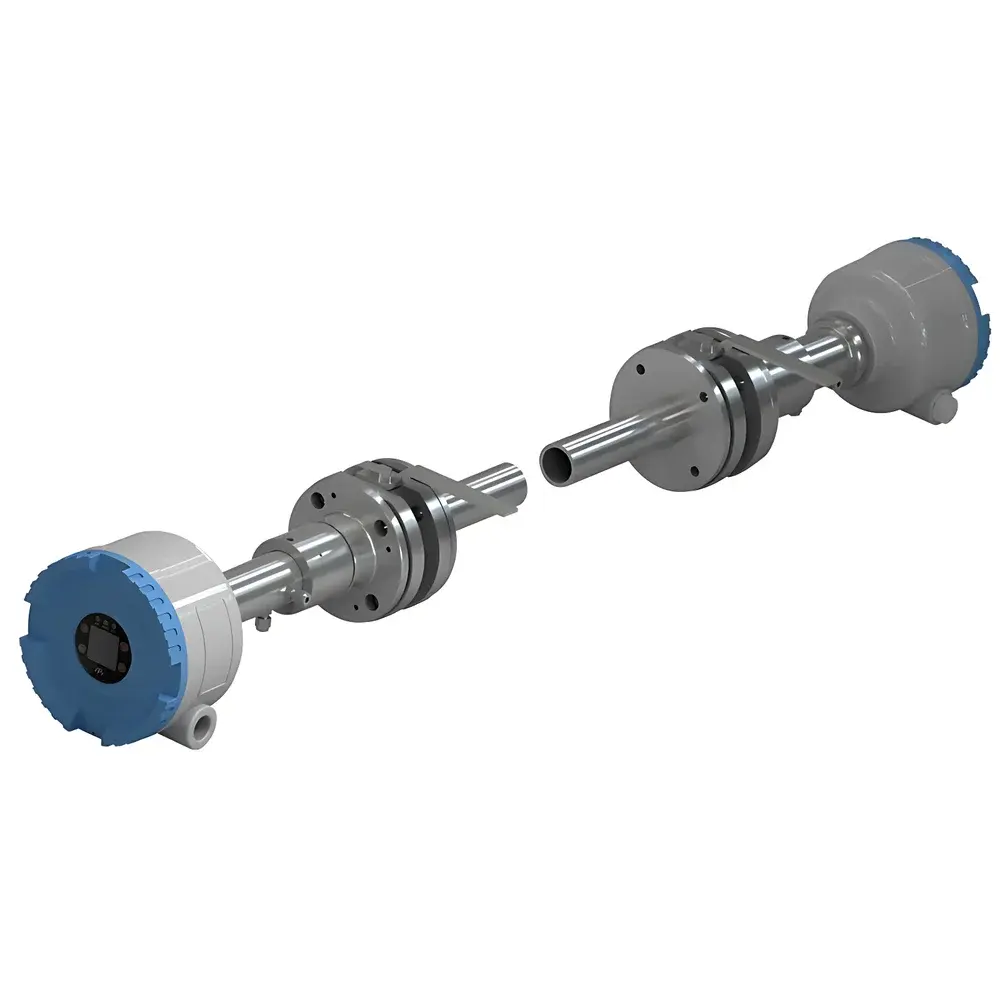
FPI LGA-6100 In-Situ Tunable Diode Laser Absorption Spectroscopy (TDLAS) Multicomponent Gas Analyzer
| Brand | FPI |
|---|---|
| Origin | Zhejiang, China |
| Manufacturer Type | Original Equipment Manufacturer (OEM) |
| Product Type | In-Situ Online Analyzer |
| Technology | Tunable Diode Laser Absorption Spectroscopy (TDLAS) |
| Explosion Protection | Ex d IIB T4 Gb certified |
| Mounting | Flanged in-situ probe configuration |
| Compliance | Designed for industrial process environments per IEC 60079-0/-1/-28 and GB 3836 series |
| Target Gases | CO, CO₂, CH₄, NH₃, HCl, HF, O₂ (configurable via wavelength selection) |
| Operating Ambient Temperature | −20 °C to +60 °C |
| Process Temperature Range | Up to 1800 °C (probe-dependent) |
| Dust Load Tolerance | ≤100 g/m³ |
| Corrosion Resistance | Hastelloy C-276 probe housing standard |
| Power Supply | 24 VDC ±10% or 220 VAC 50/60 Hz |
| Output Interfaces | 4–20 mA analog, RS485 Modbus RTU, Ethernet TCP/IP, optional PROFIBUS DP |
Overview
The FPI LGA-6100 is an in-situ, continuous multicomponent gas analyzer engineered for high-reliability quantitative measurement in demanding industrial process streams. It employs Tunable Diode Laser Absorption Spectroscopy (TDLAS), a physics-based optical technique that exploits the unique near-infrared absorption fingerprints of target gas molecules. Unlike extractive systems requiring sample conditioning, the LGA-6100 performs direct, non-contact measurement across the process duct or stack—eliminating sampling lines, filters, chillers, and calibration gas dependencies. Its dual-beam optical architecture compensates for beam attenuation caused by particulate scattering or window fouling, ensuring stable baseline performance under high-dust conditions (up to 100 g/m³). The analyzer operates on the Beer–Lambert law principle, delivering absolute concentration values traceable to NIST-standardized spectral line databases without periodic span calibration.
Key Features
- In-situ measurement capability with flanged probe installation—no sample extraction, transport delay, or condensation risk
- Explosion-proof enclosure rated Ex d IIB T4 Gb (IEC 60079-1), eliminating requirement for external purge air or positive-pressure enclosures
- Hastelloy C-276 probe construction for sustained operation in highly corrosive environments containing HCl, HF, SO₂, or ammonia
- High-temperature optical path design supporting direct measurement in hot-gas applications up to 1800 °C (dependent on probe model and cooling configuration)
- Dual-wavelength referencing system mitigates signal drift from mechanical vibration, thermal expansion, or optical misalignment
- Modular laser source platform enabling field-upgradable multi-gas configurations (e.g., simultaneous CO + CO₂ + O₂ or NH₃ + HCl)
- Embedded real-time spectral fitting algorithm with second-derivative absorption peak detection for enhanced selectivity and interference rejection
Sample Compatibility & Compliance
The LGA-6100 is validated for use in heterogeneous, high-velocity gas streams typical of blast furnace off-gas, coke oven by-product recovery, fluid catalytic cracking (FCC) regenerator exhaust, and waste incineration flue gas. It complies with mechanical and electrical safety requirements outlined in IEC 60079-0 (general explosion protection), IEC 60079-1 (flameproof enclosures), and IEC 60079-28 (optical radiation safety). While not certified to ISO 14001 or EN 15267 for emissions monitoring, its measurement uncertainty profile aligns with QAL1 requirements under EN 14181 when integrated into a certified Continuous Emission Monitoring System (CEMS). The analyzer supports GLP-compliant data logging with timestamped spectral raw data storage and audit-trail-enabled configuration change history.
Software & Data Management
FPI’s proprietary LGA-Manager software provides remote commissioning, spectral diagnostics, and multi-point zero/span verification via embedded reference cells or cross-calibration against certified reference gases. All measurement data—including absorbance spectra, fitted peak areas, temperature-compensated concentration outputs, and diagnostic flags—is logged at user-configurable intervals (1 s to 1 h) to internal SD card or external NAS via FTP/SFTP. The device supports OPC UA server functionality for seamless integration into DCS/SCADA platforms (e.g., Siemens PCS7, Honeywell Experion, Emerson DeltaV). Data export formats include CSV, XML, and JSON; all logs include SHA-256 checksums for integrity verification. Firmware updates are performed over secure HTTPS with signature validation to meet cybersecurity best practices aligned with IEC 62443-4-2.
Applications
- Real-time combustion optimization in coal-fired boilers and gas turbines via O₂ and CO feedback control
- Ammonia slip monitoring downstream of SCR reactors in power generation and cement kilns
- HF and HCl quantification in municipal solid waste incinerator flue gas for regulatory compliance reporting
- CO and CH₄ tracking in coke oven gas purification loops for safety interlock and energy recovery
- Process gas composition analysis in syngas production (e.g., Fischer–Tropsch feed streams) where moisture and particulates preclude extractive methods
- Leak detection and fugitive emission quantification in refinery flare stacks using high-speed scanning mode
FAQ
Does the LGA-6100 require calibration gas cylinders?
No—TDLAS is an absolute measurement technique based on fundamental molecular absorption cross-sections. Zero verification may be performed using nitrogen purge or clean-air reference, while span verification uses traceable certified gases only during initial QAL2 certification.
Can it measure gases in wet or saturated streams?
Yes—the in-situ optical path avoids condensation issues inherent to extractive systems. However, excessive liquid droplet loading (>5 vol%) may scatter the beam; probe orientation and optional heated purge air can mitigate this.
Is the analyzer compatible with SIL2-rated safety instrumented systems?
The LGA-6100 itself is not SIL2-certified, but its 4–20 mA safety outputs can be integrated into SIL2 loops via certified signal conditioners meeting IEC 61508 Part 2 Annex D requirements.
What maintenance is required beyond routine optical window cleaning?
Annual verification of laser wavelength stability and detector linearity is recommended. No consumables, pumps, or membranes are used—resulting in <1 hr/year average maintenance time.
How is alignment maintained in vibrating industrial environments?
The probe incorporates kinematic mounting and passive thermal compensation. Field alignment verification is supported via built-in alignment laser and digital camera viewfinder accessible through LGA-Manager.
Related Products







