
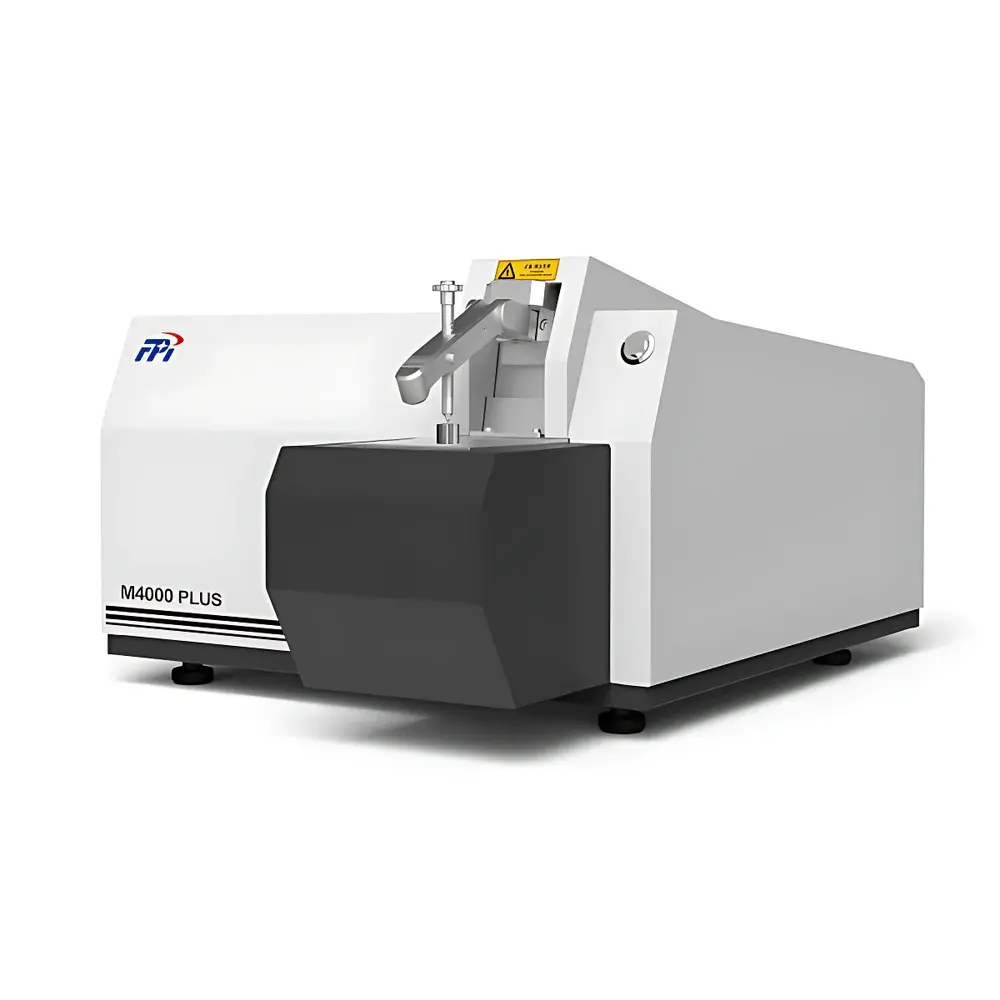
FPI M4000 PLUS N Direct-Reading Optical Emission Spectrometer (OES)
| Brand | FPI |
|---|---|
| Origin | Zhejiang, China |
| Instrument Type | Benchtop |
| Excitation Source | Spark |
| Detector Type | CMOS-based Multi-Channel Array |
| Optical Configuration | Paschen-Runge Mount |
| Wavelength Range | Configurable (Typically 130–800 nm) |
| Number of Simultaneous Channels | Up to 60 (Software-Defined) |
| Argon Purge System | Sealed Argon-Circulating Optical Chamber with Four-Point Purge |
| Operating Environment | Industrial Lab / Foundry Floor |
| Compliance | Designed to Support ISO/IEC 17025, ASTM E415, ASTM E1086, and GB/T 4336 |
Overview
The FPI M4000 PLUS N is a benchtop spark optical emission spectrometer engineered for high-precision, real-time elemental analysis of metallic alloys in demanding industrial environments. It operates on the principle of spark-induced atomic emission spectroscopy: a controlled high-voltage spark excites atoms in a solid metal sample, causing them to emit characteristic wavelengths of ultraviolet and visible light. These emissions are dispersed via a fixed Paschen-Runge optical mount and captured simultaneously by an array of high-sensitivity CMOS detectors—enabling multi-element quantification without mechanical scanning. The system integrates a sealed, argon-circulating optical chamber to eliminate atmospheric nitrogen and oxygen interference, ensuring long-term spectral stability and detection limits in the sub-ppm range for key alloying elements (e.g., C, S, P, Mn, Cr, Ni, Al, Cu). Designed specifically for foundry process control, incoming material inspection, and R&D metallurgy labs, the M4000 PLUS N delivers laboratory-grade accuracy with factory-floor robustness.
Key Features
- Full-digital programmable pulse spark source: Delivers stable, reproducible energy delivery across diverse matrix types (Fe-, Al-, Cu-, Mg-, Zn-based alloys), minimizing inter-element effects and enhancing precision for low-concentration elements.
- Optimized open-style spark stand: Reduced internal volume lowers argon consumption by up to 35% versus conventional designs; four-point argon purge efficiently removes ablation debris, extending electrode life and reducing maintenance frequency.
- Paschen-Runge optical architecture with thermally stabilized chamber: Maintains optical alignment within ±0.005 nm over 8-hour continuous operation; real-time drift correction algorithms compensate for thermal and mechanical shifts during analysis sequences.
- CMOS-based multi-channel detection system: Provides simultaneous acquisition across up to 60 pre-calibrated spectral lines; no moving parts ensure high signal-to-noise ratio and long-term calibration retention.
- One-touch analysis workflow: Integrated sample handling logic automates ignition, integration time selection, and result output—reducing operator dependency and enabling consistent throughput of >30 samples/hour.
Sample Compatibility & Compliance
The M4000 PLUS N supports flat, cylindrical, and irregularly shaped metallic specimens (diameter 10–40 mm, thickness ≥4 mm) using modular, matrix-specific clamping fixtures. It complies with core international standards for metal analysis, including ASTM E415 (carbon and low-alloy steels), ASTM E1086 (stainless steels), and GB/T 4336 (Chinese national standard for carbon steel). Its software architecture supports audit-ready data handling per ISO/IEC 17025 requirements, including full electronic signature capability, user access levels, and immutable measurement logs. Optional 21 CFR Part 11 compliance modules are available for regulated pharmaceutical or aerospace QA/QC applications requiring electronic record integrity.
Software & Data Management
FPI SmartSpectra™ v4.2 software provides intuitive, role-based interface navigation with embedded GLP/GMP workflows. Key modules include:
- Intelligent Curve Mapping: Automatically selects optimal calibration models based on sample matrix recognition—eliminating manual curve assignment errors during unknown-sample analysis.
- Real-Time Quality Control Dashboard: Configurable upper/lower specification limits per element; visual pass/fail indicators and automatic report generation upon deviation detection.
- Grade Identification Engine: Compares measured composition against built-in databases (e.g., UNS, EN, JIS, GB) to suggest candidate material grades with confidence scoring.
- Equivalency Calculator: User-definable formulas for Carbon Equivalent (CE), Pitting Resistance Equivalent Number (PREN), and other metallurgical indices—exportable to CSV or LIMS via ODBC.
- System Health Monitor: Proactive diagnostics track lamp intensity decay, argon purity, detector saturation, and spark gap wear—triggering scheduled maintenance alerts with traceable service history.
Applications
The M4000 PLUS N is deployed across three primary operational tiers: (1) Foundry Process Control—real-time monitoring of melt chemistry prior to casting, enabling rapid adjustment of ferroalloy additions; (2) Quality Assurance Laboratories—certification of incoming raw materials, finished goods, and supplier submissions against contractual specifications; (3) Materials Research & Development—compositional mapping of prototype alloys, failure analysis of in-service components, and validation of heat treatment outcomes. Its adaptability extends to scrap sorting, recycling stream verification, and third-party testing laboratories serving automotive, energy, and heavy machinery sectors.
FAQ
What sample preparation is required before analysis?
Minimal preparation is needed: samples must be clean, flat, and free of oxide layers or coatings. A standard grinding wheel or milling cutter is sufficient; no acid etching or polishing is required for routine analysis.
Does the instrument require external cooling water or compressed air?
No—operation relies solely on internal air convection and thermoelectric cooling for the optical chamber; only high-purity argon (≥99.998%) is consumed during spark excitation.
Can calibration models be transferred between instruments?
Yes—calibration files (.cal) are portable across M4000-series units when using identical optical configurations and detector firmware versions; cross-model transfer requires re-validation per ISO/IEC 17025 Clause 7.7.
Is remote diagnostics supported?
Yes—optional Secure Remote Access module enables encrypted, permission-controlled connection for firmware updates, log retrieval, and collaborative troubleshooting with FPI application engineers.
How often must the instrument be standardized?
With real-time drift correction and stable argon circulation, recalibration intervals typically extend to 8–12 hours of continuous operation under normal foundry conditions; automated standardization routines complete in <90 seconds.





