
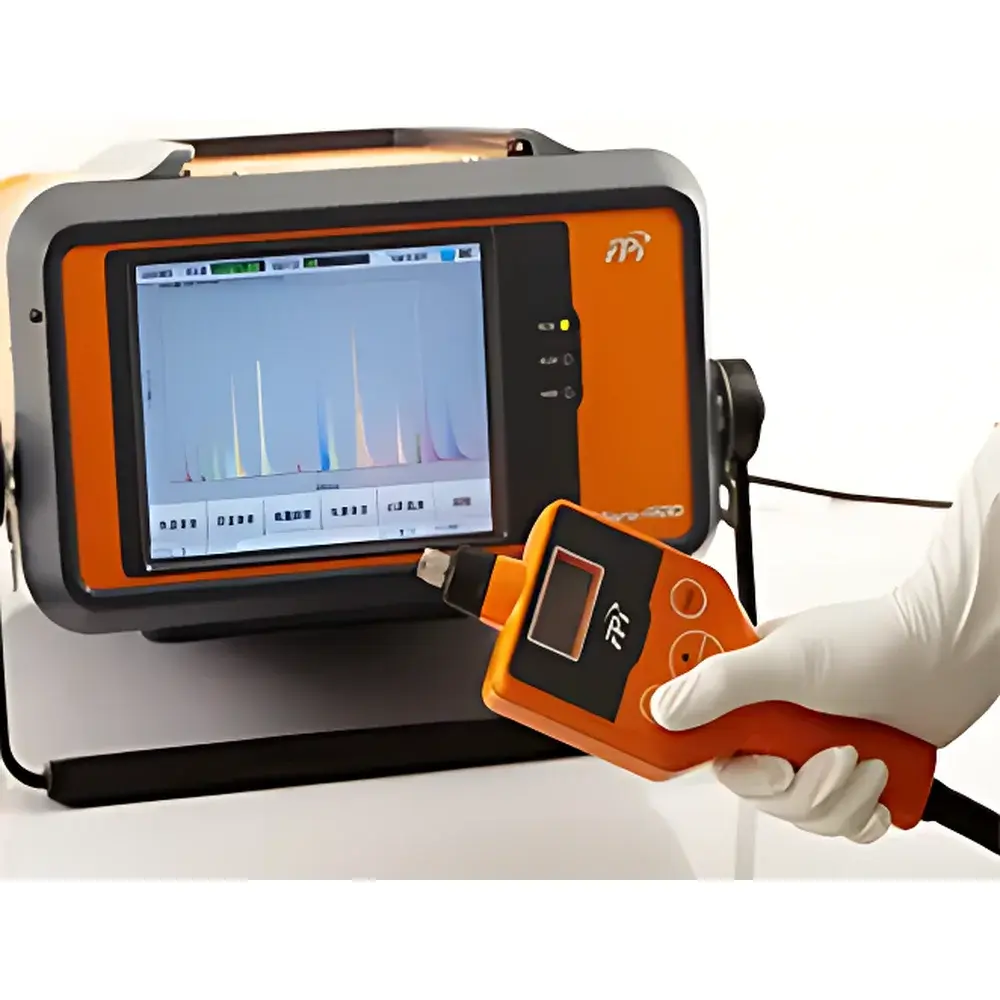
FPI Mars-400 Portable Gas Chromatography-Mass Spectrometry System
| Brand | FPI |
|---|---|
| Origin | Zhejiang, China |
| Manufacturer Type | Original Equipment Manufacturer (OEM) |
| Instrument Category | Domestic |
| Model | Mars-400 Portable |
| Mass Analyzer Type | Ion Trap |
| Mass Range | 1–1000 m/z |
| Resolution | 1000–2000 (FWHM at m/z 502) |
| Sensitivity | 300:1 (S/N for 1 pg methyl parathion, full scan) |
| Scan Speed | 15,000 µs per scan |
| GC Technology | Low Thermal Mass (LTM) Gas Chromatography |
Overview
The FPI Mars-400 Portable Gas Chromatography-Mass Spectrometry (GC-MS) System is an integrated field-deployable analytical platform engineered for rapid, on-site identification and quantification of volatile and semi-volatile organic compounds (VOCs and SVOCs). It combines low thermal mass gas chromatography (LTM-GC) with a compact quadrupole ion trap mass spectrometer to deliver high-fidelity separation, structural elucidation, and trace-level detection in resource-constrained environments. Unlike benchtop GC-MS systems requiring stable laboratory infrastructure, the Mars-400 operates autonomously using internal battery power or vehicle DC supply, enabling real-time analysis directly at incident sites—without sample transport delays or matrix degradation risks. Its core architecture adheres to fundamental GC-MS principles: analytes are thermally volatilized, separated via temperature-programmed capillary chromatography, ionized by electron impact (EI), trapped and scanned in the ion trap cell, and identified through spectral library matching (NIST/EPA/NIOSH) and retention index correlation.
Key Features
- True Field Portability: Engineered with modular, high-density integration, the Mars-400 weighs under 14 kg and occupies a footprint comparable to a standard DLP projector (290 × 220 × 180 mm). Integrated ergonomic handles, shoulder strap mounts, and shock-absorbing chassis support hand-carry, backpack, or vehicle-mounted deployment across rugged terrain.
- LTM-GC Accelerated Analysis: Utilizes micro-fabricated resistively heated capillary columns with direct column heating—eliminating conventional oven thermal inertia. Achieves ramp rates up to 120 °C/min and cool-down from 300 °C to 40 °C in <60 s, reducing total analysis cycle time to ≤15 minutes for complex environmental matrices.
- Touch-Optimized Operational Workflow: Features a 7-inch capacitive touchscreen with context-aware graphical user interface (GUI). Preloaded method templates—including EPA Method 8260D, TO-17, and ASTM D7717—guide users stepwise through calibration, injection, acquisition, and reporting—minimizing operator training requirements.
- Multi-Mode Sample Introduction: Supports interchangeable, hot-swappable inlet modules: heated probe (150 °C max), headspace autosampler (20 mL vials), purge-and-trap concentrator (with Tenax/Carbopack B traps), SPME fiber holder (with thermal desorption), and direct liquid injection (1–10 µL, split/splitless).
- Ruggedized Ion Trap Performance: Delivers unit-mass resolution (1000–2000 FWHM) across m/z 1–1000, with 300:1 signal-to-noise ratio (S/N) for 1 pg methyl parathion in full-scan mode. MS/MS capability enables structural confirmation via precursor ion isolation and collision-induced dissociation (CID) without hardware modification.
Sample Compatibility & Compliance
The Mars-400 is validated for direct analysis of air, water (via extraction), soil headspace, wipe samples, and biological fluids (urine, blood extracts). It complies with ISO/IEC 17025:2017 requirements for field analytical competence when operated within documented procedures. Data integrity meets FDA 21 CFR Part 11 expectations through built-in audit trail logging, electronic signatures, and immutable raw data storage (ANDI/NetCDF format). Method validation packages support adherence to EPA SW-846, EN 14792, and GB/T 5750.8–2023 protocols for VOC/SVOC monitoring in environmental and occupational health applications.
Software & Data Management
Controlled by FPI’s proprietary MarsControl™ software (v3.2+), the system provides real-time chromatogram visualization, automated peak deconvolution (AMDIS-integrated), spectral library search (NIST 2022, Wiley 11th Ed.), and customizable report generation (PDF/Excel). All acquisition parameters, spectra, and chromatograms are stored with timestamped metadata and cryptographic hash verification. Remote diagnostics and firmware updates are supported via encrypted Wi-Fi or LTE module (optional). Raw data files are fully compatible with third-party chemometric tools (e.g., MATLAB, SIMCA) for multivariate analysis and pattern recognition.
Applications
- Emergency response to chemical spills, industrial accidents, and CBRN incidents
- Real-time ambient air quality assessment (BTEX, PAHs, chlorinated solvents)
- Occupational exposure monitoring in refineries, manufacturing plants, and confined spaces
- Food safety screening for pesticide residues, packaging migrants, and adulterants
- Forensic toxicology and anti-doping control in mobile labs
- Soil vapor intrusion studies and landfill emission profiling
FAQ
What regulatory standards does the Mars-400 support for field data acceptance?
It supports method validation per EPA Methods 8260D (VOCs), 8270E (SVOCs), and ASTM D7717 (field-portable GC-MS performance criteria), with documentation packages aligned with GLP and ISO 17025 audit requirements.
Can the Mars-400 perform quantitative analysis without laboratory calibration?
Yes—internal standard calibration curves (e.g., deuterated surrogates) can be generated in situ using certified reference materials; instrument response factors are auto-updated based on daily tuning and retention time locking.
Is helium carrier gas mandatory, or are alternatives supported?
Hydrogen and nitrogen are fully supported as carrier gases; hydrogen enables faster separations and improved sensitivity for many VOCs, while nitrogen extends battery life during extended deployments.
How is mass calibration maintained during temperature fluctuations in outdoor environments?
The system performs automatic mass recalibration every 8 hours using perfluorotributylamine (PFTBA) internal reference ions, with temperature-compensated trap voltage control ensuring ±0.1 Da mass accuracy across −10 °C to +45 °C operating range.
What cybersecurity measures protect data during wireless transmission?
All Wi-Fi/LTE communications use TLS 1.2+ encryption; device authentication employs certificate-based mutual TLS (mTLS), and remote access requires multi-factor authentication (MFA) enforced via enterprise identity providers (e.g., Azure AD, Okta).





