
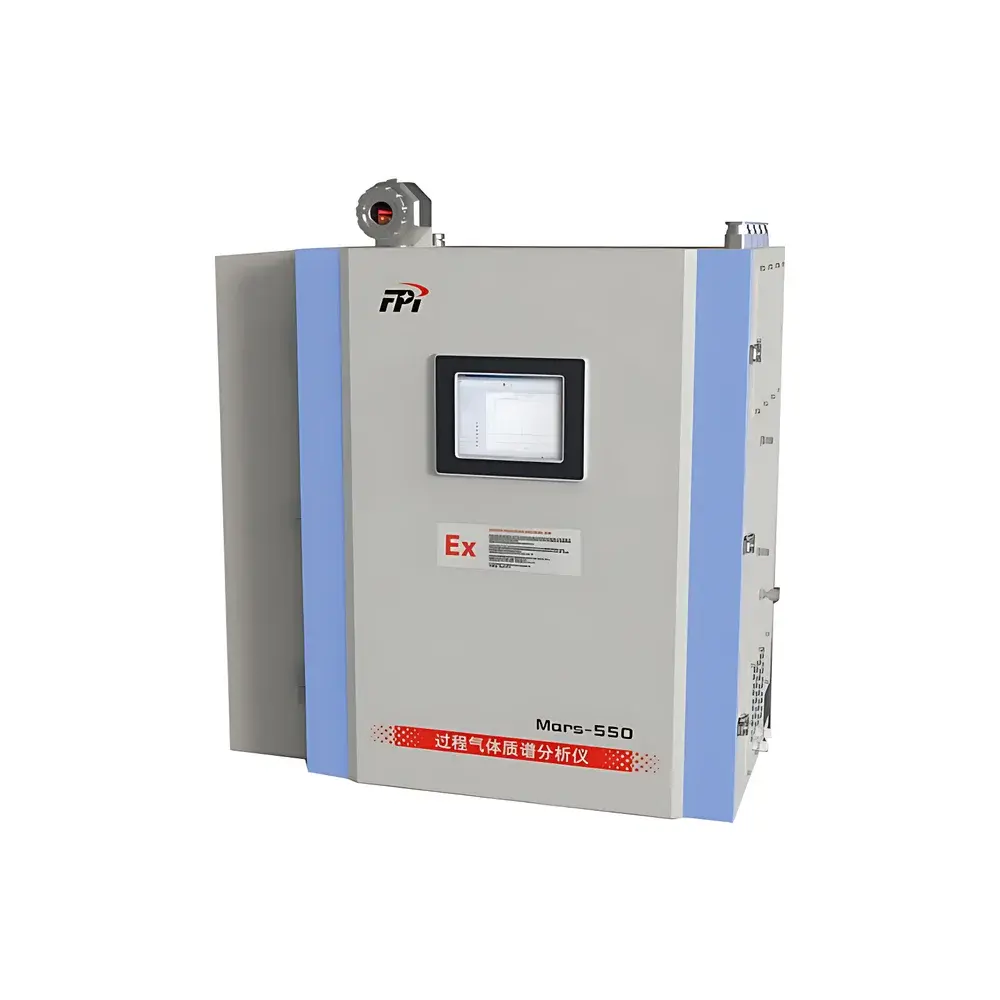
FPI Mars-550 Process Mass Spectrometer
| Brand | FPI |
|---|---|
| Origin | Zhejiang, China |
| Manufacturer Type | Original Equipment Manufacturer (OEM) |
| Product Origin | Domestic (China) |
| Model | Mars-550 |
| Pricing | Available Upon Request |
Overview
The FPI Mars-550 Process Mass Spectrometer is a rugged, industrial-grade quadrupole mass spectrometer engineered for continuous, real-time gas-phase compositional analysis in demanding process environments. Operating on the principle of electron ionization (EI) coupled with quadrupole mass filtering, the Mars-550 separates and detects gaseous ions based on their mass-to-charge ratio (m/z) with high specificity and repeatability. Designed specifically for in-line or at-line process monitoring—not laboratory benchtop use—the instrument delivers quantitative multi-component analysis across up to eight independent sample streams without manual intervention. Its architecture integrates vacuum system management, ion optics optimization, and temperature-stabilized electronics to maintain measurement integrity under fluctuating ambient conditions typical of chemical plants, refineries, semiconductor fabs, and biopharmaceutical fermentation suites.
Key Features
- High-speed quadrupole scanning: Full-spectrum acquisition (m/z < 300) completed in under 1 second per component, enabling sub-second response to dynamic process events.
- Dual detection system: Integrated Faraday cup (for high-concentration species, ppm–% range) and electron multiplier (for trace-level detection down to low ppb), with automatic gain switching and dynamic range extension exceeding 10⁶.
- Modular flow path architecture: Electromagnetic multi-port valves and pressure-regulated sampling manifolds support up to eight parallel inlet channels; each stream undergoes dedicated pressure regulation, filtration, and optional pre-concentration.
- Robust ion source design: Dual filament assembly with overcurrent protection, inertized (gold-coated or stainless-steel passivated) ionization chamber, and bake-out capability to minimize memory effects and hydrocarbon contamination.
- On-board industrial PC: Embedded x86-based controller running real-time Linux OS, providing local HMI, data logging, alarm handling, and remote diagnostics via Ethernet/IP or Modbus TCP.
- Automated calibration & maintenance routines: Scheduled sensitivity verification using internal reference gases; auto-tune sequences for mass axis alignment and resolution optimization; predictive filament life monitoring.
Sample Compatibility & Compliance
The Mars-550 is validated for direct analysis of non-corrosive and mildly corrosive process gases—including N₂, O₂, H₂, CO, CO₂, CH₄, NH₃, H₂S, C₂H₄, and VOCs—within operating pressures from 10⁻⁵ to 10⁻² mbar in the analyzer chamber. Sample introduction supports heated capillary inlets (up to 200 °C), PTFE-lined tubing, and optional catalytic crackers for speciation of organic fragments. The system complies with IEC 61000-6-2/6-4 (EMC), ATEX/IECEx Zone 2 (optional hazardous area certification), and meets mechanical safety requirements per ISO 13857. While not pre-certified to FDA 21 CFR Part 11, its software architecture supports audit trail generation, electronic signature integration, and role-based access control—enabling qualification under GMP/GLP frameworks when deployed with documented validation protocols.
Software & Data Management
The proprietary FPI ProcessMS Suite provides a unified interface for instrument control, method development, and data interpretation. Key modules include real-time spectral visualization with peak deconvolution, automated library matching (NIST-compatible), multi-point calibration curve generation, and time-series trending with configurable alarms (e.g., deviation thresholds, rate-of-change limits). Raw data is stored in HDF5 format with embedded metadata (timestamp, valve position, detector mode, tuning parameters). Export options include CSV, XML, and OPC UA server integration for MES/DCS interoperability. All user actions—including method edits, calibration runs, and system resets—are logged with timestamps and operator IDs, satisfying traceability requirements for regulated industries.
Applications
- Chemical synthesis monitoring: Real-time tracking of reactant depletion, intermediate formation, and byproduct evolution in batch and continuous reactors.
- Refinery fluid catalytic cracking (FCC) unit optimization: Simultaneous measurement of H₂, C₁–C₅ hydrocarbons, H₂S, and CO in regenerator off-gas for combustion efficiency control.
- Biopharmaceutical upstream processing: Dissolved oxygen, CO₂, and metabolic volatiles (e.g., ethanol, acetate) monitoring in mammalian cell culture bioreactors.
- Environmental emission compliance: Continuous stack gas analysis for NOₓ, SO₂, NH₃, and unburned hydrocarbons per EPA Method 25A and EN 15267-3.
- Semiconductor process chamber endpoint detection: In-situ etch rate verification via halogen-containing fragment ion ratios (e.g., CF⁺, Cl⁺, F⁺).
FAQ
What is the minimum detectable concentration for trace gases?
Detection limits are compound-dependent but typically reach 0.1–1 ppb for permanent gases (e.g., H₂, CO) and light VOCs under optimal tuning and sample conditioning.
Can the Mars-550 be integrated into an existing DCS or SCADA system?
Yes—via standard industrial protocols including Modbus TCP, OPC UA, and 4–20 mA analog outputs (with optional signal isolators); configuration files and driver documentation are provided.
Is routine maintenance required between calibration cycles?
No scheduled downtime is needed; the system performs self-diagnostics during idle periods, and consumables (filaments, pump oil) have documented service intervals exceeding 12 months under continuous operation.
Does the instrument support isotopic ratio measurements?
While not optimized for high-precision isotope ratio mass spectrometry (IRMS), the Mars-550 resolves common isotopic peaks (e.g., ¹²CO vs. ¹³CO, N₂ vs. CO at m/z 28) with sufficient mass accuracy (±0.1 amu) for relative abundance estimation in process contexts.
What vacuum pumping technology is used?
A two-stage system comprising a dry scroll backing pump and a turbomolecular pump (200–300 L/s), with active pressure regulation and vibration isolation mounts to ensure stable base pressure (<5×10⁻⁷ mbar) in industrial settings.






