
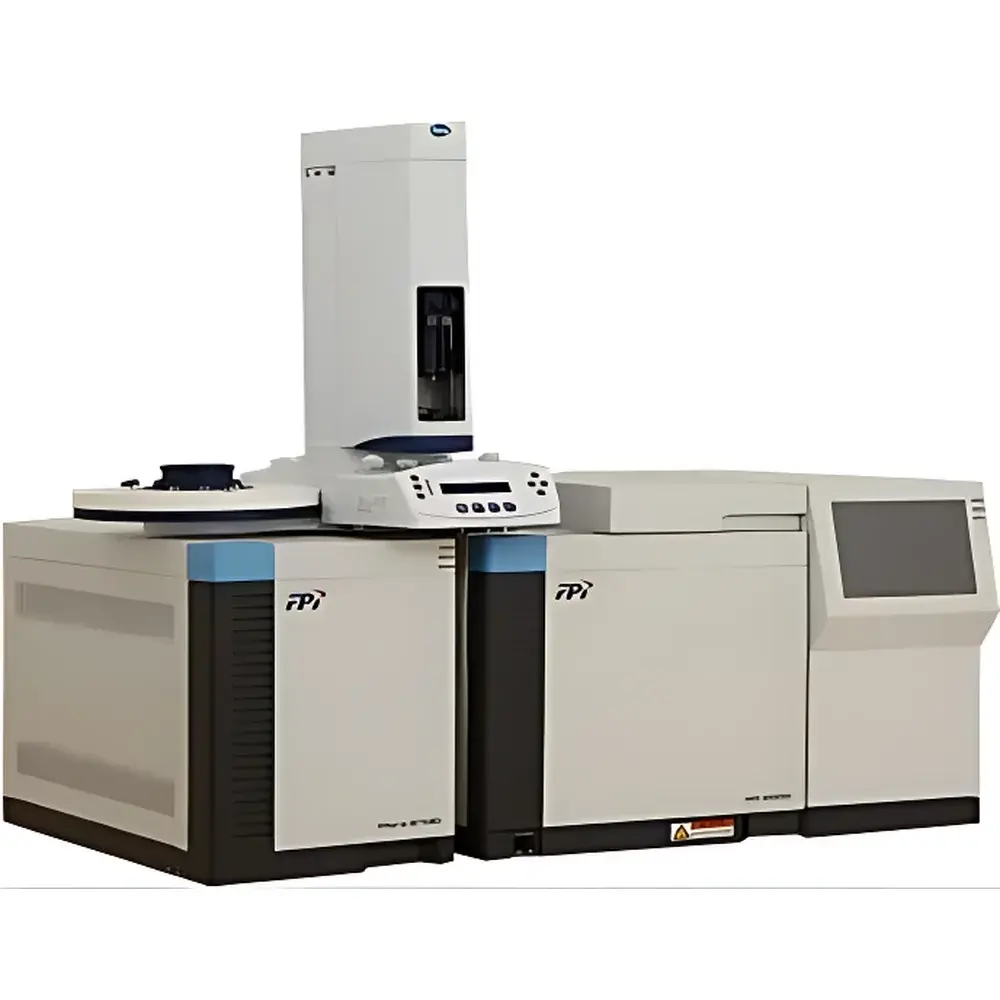
FPI Mars-6100 Gas Chromatography Ion Trap Mass Spectrometer
| Brand | FPI |
|---|---|
| Origin | Zhejiang, China |
| Manufacturer Type | Original Equipment Manufacturer (OEM) |
| Instrument Category | Domestic |
| Model | Mars-6100 |
| Mass Range | 10–750 m/z |
| Resolution | 1 amu (unit mass resolution) |
| Sensitivity | ≥150:1 S/N at m/z 272 for 1 pg octafluoronaphthalene (OFN), 1 µL injection |
| Scan Speed | 10,000 amu/s |
| Analyzer Type | 3D Quadrupole Ion Trap |
| GC-MS Configuration | Conventional Capillary GC-Coupled Ion Trap MS |
| Interface | Patented Self-Locking GC-MS Interface |
Overview
The FPI Mars-6100 is a laboratory-grade gas chromatography ion trap mass spectrometer (GC-ITMS) engineered for high-fidelity qualitative and semi-quantitative analysis of volatile and semi-volatile organic compounds. Built upon a proprietary 3D quadrupole ion trap architecture, the system operates on the principles of resonant ejection and controlled collision-induced dissociation (CID) within a stable RF trapping field. Unlike single-stage quadrupole or time-of-flight systems, the Mars-6100 enables true MSn capability—up to MS³—by sequentially isolating, exciting, and fragmenting precursor ions within the same physical volume. This architecture supports structural elucidation, library matching, and confirmation-level analysis in compliance with international method validation frameworks including ASTM D7894, ISO 17025, and USP . Developed under China’s National Key Technology R&D Program (“Eleventh Five-Year Plan”), the instrument integrates 12 patented technologies—including pulsed internal ionization and sample-region ion residence enhancement—to maximize ion transmission efficiency and duty cycle.
Key Features
- Patented pulsed internal electron ionization (EI) source: Minimizes ion scattering and space-charge effects during generation, improving signal stability across dynamic concentration ranges.
- Enhanced Collision-Induced Dissociation (ECID) mode: Delivers controlled, reproducible fragmentation with optimized activation waveforms—enabling robust spectral libraries and confident compound identification.
- Self-locking GC-MS interface: A mechanically indexed, thermally stabilized transfer line ensures repeatable capillary column alignment and leak-free coupling without torque-sensitive manual adjustment.
- Graphical method wizard: Guided four-step workflow (inject → tune → acquire → report) with pre-validated methods for >200 common analytes (e.g., PAHs, PCBs, pesticides, residual solvents).
- Fully integrated method development suite: Supports automated parameter optimization—including isolation width, excitation amplitude, and scan timing—for targeted structural characterization of unknowns.
- Domestically sourced critical components: Ion trap assembly, detector electronics, vacuum gauges, and consumables (ion source parts, GC septa, liner kits) are manufactured in-house or by certified Tier-1 Chinese suppliers, ensuring supply chain continuity and service cost predictability.
Sample Compatibility & Compliance
The Mars-6100 accepts standard 0.1–0.53 mm ID fused-silica capillary columns and is compatible with split/splitless, PTV, and cold-on-column injection techniques. It supports direct aqueous injection (DAI) and thermal desorption (TD) interfaces via optional modules. All firmware and acquisition software comply with GLP/GMP data integrity requirements: full audit trail logging, user-defined electronic signatures, and 21 CFR Part 11–ready configuration (with optional PKI certificate integration). Method files include embedded metadata per ISO/IEC 17025:2017 Clause 7.2.2, and raw data formats adhere to ANDI/NetCDF standards for third-party reprocessing.
Software & Data Management
FPI MassLab™ v3.2 provides native support for NIST MS Search, Wiley Registry, and user-customizable spectral libraries. Quantitative workflows implement internal standard calibration curves with weighted linear regression (1/x or 1/x²), limit of detection (LOD) estimation per ICH Q2(R2), and batch processing with QC flagging (e.g., retention time drift >0.05 min, peak area RSD >15%). Raw data (.raw) and processed results (.res) are stored in encrypted SQLite databases with automatic daily backup to network-attached storage (NAS). Audit logs record every parameter change, file export, and user login—retained for ≥36 months per laboratory SOP requirements.
Applications
The Mars-6100 is deployed in environmental monitoring laboratories for EPA Method 8270-compliant analysis of SVOCs in soil and water; in food safety labs for EU Regulation (EC) No 396/2005 pesticide residue screening; in pharmaceutical QC for residual solvent profiling (ICH Q3C); and in forensic toxicology units for rapid identification of designer drugs and metabolites in biological matrices. Its MSn capability makes it particularly suited for differentiating structural isomers (e.g., alkylbenzenes, phthalate esters) where unit-resolution spectra from conventional quadrupole instruments yield ambiguous matches.
FAQ
Does the Mars-6100 support quantitative analysis under regulated environments?
Yes—when configured with audit-trail-enabled MassLab™ and validated SOPs, it meets data integrity requirements for ISO/IEC 17025 accreditation and FDA-regulated testing.
Is remote instrument control supported?
Yes—via secure HTTPS-based web interface with role-based access control (RBAC) and TLS 1.2 encryption.
What vacuum system does the Mars-6100 use?
A dual-stage turbomolecular pump (200 L/s) backed by a dry scroll pump, achieving base pressure <5 × 10⁻⁶ Torr within 15 minutes of pump-down.
Can the system be upgraded to support GC×GC coupling?
Yes—through optional modulator integration and firmware update to enable comprehensive two-dimensional chromatographic data acquisition and deconvolution.
What is the typical maintenance interval for the ion trap and detector?
Under routine operation (≤8 h/day, clean samples), ion source cleaning is recommended every 2–3 weeks; trap and detector require annual performance verification—not routine replacement—per FPI Technical Bulletin TB-MS-004.
Related Products





