
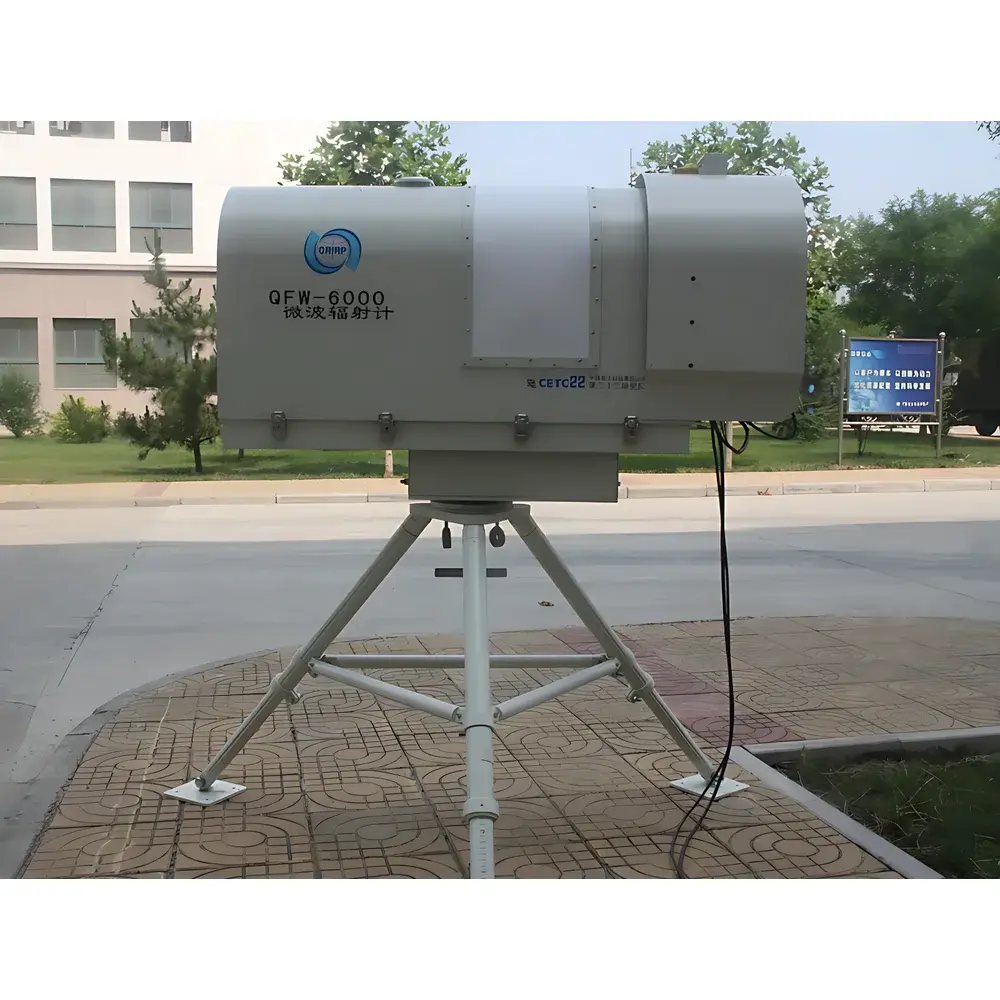
FPI Microwave Radiometer
| Brand | FPI |
|---|---|
| Origin | Zhejiang, China |
| Manufacturer Type | Manufacturer |
| Product Category | Domestic |
| Model | Microwave Radiometer |
| Instrument Type | Other Weather Station |
| Operating Conditions | All-weather, automatic long-term operation (effective under light-to-moderate rain) |
| Measurement Capabilities | Tropospheric temperature profile, humidity profile, integrated water vapor (IWV), liquid water path (LWP), cloud base temperature & height, boundary-layer temperature profiling |
| Calibration | Real-time internal auto-calibration + periodic absolute calibration |
| Design | Modular architecture, RF interference immunity, lightning protection compliant, wind- and moisture-resistant enclosure |
| Remote Monitoring | Yes, with status telemetry and alarm notification |
Overview
The FPI Microwave Radiometer is a ground-based passive remote sensing instrument engineered for continuous, unattended atmospheric profiling in operational meteorological and environmental monitoring networks. It operates on the principle of passive microwave radiometry—detecting naturally emitted thermal radiation from atmospheric oxygen and water vapor molecules across multiple frequency bands (typically 22–30 GHz and 51–58 GHz). By measuring brightness temperatures at these frequencies with high spectral resolution and calibrated sensitivity, the system retrieves vertical profiles of temperature and humidity in the troposphere (0–10 km AGL), along with column-integrated parameters including integrated water vapor (IWV), liquid water path (LWP), cloud base height and temperature, and boundary-layer thermodynamic structure. Unlike radiosondes or lidar systems, it requires no active transmission, enabling true all-weather operation—including during precipitation events up to moderate rain intensity—while maintaining metrological traceability through embedded blackbody and ambient sky reference targets.
Key Features
- Passive dual-band (K-band and V-band) radiometric detection with calibrated antenna temperature measurement accuracy ≤ 0.5 K (RMS) over operational temperature range (−20 °C to +50 °C)
- Real-time internal calibration using dual-reference (hot/cold load) system synchronized with every scan cycle; supports optional external absolute calibration via NIST-traceable blackbody sources
- Modular hardware architecture with redundant power management, industrial-grade enclosures rated IP65, and structural design validated for wind loading up to 50 m/s and humidity exposure ≥95% RH non-condensing
- Electromagnetic compatibility certified to IEC 61000-4-3 (radiated immunity) and IEC 61000-4-6 (conducted immunity), ensuring stable operation near radio transmitters, cellular infrastructure, and other RF-emitting equipment
- Integrated lightning protection per IEC 62305-4, including surge-protected power and data interfaces, grounding continuity monitoring, and equipotential bonding provisions
- Remote diagnostics and state-of-health telemetry via Ethernet or LTE interface, supporting SNMP v3 and MQTT protocols for integration into centralized SCADA or environmental data platforms
Sample Compatibility & Compliance
The FPI Microwave Radiometer is designed for deployment in fixed-site environmental observatories, airport weather stations, and research-grade atmospheric profiling networks. It complies with international observational standards including WMO No. 8 (Guide to Instruments and Methods of Observation), ISO/IEC 17025:2017 (for calibration laboratories supporting its maintenance), and relevant national technical specifications for automatic weather stations (e.g., QX/T 23–2019 in China). While not a direct regulatory compliance device, its retrieved products—such as IWV and LWP—are traceable to SI units through documented calibration chains and are routinely assimilated into numerical weather prediction models (e.g., ECMWF, GFS) and air quality forecasting systems. The instrument meets electromagnetic safety requirements per ICNIRP guidelines and fulfills structural resilience criteria outlined in GB/T 34235–2017 (Wind Resistance Design Standard for Meteorological Equipment).
Software & Data Management
The radiometer is operated and monitored using FPI’s proprietary Radiometrics Control Suite (RCS), a Windows/Linux-compatible application providing real-time spectrum visualization, retrieval algorithm configuration, quality control flagging, and automated export of Level 2 geophysical products (netCDF-4 compliant, CF-1.8 metadata convention). RCS supports audit-trail logging in accordance with GLP principles, including user action timestamps, calibration event records, and sensor health metrics. Raw brightness temperature data and processed profiles are stored locally on an industrial SSD with configurable retention policies and can be synchronized to central databases via SFTP or HTTPS REST APIs. Optional integration with EUMETCast or NOAA’s IDD enables near-real-time dissemination to regional meteorological services.
Applications
- Nowcasting of convective initiation through rapid detection of low-level moisture convergence and boundary-layer destabilization
- Monitoring of temperature inversions and fog formation potential in aviation meteorology
- Quantitative assessment of atmospheric stability indices (e.g., CAPE, CIN, Lifted Index) for severe weather early warning
- Supporting PM2.5 dispersion modeling by constraining boundary-layer height and relative humidity profiles critical to aerosol hygroscopic growth and sedimentation
- Long-term climate monitoring of tropospheric water vapor trends—recognized as a key Essential Climate Variable (ECV) by GCOS
- Validation of satellite-based microwave sounders (e.g., AMSU, ATMS) and reanalysis products (ERA5, MERRA-2)
FAQ
What atmospheric parameters does the FPI Microwave Radiometer retrieve?
It retrieves high-temporal-resolution vertical profiles of temperature and relative humidity from surface to ~10 km, plus integrated quantities: integrated water vapor (kg/m²), liquid water path (mm), cloud base height (m AGL), and cloud base temperature (°C).
Can it operate during rainfall?
Yes—designed for all-weather operation, it maintains valid retrievals under light to moderate rain (≤ 5 mm/h); heavy rain may attenuate higher-frequency channels but lower-band measurements remain functional.
Is absolute calibration required on-site?
No. Internal hot/cold load calibration ensures continuous traceability; however, annual absolute calibration using portable blackbody references is recommended for metrological assurance in research-grade deployments.
How is data quality assured?
Each retrieval includes uncertainty estimates derived from radiometric noise propagation and forward-model Jacobian analysis; QC flags identify periods affected by RFI, precipitation attenuation, or instrument anomalies.
Does it support integration with existing weather station networks?
Yes—via Modbus TCP, SNMP, or ASCII serial output, and compatible with common environmental data acquisition systems (e.g., Campbell Scientific CR-series, Vaisala MAWS).
Related Products







