
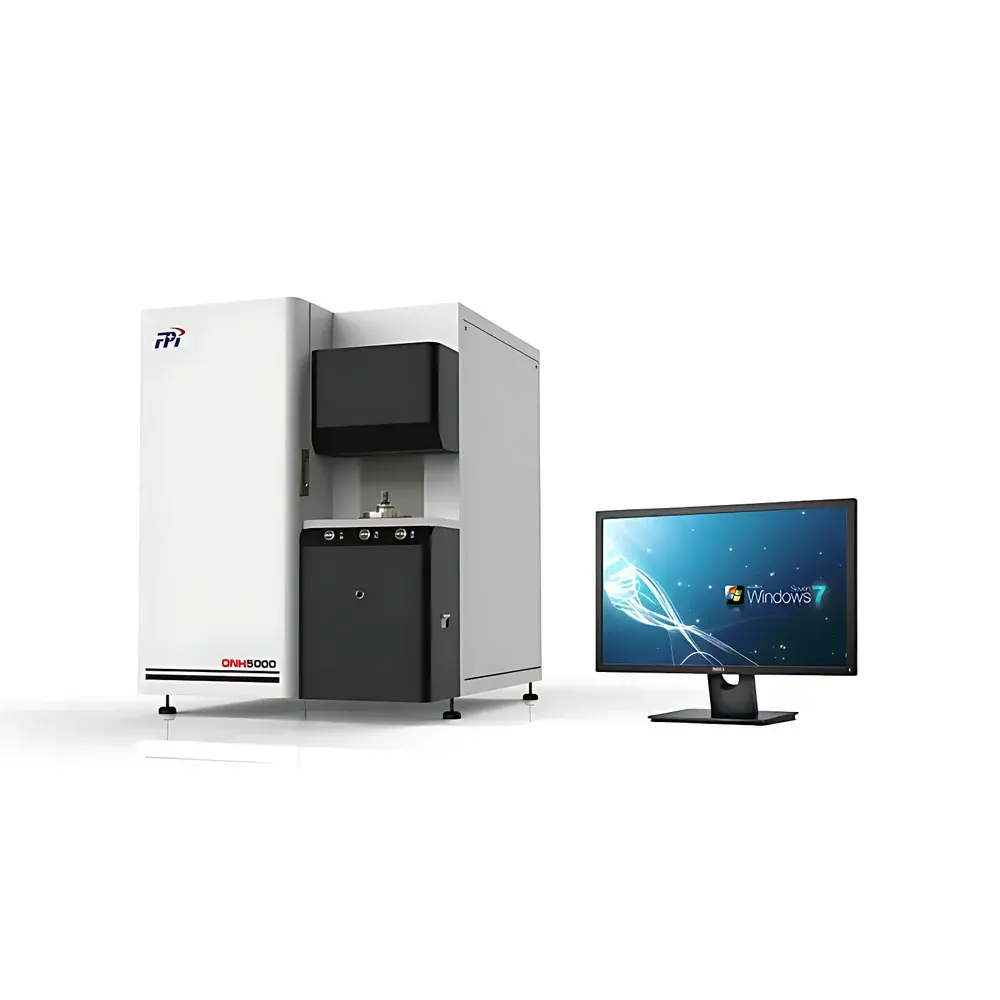
FPI ONH5000 Oxygen-Nitrogen-Hydrogen Elemental Analyzer
| Brand | FPI |
|---|---|
| Origin | Zhejiang, China |
| Manufacturer Type | Original Equipment Manufacturer (OEM) |
| Model | ONH5000 |
| Instrument Type | Oxygen-Nitrogen-Hydrogen Analyzer |
| Oxygen Range | 0.00001–3.0 wt% |
| Nitrogen Range | 0.00001–3.0 wt% |
| Hydrogen Range | 0.00000–0.25 wt% |
| Oxygen Precision | ±0.0001 wt% or RSD ≤ 1.0% |
| Nitrogen Precision | ±0.0001 wt% or RSD ≤ 1.0% |
| Hydrogen Precision | ±0.00002 wt% or RSD ≤ 2.0% |
| Sensitivity | 0.000001 wt% |
| Typical Analysis Time | 120–180 s (including purge, delay, and measurement) |
Overview
The FPI ONH5000 Oxygen-Nitrogen-Hydrogen Elemental Analyzer is a high-performance inert gas fusion analyzer engineered for precise quantification of interstitial elements—oxygen (O), nitrogen (N), and hydrogen (H)—in solid metallic and non-metallic materials. It operates on the principle of inert gas fusion coupled with dual detection methodologies: non-dispersive infrared (NDIR) absorption for oxygen determination and thermal conductivity detection (TCD) for simultaneous nitrogen and hydrogen analysis. Samples are thermally decomposed in a high-power pulse electrode furnace under helium or nitrogen carrier gas, where oxygen reacts with graphite to form CO; nitrogen and hydrogen are released as elemental N2 and H2. The evolved gases pass through a CO-to-CO2 catalytic converter before entering the infrared cell, while the remaining N2/H2 mixture is directed to the TCD. This integrated approach enables trace-level quantification with sub-ppm sensitivity and high reproducibility across diverse material classes.
Key Features
- 8.0 kW pulse electrode furnace with programmable temperature control (up to >3500 °C), supporting multiple heating modes: constant power, constant current, constant voltage, and ramped profiles;
- Modular hardware architecture comprising six independent subsystems: furnace, gas handling, IR detection, TCD, power supply, and water-cooled thermal management;
- Hermetically sealed gas path using premium imported components, featuring dual-axis guided electrode actuation and gas-curtain protected auto-sampling;
- Digital closed-loop furnace control with real-time feedback, eliminating thermal drift and ensuring consistent sample decomposition;
- High-stability solid-state infrared detector with narrow-band optical filters, long-life noble-metal IR source, and full-range linear calibration with automatic temperature/pressure/flow compensation;
- High-sensitivity TCD with low-noise tungsten-rhenium filaments, wide dynamic range, and proprietary linearity correction algorithms;
- Embedded 32-bit RISC processor running uClinux OS, enabling deterministic real-time data acquisition without sampling interference between channels.
Sample Compatibility & Compliance
The ONH5000 is validated for analysis of ferrous and non-ferrous alloys, superconductors, semiconductors, rare-earth compounds, technical ceramics, refractories, and other high-purity solid matrices. Its design adheres to core metrological requirements outlined in ASTM E1019 (Standard Test Methods for Determination of Carbon, Sulfur, Nitrogen, and Oxygen in Steel, Iron, Nickel, and Cobalt Alloys), ISO 14284 (Steel and Iron — Sampling and Preparation of Samples for Determination of Chemical Composition), and relevant sections of USP and ICH Q2(R2) for method validation in regulated environments. While not pre-certified for FDA 21 CFR Part 11, the system supports audit-trail-enabled software configurations compatible with GLP/GMP documentation workflows when deployed with validated SOPs and instrument qualification protocols (IQ/OQ/PQ).
Software & Data Management
The ONH5000 is operated via FPI’s dedicated Windows-based analytical software, which provides full instrument control, real-time signal visualization, multi-point calibration management, and automated report generation. Data files are stored in structured binary format with embedded metadata (operator ID, timestamp, sample ID, calibration status, gas flow logs). Export options include CSV, PDF, and XML formats compliant with LIMS integration standards. Software supports user-defined calculation templates, statistical process control (SPC) charts, and configurable pass/fail criteria per element. All measurement events—including parameter changes, calibration runs, and maintenance alerts—are logged with time stamps and operator authentication, forming a complete electronic record traceable for internal QA review.
Applications
- Quality control of aerospace-grade titanium and nickel-based superalloys where hydrogen embrittlement risk demands sub-10 ppm detection;
- Process monitoring of silicon carbide (SiC) and gallium nitride (GaN) wafers for oxygen contamination affecting epitaxial growth;
- Characterization of rare-earth permanent magnets (e.g., NdFeB) to correlate O/N/H content with coercivity degradation;
- Research into high-temperature superconductors (e.g., YBCO) where stoichiometric oxygen vacancy control is critical;
- Verification of ceramic matrix composites (CMCs) used in turbine blades, where nitrogen solubility influences creep resistance;
- Trace hydrogen analysis in zirconium cladding materials for nuclear fuel rods, per ASTM C1611 requirements.
FAQ
What carrier gases are supported, and how is selection determined?
Helium is standard for optimal TCD response and low background interference; nitrogen may be selected when analyzing high-nitrogen samples to avoid spectral overlap or when helium supply is constrained.
Can the ONH5000 perform single-element analysis only?
Yes—software-configurable analysis modes include O-only, N-only, H-only, O+N, O+H, and full O+N+H quantification, allowing method optimization per sample type.
Is external cooling water required?
No—the system integrates an energy-efficient recirculating chiller unit rated for continuous operation at ambient temperatures up to 35 °C.
How is calibration traceability maintained?
Certified reference materials (CRMs) traceable to NIST or BAM standards are used for daily calibration verification; multi-point calibration curves are stored with version-controlled metadata.
What maintenance intervals are recommended for routine operation?
Daily: crucible inspection and cleaning; weekly: filter replacement and leak check; quarterly: IR cell purge and TCD filament resistance verification; annually: full furnace alignment and gas path integrity validation.





