
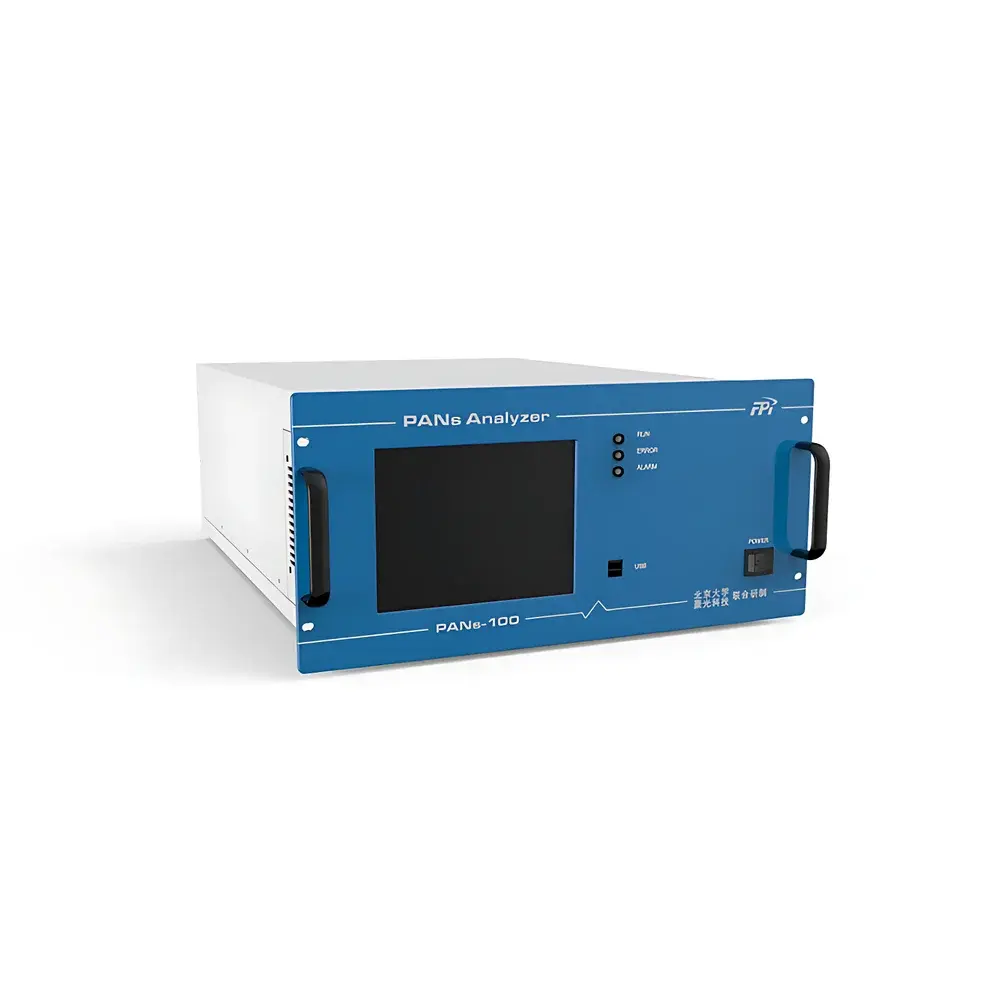
FPI PAN Analyzer
| Brand | FPI (Fortune Photonics Instrumentation) |
|---|---|
| Origin | Zhejiang, China |
| Manufacturer Type | Original Equipment Manufacturer (OEM) |
| Country of Manufacture | China |
| Model | PAN |
| Pricing | Available Upon Request |
Overview
The FPI PAN Analyzer is a high-sensitivity, real-time gas-phase instrument engineered for the quantitative detection of peroxyacetyl nitrate (PAN) in ambient air. PAN is a thermally labile, secondary atmospheric pollutant formed exclusively through photochemical reactions involving nitrogen oxides (NOx) and volatile organic compounds—primarily acetaldehyde—in the presence of hydroxyl radicals (•OH) and molecular oxygen. Its formation pathway is tightly coupled to solar irradiance and temperature, making PAN a robust tracer for photochemical smog activity. Unlike primary pollutants, PAN has no natural emission sources; its atmospheric presence directly indicates ongoing photooxidation processes. As a key component of the peroxyacyl nitrates (PANs) family, it exhibits high phytotoxicity, ocular irritancy, and suspected mutagenic potential. Moreover, PAN contributes to acid deposition upon hydrolysis in cloud droplets or rainwater, releasing nitrate ions and organic acids—thus playing a dual role in both tropospheric ozone chemistry and precipitation acidification.
Key Features
- Thermal-dissociation–chemiluminescence (TD-CL) detection principle, optimized for selective PAN quantification with minimal interference from other NOy species
- Integrated catalytic converter and cryogenic pre-concentration module to enhance detection sensitivity below 10 pptv (parts-per-trillion by volume) at 1-minute integration time
- Onboard temperature-controlled reaction chamber ensuring stable PAN thermal dissociation at 180–220 °C with <±0.5 °C precision
- Automated zero-air calibration system using synthetic air scrubbed via catalytic ozone removal and hydrocarbon traps
- Ruggedized field-deployable architecture compliant with IP54 environmental rating for continuous unattended operation in urban, rural, and mountain-top monitoring stations
- Real-time data logging with timestamped raw signal output, supporting traceable calibration history per ISO/IEC 17025 requirements
Sample Compatibility & Compliance
The analyzer is designed for direct analysis of ambient air samples without pre-filtration (except optional PM10 inlet filter). It maintains measurement integrity across humidity ranges of 10–90% RH and ambient temperatures from −20 °C to +45 °C. The system meets EN 14625:2017 for ambient air quality—measurement of PAN using chemiluminescence after thermal dissociation—and supports method validation per EPA TO-15 and ASTM D6348-22 protocols. All firmware and data handling routines are structured to support audit-ready GLP/GMP workflows, including electronic signature capability and full 21 CFR Part 11-compliant audit trails when integrated with validated LIMS platforms.
Software & Data Management
FPI’s proprietary PANView™ software provides real-time spectral visualization, automated baseline correction, and multi-point linear/nonlinear calibration curve generation. Raw voltage signals from the photomultiplier tube (PMT) are digitized at 10 Hz and processed using embedded Savitzky–Golay smoothing and outlier rejection algorithms. Data export formats include netCDF-4 (CF-compliant), CSV with ISO 8601 timestamps, and XML metadata packages containing instrument status, calibration logs, and environmental sensor readings (T, RH, pressure). Remote diagnostics and firmware updates are supported via TLS-secured SSH or HTTPS API endpoints, enabling centralized fleet management for regional air quality networks.
Applications
- Photochemical smog early-warning systems in megacities and industrial corridors
- Long-term trend analysis of PAN/NOx/O3 correlations in background monitoring sites (e.g., EMEP, GAW, and ACTRIS stations)
- Process emission verification for petrochemical refineries and solvent-use facilities under national VOC control policies
- Field validation of regional chemical transport models (e.g., CMAQ, WRF-Chem) requiring speciated PAN boundary conditions
- Ecological impact studies assessing PAN-mediated stomatal conductance inhibition in sensitive bioindicator species (e.g., Phaseolus vulgaris)
FAQ
What is the lower limit of detection (LOD) for PAN under standard operating conditions?
The LOD is 8 pptv (signal-to-noise ratio = 3) for a 60-second averaging period, verified using certified PAN permeation tubes traceable to NIST SRM 2795.
Does the analyzer require external gas supplies beyond zero air?
No—only zero air (generated internally or supplied externally) is required; no ozone, NO, or calibration gases are consumed during routine operation.
Can the system be integrated into existing air quality monitoring networks using Modbus or MQTT?
Yes—native support for Modbus TCP and MQTT v3.1.1 is provided, with configurable topic hierarchies and JSON payload schemas aligned with AQMesh and OpenAQ specifications.
How frequently must the catalytic converter be replaced?
Under typical urban ambient conditions, the MnO2/Al2O3 catalyst demonstrates >18 months operational stability before performance drift exceeds ±2% of initial response factor.
Is the instrument suitable for mobile platform deployment (e.g., vehicle or aircraft)?
Yes—the analyzer meets MIL-STD-810G vibration and shock specifications; optional inertial motion compensation and pressure-normalized flow control are available for airborne applications.
Related Products







