
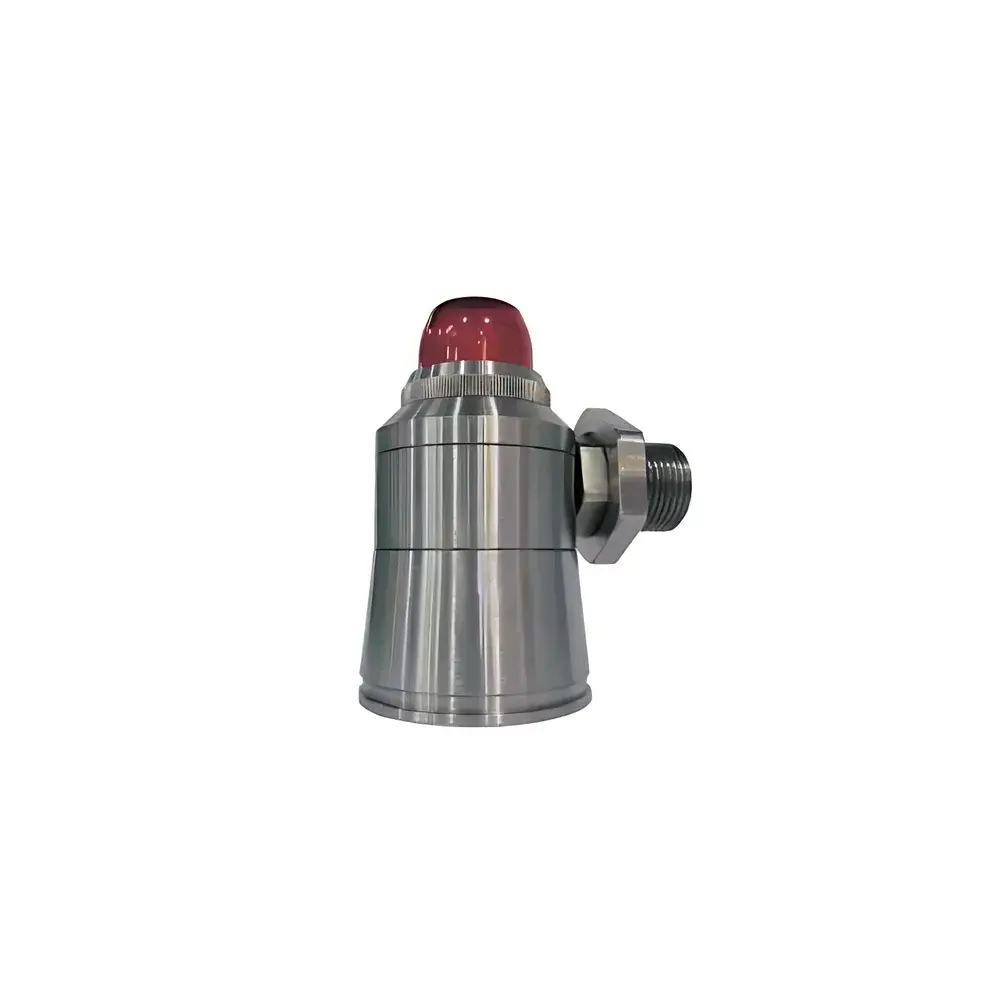
FPI SG-100 Integrated Acoustic-Optic Gas Alarm
| Brand | FPI |
|---|---|
| Origin | Zhejiang, China |
| Manufacturer Type | OEM/ODM Producer |
| Country of Origin | China |
| Model | SG-100 |
| Pricing | Available Upon Request |
Overview
The FPI SG-100 Integrated Acoustic-Optic Gas Alarm is a field-deployable safety interface device engineered for real-time hazard indication in industrial gas detection systems. Designed to operate as a standalone visual and audible alert unit—or in coordinated configuration with compatible FPI gas transmitters—the SG-100 implements dual-mode signaling based on input alarm triggers from upstream detection electronics. Its core function is not gas sensing itself, but rather the reliable, high-visibility translation of digital or analog alarm states into human-perceivable stimuli: synchronized pulsed red LED illumination and frequency-modulated audible tones. The device adheres to fundamental principles of occupational safety engineering—ensuring rapid attention capture under ambient noise (up to 85 dB(A)) and variable lighting conditions (including direct sunlight exposure). It is intended for fixed installation in Zone 2/22 hazardous locations when used with certified intrinsically safe gas detectors, and complies with IEC 60079-0 general requirements for explosive atmospheres.
Key Features
- 360° adjustable mounting via integrated locking nut mechanism—enables precise directional alignment of both optical and acoustic output axes without tools
- Dual-intensity red LED strobe (peak luminous intensity ≥ 15 cd) with configurable flash patterns (steady, single-pulse, dual-pulse, or modulated burst) per alarm level
- Wide-spectrum audible alarm (85–110 dB(A) at 1 m) with three distinct tone frequencies (450 Hz, 850 Hz, 1200 Hz) programmable per alarm severity tier
- IP65-rated polycarbonate housing with UV-stabilized finish—certified for continuous outdoor operation across −20 °C to +60 °C ambient temperature range
- Universal 24 VDC ±20% power input with reverse polarity protection and transient voltage suppression (IEC 61000-4-5 Level 3)
- Compatibility with all FPI G-Ding series gas detectors except two-wire loop-powered models—supports dry-contact, 4–20 mA, and Modbus RTU alarm interfaces
Sample Compatibility & Compliance
The SG-100 does not perform gas analysis; it functions exclusively as an alarm annunciator. Its compatibility is defined by electrical interface standards—not chemical or physical sample properties. It accepts standard industrial alarm signals including SPST relay closure (max. 250 VAC / 2 A), active 4–20 mA current loop (sink/source configurable), or RS-485 Modbus RTU commands (addressable up to 247 nodes). The unit meets CE marking requirements under Directive 2014/30/EU (EMC) and 2014/35/EU (LVD). For use in North America, it is listed to UL 1610 (Carbon Monoxide and Smoke Alarms) and UL 2075 (Gas and Vapor Detectors and Sensors) when deployed with UL-listed FPI transmitters. Documentation includes full traceability to ISO 9001:2015 manufacturing controls and supports GLP/GMP audit readiness through factory calibration records and revision-controlled firmware logs.
Software & Data Management
While the SG-100 operates autonomously without embedded firmware updates, its integration into networked safety systems relies on interoperability with FPI’s G-Ding System Manager software (v3.2+). This Windows-based platform enables centralized configuration of flash duration, tone frequency mapping, and alarm escalation logic across multiple SG-100 units. All configuration changes are logged with timestamp, operator ID, and CRC-verified parameter checksums—supporting FDA 21 CFR Part 11 compliance when deployed in pharmaceutical or food processing facilities. Event history (alarm activation count, duration, and timestamp) is retained in non-volatile memory for ≥12 months and exportable via USB-C or Modbus TCP to SCADA or MES platforms. No cloud connectivity or remote firmware update capability is implemented—consistent with ISA/IEC 62443-3-3 SL2 cybersecurity requirements for safety-critical perimeter devices.
Applications
- Chemical manufacturing plants: Localized alarm indication at reactor skids, loading bays, and solvent storage areas
- Wastewater treatment facilities: H2S and CH4 hazard notification near anaerobic digesters and pump stations
- Pharmaceutical cleanrooms: Silent-mode visual alerts during aseptic operations where audible alarms are restricted
- Refinery maintenance zones: Temporary deployment during turnaround activities using magnetic or clamp-mount accessories
- Biogas upgrading stations: Redundant alarm layer interfaced with methane and CO2 analyzers per EN 14181 QA/QC protocols
FAQ
Can the SG-100 be used in Class I, Division 1 hazardous locations?
No. The SG-100 is rated for Class I, Division 2 / Zone 2 environments only. It must be installed downstream of intrinsically safe barriers when connected to field sensors in higher-risk zones.
Is third-party calibration required before commissioning?
No. As a non-measuring device, the SG-100 undergoes functional verification at factory (flash timing accuracy ±50 ms, sound pressure level tolerance ±3 dB). Field validation consists of end-to-end system test per IEC 61511 SIS verification procedures.
Does it support HART or Foundation Fieldbus communication?
No. Communication is limited to discrete relay, analog 4–20 mA, and Modbus RTU over RS-485. HART and FF are unsupported due to signal integrity constraints in high-noise industrial settings.
What is the expected service life under continuous operation?
LED light source lifetime exceeds 50,000 hours at 25 °C ambient; electromechanical relay contacts rated for ≥100,000 operations; housing UV resistance validated to ASTM G154 Cycle 4 (1000 hrs QUV exposure).







