
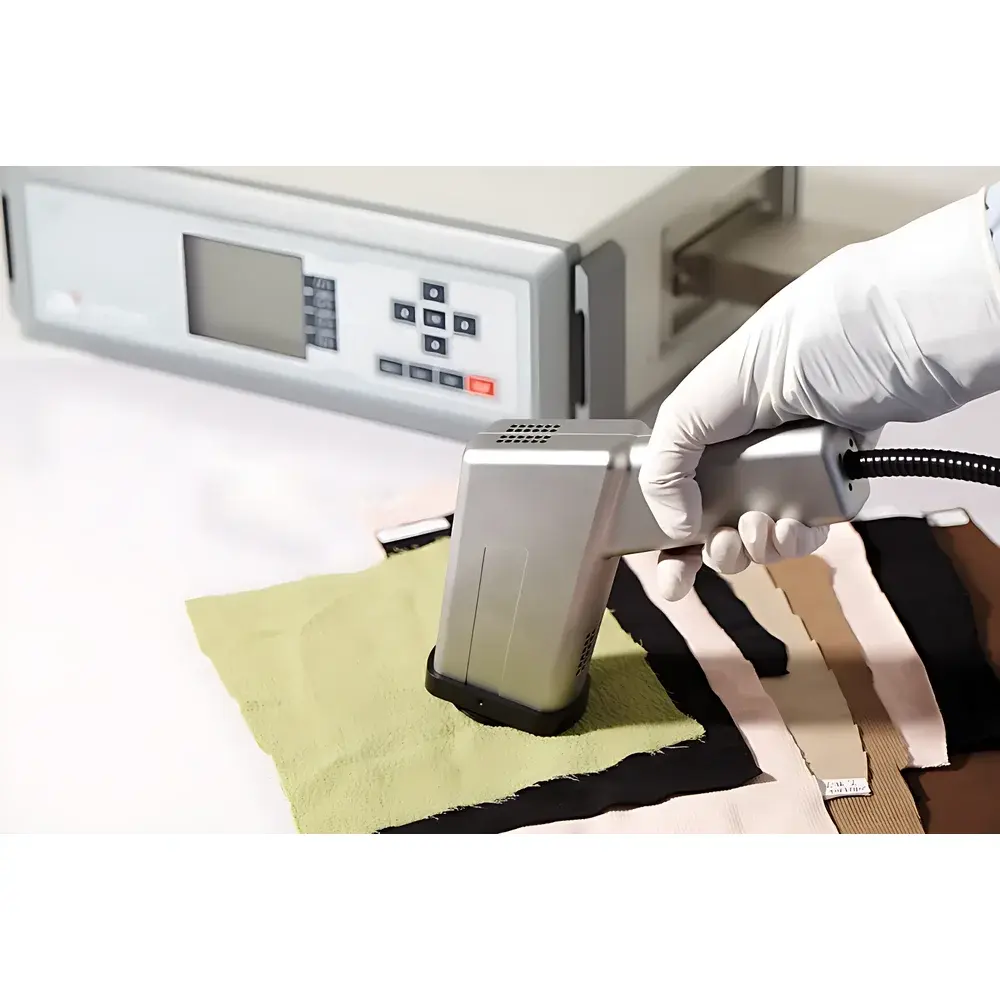
FPI SupNIR-1000 Portable Near-Infrared Spectrometer
| Brand | FPI |
|---|---|
| Origin | Zhejiang, China |
| Manufacturer Type | Original Equipment Manufacturer (OEM) |
| Product Category | Domestic |
| Model | SupNIR-1000 |
| Instrument Type | Portable |
| Operating Principle | Grating Scanning |
| Wavelength Range | 600–1100 nm & 1000–1800 nm |
| Analysis Time | <30 s |
| Wavelength Repeatability | ±0.05 nm |
| Sampling Modes | Diffuse Reflectance & Transmission |
| Chemometrics Software | RIMP |
Overview
The FPI SupNIR-1000 is a rugged, field-deployable near-infrared (NIR) spectrometer engineered for high-fidelity spectral acquisition in non-laboratory environments. Based on grating scanning optical architecture, it delivers stable, reproducible spectra across two complementary wavelength bands—visible-NIR (600–1100 nm) and short-wave NIR (1000–1800 nm)—enabling broad chemical selectivity for organic functional group detection (e.g., O–H, C–H, N–H overtones and combinations). Its optical design minimizes stray light (<0.1%) and ensures wavelength accuracy of ±0.2 nm with repeatability better than ±0.05 nm—critical for quantitative calibration transfer between instruments and field-to-lab method alignment. The system operates without consumables or sample preparation, supporting true non-destructive analysis of solids, pastes, and liquids in situ.
Key Features
- Portable form factor (355 × 278 × 117 mm; 6 kg) with integrated rechargeable Li-ion battery (up to 8 h operation) and dual-power support (DC 19 V/4.5 A adapter)
- Dual-band spectral coverage optimized for multi-matrix applications: 600–1100 nm for fruit maturity, pigment, and moisture assessment; 1000–1800 nm for protein, fat, starch, and cellulose quantification
- Optical performance validated per ASTM E1655-22 (Standard Practices for Infrared Multivariate Quantitative Analysis) and ISO 12099:2017 (Animal feeding stuffs — Guidance on the application of near infrared spectroscopy)
- Integrated reference standard for automated self-diagnosis, wavelength calibration verification, and real-time fault logging
- High-resolution monochrome LCD interface with full Chinese localization—designed for intuitive navigation by non-specialist operators in industrial QA/QC or agricultural extension settings
- Modular probe interface supporting rapid interchange of reflectance probes (contact/non-contact), transmission cells, and fiber-optic accessories for heterogeneous sample geometries
- Onboard storage capacity: ≥500 spectra, ≥6000 analysis results, and up to 6 independent chemometric model groups—each configurable with user-defined prediction equations and statistical limits
Sample Compatibility & Compliance
The SupNIR-1000 accommodates diverse physical forms via standardized sampling interfaces: intact fruits (e.g., apples, citrus), ground grains, powdered pharmaceuticals, liquid oils, and compressed feed pellets. Diffuse reflectance mode enables surface-level compositional mapping without grinding; transmission mode supports homogeneous liquid or thin-film analysis (e.g., edible oil adulteration screening). All hardware and firmware comply with IEC 61326-1:2023 (EMC requirements for laboratory equipment) and meet IP54 ingress protection rating for dust and splash resistance during outdoor deployment. Data integrity protocols align with GLP/GMP documentation standards—including time-stamped audit trails for model updates, spectral acquisitions, and result exports—supporting regulatory readiness in food safety (FDA FSMA), agriculture (USDA AMS), and pharma (ICH Q2(R2)) contexts.
Software & Data Management
RIMP (Remote Intelligent Modeling Platform) is a Windows-based chemometrics suite bundled with the instrument. It supports full lifecycle management of PLS, PCR, and SVM models—from spectral preprocessing (Savitzky-Golay smoothing, SNV, MSC, derivative transformations) to cross-validation (leave-one-out, k-fold) and performance reporting (RMSEC, RMSEP, R², bias, slope). RIMP enables secure data synchronization via USB 2.0, batch report generation (PDF/CSV/XLSX), and remote instrument control through encrypted TCP/IP connections—facilitating centralized fleet monitoring across distributed agricultural cooperatives or contract manufacturing sites. All exported reports include embedded metadata (instrument ID, operator tag, environmental conditions, calibration version) to satisfy 21 CFR Part 11 electronic record requirements when configured with user authentication and digital signature modules.
Applications
- Agriculture & Food: Real-time sugar content (Brix), dry matter, acidity, and firmness profiling in orchards; grain protein/oil/moisture analysis at elevators; edible oil authenticity screening (palm vs. sunflower); meat species identification and fat content verification
- Tobacco Industry: Leaf moisture monitoring during curing; alkaloid (nicotine) and reducing sugar quantification for blending optimization; post-fermentation quality grading
- Pharmaceuticals & Herbal Medicine: Identity testing of raw botanical materials (e.g., ginseng, astragalus); tablet assay uniformity checks; excipient blend homogeneity assessment
- Environmental & Materials Science: Soil organic carbon and nitrogen estimation in field surveys; polymer type identification in plastic recycling streams; textile fiber composition analysis (cotton/polyester blends)
FAQ
Is the SupNIR-1000 compliant with international calibration traceability standards?
Yes—the instrument includes an onboard NIST-traceable ceramic reference tile for daily wavelength and photometric validation, supporting ISO/IEC 17025-compliant calibration intervals.
Can RIMP software import third-party calibration models built in Unscrambler or MATLAB?
RIMP accepts .csv and .txt spectral files and supports manual coefficient import for PLS models; however, proprietary binary formats require conversion via FPI’s model translation utility (provided under support agreement).
What environmental conditions limit operational use?
Rated for ambient temperatures of 5–35 °C and relative humidity ≤85% non-condensing; extended operation beyond these ranges requires external thermal stabilization and desiccant housing.
How is data security managed during remote network operation?
RIMP implements TLS 1.2 encryption for data-in-transit and AES-256 encryption for stored models and spectra; role-based access control (RBAC) is configurable via Active Directory integration.
Does the system support FDA 21 CFR Part 11 compliance out-of-the-box?
Full Part 11 functionality—including electronic signatures, audit trail review, and system validation documentation—is available as an optional configuration package, validated per GAMP 5 guidelines.





