
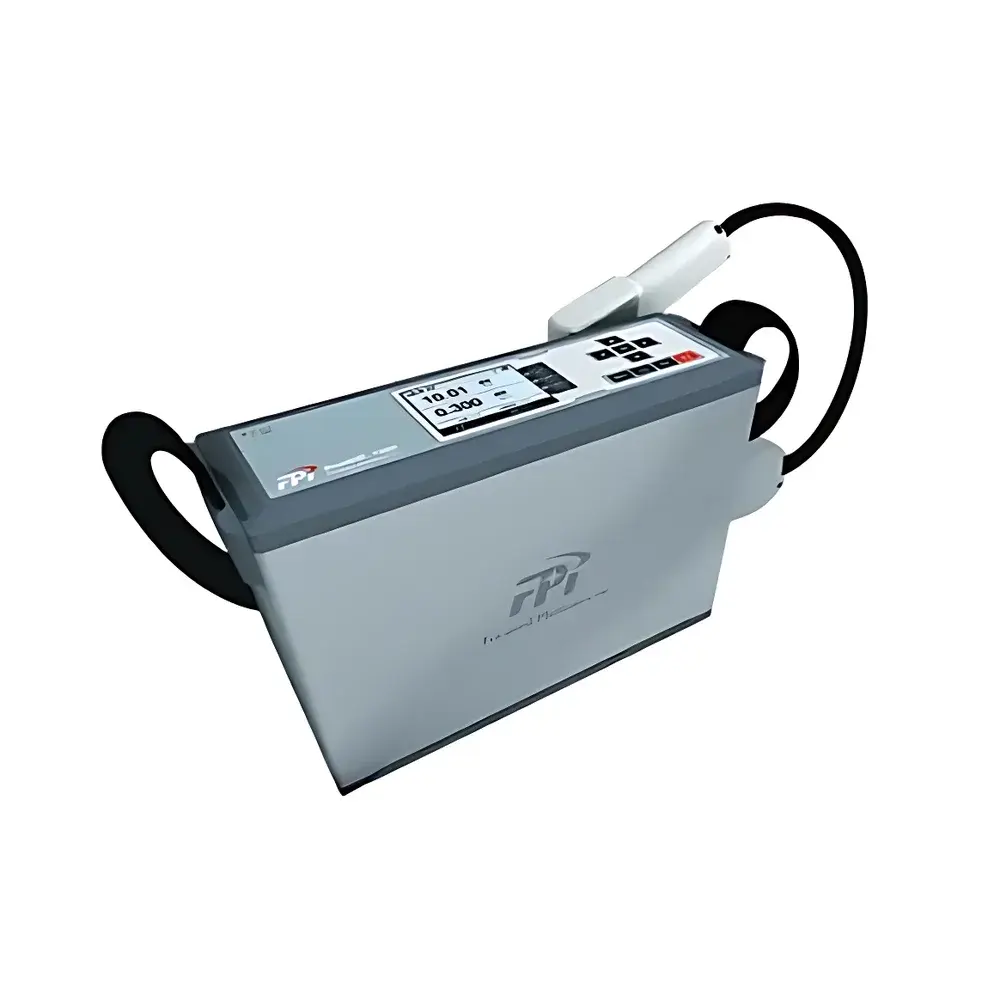
FPI SupNIR-1500 Portable Near-Infrared Spectrometer
| Brand | FPI |
|---|---|
| Origin | Zhejiang, China |
| Model | SupNIR-1500 |
| Instrument Type | Portable |
| Optical Principle | Holographic Grating Scanning |
| Wavelength Range | 1000–1800 nm |
| Scan Speed | >1 spectrum/sec |
| Spectral Resolution | 1 nm sampling interval |
| Measurement Modes | Diffuse Reflectance / Transmission |
| Detector | TE-Cooled InGaAs |
| Chemometrics Software | RIMP |
| Power Supply | Integrated Rechargeable Battery |
| Display | Built-in LCD |
| Data Storage | Onboard Memory |
Overview
The FPI SupNIR-1500 Portable Near-Infrared Spectrometer is an engineered solution for field-deployable, non-destructive compositional analysis based on diffuse reflectance and transmission spectroscopy in the short-wave near-infrared (SW-NIR) region. Operating on a holographic grating scanning optical architecture, it delivers high-fidelity spectral acquisition from 1000 nm to 1800 nm with a fixed 1 nm data sampling interval—optimized for robust chemometric modeling of organic functional groups (e.g., O–H, C–H, N–H) in complex matrices. Unlike filter-based or fixed-grating systems, its scanning design ensures full spectral coverage without interpolation artifacts, supporting method transfer across instruments and long-term calibration stability. The integrated thermoelectrically cooled (TEC) InGaAs detector maintains thermal equilibrium during extended field use, minimizing dark current drift and preserving signal-to-noise ratio (SNR) under variable ambient conditions. Designed for operational autonomy, the SupNIR-1500 functions as a standalone analyzer with onboard data storage, real-time spectral preview, and result display via its built-in LCD—eliminating dependency on external computing hardware during rapid screening.
Key Features
- Compact, ruggedized chassis with ergonomic handheld form factor and IP54-rated enclosure for dust/moisture resistance in agricultural fields, factory floors, and laboratory peripheries.
- Modular probe interface supporting interchangeable diffuse reflectance probes (with integrated illumination optics) and transmission cuvette holders—enabling method flexibility without recalibration.
- Onboard rechargeable lithium-ion battery providing ≥6 hours of continuous operation; supports hot-swappable battery packs for uninterrupted multi-shift deployment.
- Real-time spectral acquisition at >1 spectrum per second, synchronized with internal clock and GPS timestamping (optional module), facilitating time-series monitoring and spatial mapping applications.
- Firmware-level spectral preprocessing including dark current subtraction, detector linearity correction, and Savitzky-Golay smoothing—ensuring raw spectra meet ASTM E1655-22 baseline requirements for multivariate calibration inputs.
Sample Compatibility & Compliance
The SupNIR-1500 accommodates heterogeneous sample geometries without preparation: intact grains, powdered APIs, textile yarns, polymer films, liquid solutions, and semi-solids (e.g., creams, slurries). Its dual-mode optical path supports both contact-based diffuse reflectance (for solids and pastes) and pathlength-controlled transmission (for clear liquids and thin films). All measurement protocols align with ISO 12099:2017 (Animal feeding stuffs — Guidance on the application of near-infrared spectroscopy) and AOAC Official Method 2014.01 (NIRS for protein in cereal grains). When operated with RIMP software under validated configurations, data workflows comply with GLP documentation standards—including electronic signature support, audit trail logging, and user-access controls per FDA 21 CFR Part 11 Annex 11 requirements.
Software & Data Management
RIMP (Robust Intelligent Modeling Platform) is a Windows-based chemometrics suite certified for method development, validation, and routine prediction. It implements PLS regression, PCA, SIMCA, and outlier detection algorithms compliant with ICH Q2(R2) guidelines. RIMP supports ASTM E1655-22-compliant calibration file formats (.cal, .spc), enables cross-instrument model portability, and exports prediction reports in CSV/PDF with uncertainty estimates. All spectral acquisitions—whether generated onboard or via PC tethering—are tagged with metadata (operator ID, location, timestamp, probe ID, ambient temperature) and stored in encrypted SQLite databases. Raw spectra and processed results are exportable in JCAMP-DX v5.0 format for third-party integration with LIMS or enterprise analytics platforms.
Applications
- Agricultural Science: Rapid quantification of moisture, protein, starch, and oil content in cereals, oilseeds, and forage crops—supporting breeding programs and harvest quality grading.
- Pharmaceutical QA/QC: Identification of counterfeit tablets, verification of blend uniformity, and assay of active pharmaceutical ingredients (APIs) in powder blends—aligned with USP <1119> NIR guidelines.
- Food Safety & Authenticity: Detection of adulterants (e.g., melamine in milk powder), origin tracing of olive oil and honey, and shelf-life prediction via oxidation marker tracking.
- Textile & Polymer Industry: Fiber type identification (cotton vs. polyester), moisture regain assessment, and additive concentration monitoring in synthetic filaments.
- Chemical Manufacturing: Real-time reaction endpoint determination in batch processes, solvent purity verification, and catalyst activity profiling in petrochemical feedstocks.
FAQ
Does the SupNIR-1500 require external calibration standards for routine use?
No—once a validated PLS model is deployed to the instrument’s firmware, predictions are self-contained. However, periodic performance qualification (PQ) using NIST-traceable reference materials (e.g., SRM 1921b) is recommended per ISO/IEC 17025:2017.
Can RIMP models developed on benchtop NIR instruments be transferred to the SupNIR-1500?
Yes, provided the spectral resolution, wavelength range, and preprocessing steps match. RIMP includes a spectral matching utility that applies instrument-specific correction vectors to ensure inter-platform equivalence.
Is the device suitable for hazardous environments (e.g., grain silos or chemical plants)?
The standard unit is not ATEX/IECEx certified. For intrinsically safe deployment, consult FPI’s industrial variant (SupNIR-1500-EX), which features explosion-proof housing and isolated power management.
What spectral data output formats are supported?
Raw intensity spectra (.jdx), processed absorbance/transmittance files (.csv), and prediction reports (.pdf/.xlsx) with full traceability metadata.
How is firmware updated and method security managed?
Updates are delivered via signed .bin packages through RIMP’s secure update portal. All calibration models are digitally signed and encrypted; unauthorized modification triggers firmware-level integrity checks and disables prediction mode.
Related Products






