
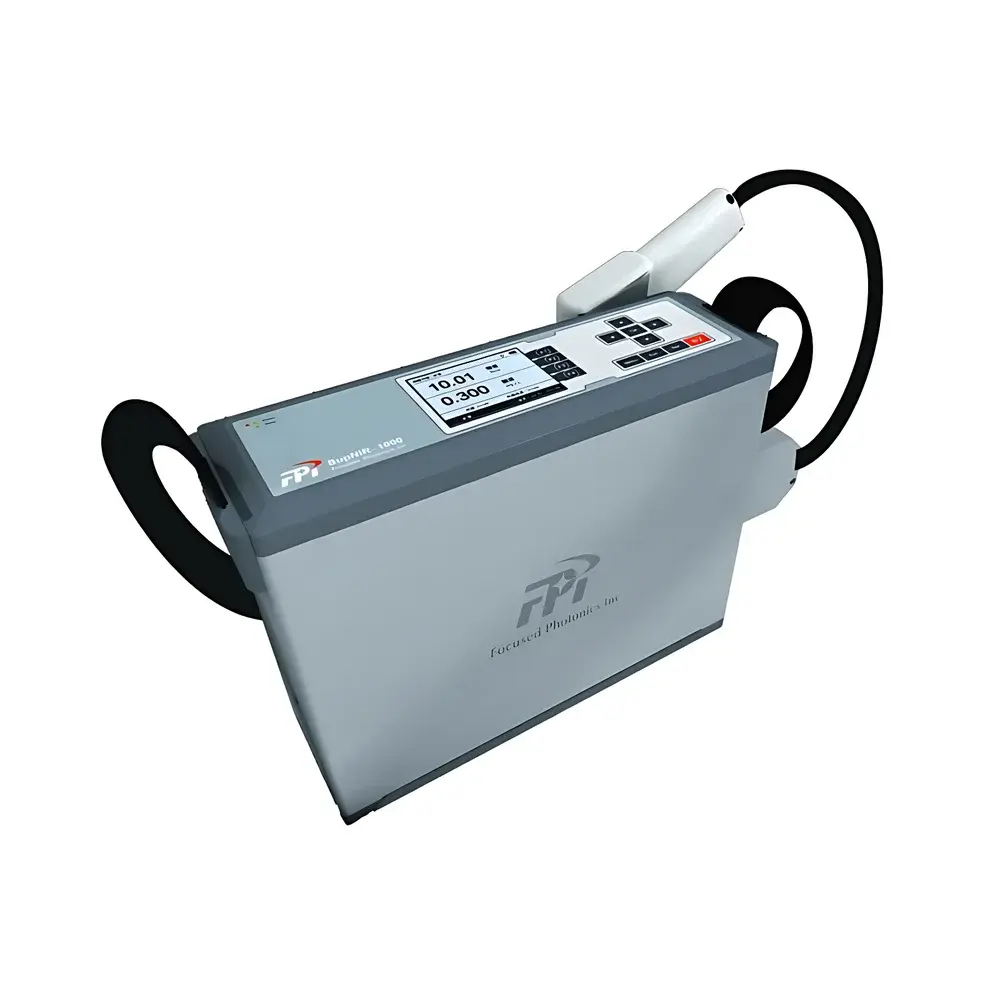
FPI SupNIR-1520TM Portable Near-Infrared Spectrometer
| Brand | FPI |
|---|---|
| Origin | Zhejiang, China |
| Manufacturer Type | Original Equipment Manufacturer (OEM) |
| Product Category | Domestic |
| Model | SupNIR-1520TM |
| Instrument Type | Portable |
| Optical Principle | Holographic Gold-Coated Concave Grating Scanning |
| Detection Mode | Diffuse Reflectance |
| Software | RIMP Chemometrics Platform |
| Compliance | Designed for ISO 17025-aligned textile testing workflows |
Overview
The FPI SupNIR-1520TM Portable Near-Infrared Spectrometer is an optical analytical instrument engineered for rapid, non-destructive quantitative and qualitative analysis of textile fiber composition using diffuse reflectance near-infrared (NIR) spectroscopy. Operating on the principle of grating-scanned spectral acquisition in the NIR region (typically 1100–2500 nm, consistent with industry-standard textile characterization bands), the instrument captures molecular vibrational overtones and combination bands—primarily from C–H, N–H, and O–H functional groups—to enable discrimination and quantification of natural (e.g., cotton, wool, silk) and synthetic fibers (e.g., polyester, nylon, acrylic). Its compact, battery-operable architecture supports field-deployable operation without compromising optical stability, making it suitable for quality control at textile mills, customs inspection sites, third-party testing laboratories, and academic research environments where traditional wet chemistry or destructive methods (e.g., ASTM D276, ISO 1833) are impractical due to time, cost, or sample integrity constraints.
Key Features
- Portable, self-contained design with integrated light source, holographic gold-coated concave grating monochromator, and high-sensitivity InGaAs detector array—optimized for signal-to-noise ratio in diffuse reflectance geometry.
- Non-contact or light-contact optical measurement: no sample cutting, dissolution, or chemical reagents required; preserves specimen integrity for archival or further testing.
- Single-button operation mode for routine analysis; intuitive interface enables minimal operator training—ideal for frontline QC technicians and regulatory inspectors.
- Ruggedized housing compliant with IP54 environmental rating; shock-absorbing chassis and low-power consumption support extended battery operation (>6 hours typical).
- Calibration traceability maintained via onboard reference standards and user-configurable wavelength validation routines aligned with NIST-traceable practices.
Sample Compatibility & Compliance
The SupNIR-1520TM accommodates a broad range of textile forms—including woven/knitted fabrics, yarns, loose fibers, and blended nonwovens—with minimal geometric constraints. Sample presentation requires no homogenization or pelletization; flat, uniform surfaces yield optimal spectral reproducibility. The system is validated for use in accordance with textile testing frameworks including ISO 1833-1:2019 (quantitative analysis of binary fiber mixtures) and GB/T 2910 (Chinese national standard series for fiber identification). While not pre-certified for FDA or EU MDR compliance, its data structure and audit-ready software logs support integration into GLP- and GMP-aligned quality systems when deployed under documented SOPs.
Software & Data Management
The RIMP (Remote Intelligent Modeling Platform) chemometrics software serves as the central analytical engine. It provides full English/Chinese bilingual UI (configurable per user preference), model development, validation, and deployment tools. Core algorithms include Partial Least Squares (PLS) regression for quantitative prediction of fiber mass fractions, Artificial Neural Networks (ANN) for complex non-linear blend modeling, SIMCA for class-based identification, and hierarchical clustering for unsupervised pattern recognition. All models store metadata (date, operator ID, instrument serial, calibration version) and generate timestamped, immutable spectra files (.spc format). Data export supports CSV, Excel, and XML; reporting templates are customizable and support automated PDF generation with embedded spectral plots and statistical confidence intervals. RIMP supports centralized model distribution across networked instruments—enabling harmonized analysis protocols across multi-site textile supply chains.
Applications
- On-site verification of fiber content declarations per labeling regulations (e.g., FTC Textile Rules, EU Regulation (EU) No 1007/2011).
- Real-time monitoring of spinning, weaving, and dyeing process consistency through trending of spectral residuals and PCA score plots.
- Forensic fiber comparison in law enforcement and insurance claim assessment.
- Raw material incoming inspection at garment manufacturers to prevent substitution fraud.
- Academic research on spectral library expansion, aging effects on NIR signatures, and multivariate calibration transfer between instruments.
FAQ
Does the SupNIR-1520TM require external PC connectivity to operate?
No—it operates autonomously with embedded computing and touchscreen interface; optional USB/Bluetooth connection to Windows PCs enables advanced modeling and database synchronization.
Can RIMP models be transferred between different SupNIR units?
Yes—models are stored in portable .rmp format and retain full parameterization, including preprocessing steps, variable selection masks, and validation statistics.
Is spectral calibration stable over temperature fluctuations?
The instrument incorporates real-time thermal drift compensation via internal reference channel monitoring and auto-zero correction during each scan cycle.
What is the minimum detectable fiber concentration difference?
Detection sensitivity depends on matrix complexity and calibration robustness; typical PLS-based quantitation achieves ±1.5% w/w standard error of prediction for major components in binary blends under controlled conditions.
Does the system support 21 CFR Part 11 compliance?
RIMP includes configurable electronic signature, audit trail logging, and role-based access control—providing foundational capabilities for Part 11 implementation when deployed within validated IT infrastructure and procedural controls.




